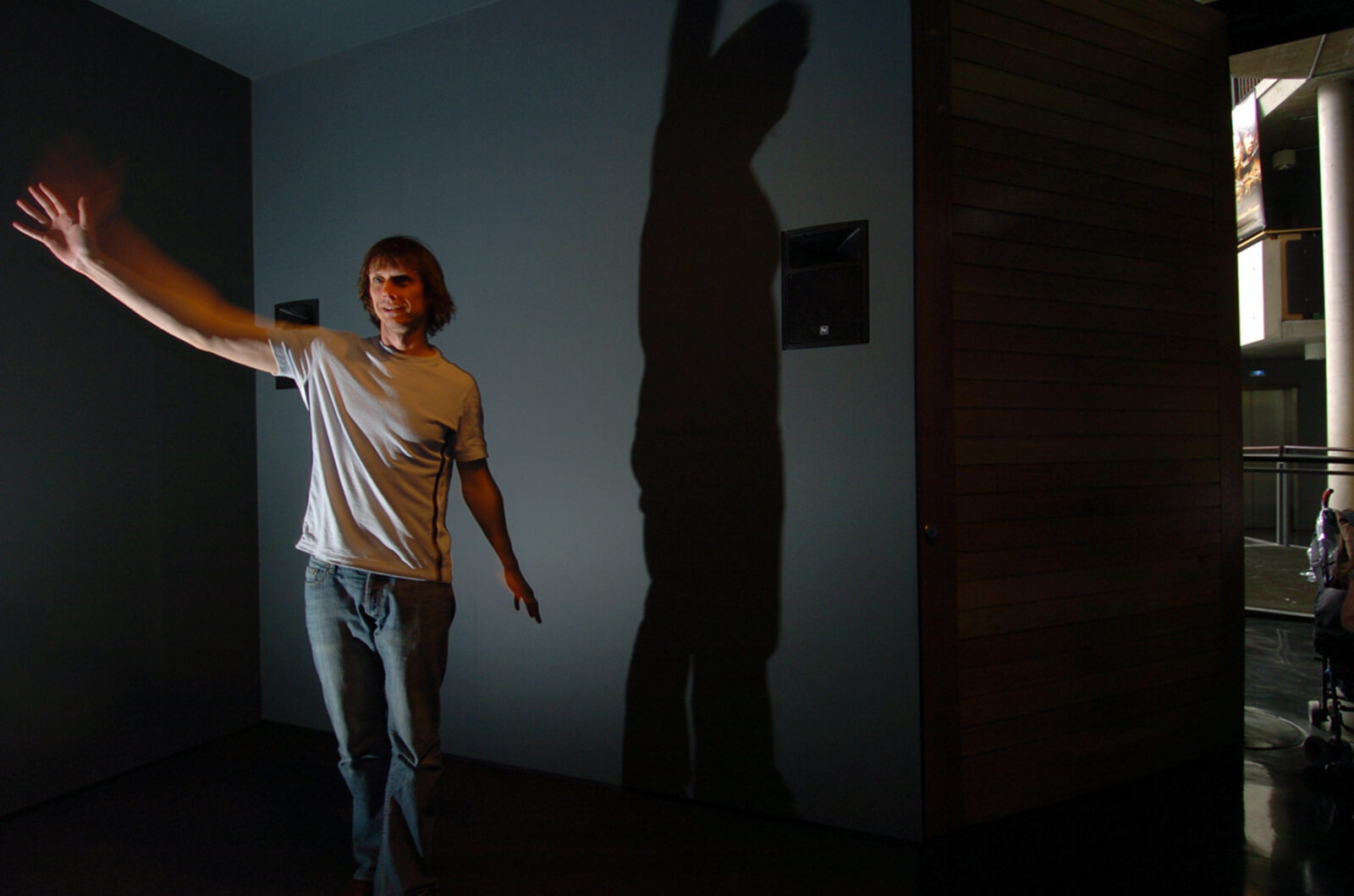
The gallery could look empty. In its account of a 2015 presentation of David Rokeby's Very Nervous System, the Robert McLaughlin Gallery describes a ceiling-mounted camera watching the visitor, a hidden computer interpreting movement, and speakers playing the resulting sounds. Move through the space and the apparent vacancy answers. The exhibition invited visitors to search for sounds with their bodies.[1]
That invitation contains a small trap. Once a gesture produces an audible result, it is tempting to treat the room as an enormous instrument awaiting instructions. But the sound can change how the person moves next. The interesting action happens in that return journey: a visitor makes something happen, hears it, and becomes a slightly different participant in what follows.
Developed through the 1980s and repeatedly revised, Very Nervous System makes a useful case for looking at interactive art through its exchanges. Its history includes changes in equipment and in what the encounter could feel like.[5] Following those changes brings the work into focus more clearly than calling it an early example of a computer responding to a person.
What the camera can hear
Rokeby's technical description, preserved in the Ars Electronica archive, begins with a modest operation: comparing consecutive video frames. In the configuration described there, a handmade processor examines images at thirty frames per second. Further processing builds histories of movement, allowing the system to register qualities such as intensity, rhythm and consistency.[2]
The distinction matters. A camera image contains a body, but the work needs decisions about what to extract from that image. A hand's changing position becomes information that software can use. Rokeby's programming language, IntAct, defines behaviors linking input and output; MIDI messages can then control a synthesizer. He also acknowledges errors in the system's tracking of moving objects.[2] The room's apparent responsiveness rests on a selective, fallible account of what it sees.
Another document makes the physical arrangement concrete. The artist statement preserved for the 1990 ISEA symposium in Groningen describes three low-resolution cameras positioned in a triangle. It identifies the amount of the body in motion, the intensity of movement and its abruptness or continuity as relevant features; sound volume and instrumentation respond to how the participant moves.[3]
These records describe particular configurations. They give no reason to imagine that every later exhibition used the same cameras or mappings. What they do establish is an artistic choice: movement has qualities that can be translated. A visitor contributes much more than the fact of having arrived.
The gesture changes when it becomes a command
Stephanie Anderson and Margherita Papadatos recount a revealing observation by Rokeby in their McIntosh Gallery essay. Visitors would try a tentative movement, hear a sound and repeat the experiment. Having satisfied themselves that the response was predictable, they would make the gesture again with greater confidence. But that confidence changed its physical dynamics, and the system produced a different sound.[4]
The episode does not require a machine that recognizes confidence. It requires a person whose manner of moving changes while they believe they are repeating an action. What feels like the same instruction can be a different event for a camera measuring motion.
This is where the installation becomes more interesting than a demonstration of technical capability. A conventional demonstration succeeds when its promised response can be reproduced. Here, the mismatch can become the material of the encounter. The participant has to attend to the movement itself: its force, hesitation and duration, rather than only the result they hoped to obtain.
Anderson and Papadatos read the work as an exchange in which the apparatus also shapes the visitor's actions.[4] The visitor's freedom has a form. Software determines which features matter, and the audible response invites another attempt within those conditions. Participation gives the person a consequential role without making the room wholly theirs to command.
From a broad gesture to the rustle of paper
The 2015 Robert McLaughlin Gallery text describes a consequential revision: earlier versions responded best to large gestures, while this presentation could register minute movements. Its sounds had changed too. More conventionally musical synthesizer sounds had largely given way to intimate noises, including crinkling paper and unrolling duct tape.[1]
Those are evocative materials to hear without handling. A rustle suggests pressure and friction; a tiny movement producing it could make the space seem close to the skin. That is a way to understand the revision's artistic stakes. Greater sensitivity changes the scale at which a person can investigate the work. It permits a different kind of attention.
Keeping the encounter in the archive
A photograph can show someone performing in the installation, as FACT's archival image does.[6] It cannot tell us which sound prompted the next movement, or how readily the performer felt the connection. The visible action is only one part of the event.
For their Daniel Langlois Foundation documentary collection, Caitlin Jones and Lizzie Muller made audience experience central to the record. They combined perspectives rather than treating the artist's intention as a complete account. They also identified a historical gap: older videos could show people using the work, but could not recover how those people experienced it. The changing installation complicated any claim to a single ideal version.[5]
Their approach suggests what deserves to survive alongside equipment specifications: the visitor's surprise, uncertainty or pleasure in a particular encounter. A functioning camera and a speaker producing sound establish that a system operates. An account of the exchange helps explain what the artwork did.
Return to the apparently empty room. Its most consequential feature may be the interval between one gesture and the next. In that interval, the visitor hears the consequences of moving—and finds another movement to make.
Sources
- The Robert McLaughlin Gallery, “David Rokeby: Very Nervous System,” May 30–September 13, 2015 — exhibition account of the camera, movement sensitivity and changing sound materials.
- David Rokeby, “Technical Description of ‘Very Nervous System,’” Ars Electronica archive, undated, one-page PDF — frame comparison, gesture histories, tracking limitations, IntAct and MIDI.
- ISEA Symposium Archives, “Very Nervous System” by David Rokeby, SISEA 1990, Groningen — artist statement documenting a three-camera configuration and movement-to-sound relationships.
- Stephanie Anderson and Margherita Papadatos, “The Space Between: Control and Causality in David Rokeby's Very Nervous System,” McIntosh Gallery, especially PDF pages 4–5 — Rokeby's gesture anecdote and the authors' interpretation of reciprocal influence.
- Caitlin Jones and Lizzie Muller, “David Rokeby, Very Nervous System: Documentary Collection,” Daniel Langlois Foundation, 2010 — introduction explaining repeated revisions, audience testimony and the limits of historical documentation.
- FACT, “Very Nervous System (1982–1991)” — artwork record and archival performance photograph reproduced above.