A basketball hoop tells the body what to do before anyone explains it. Look up, judge the distance, imagine the arc. David Hammons's Higher Goals preserves that invitation while moving its destination far above ordinary play. The eye can make the journey. The body has to reconsider.
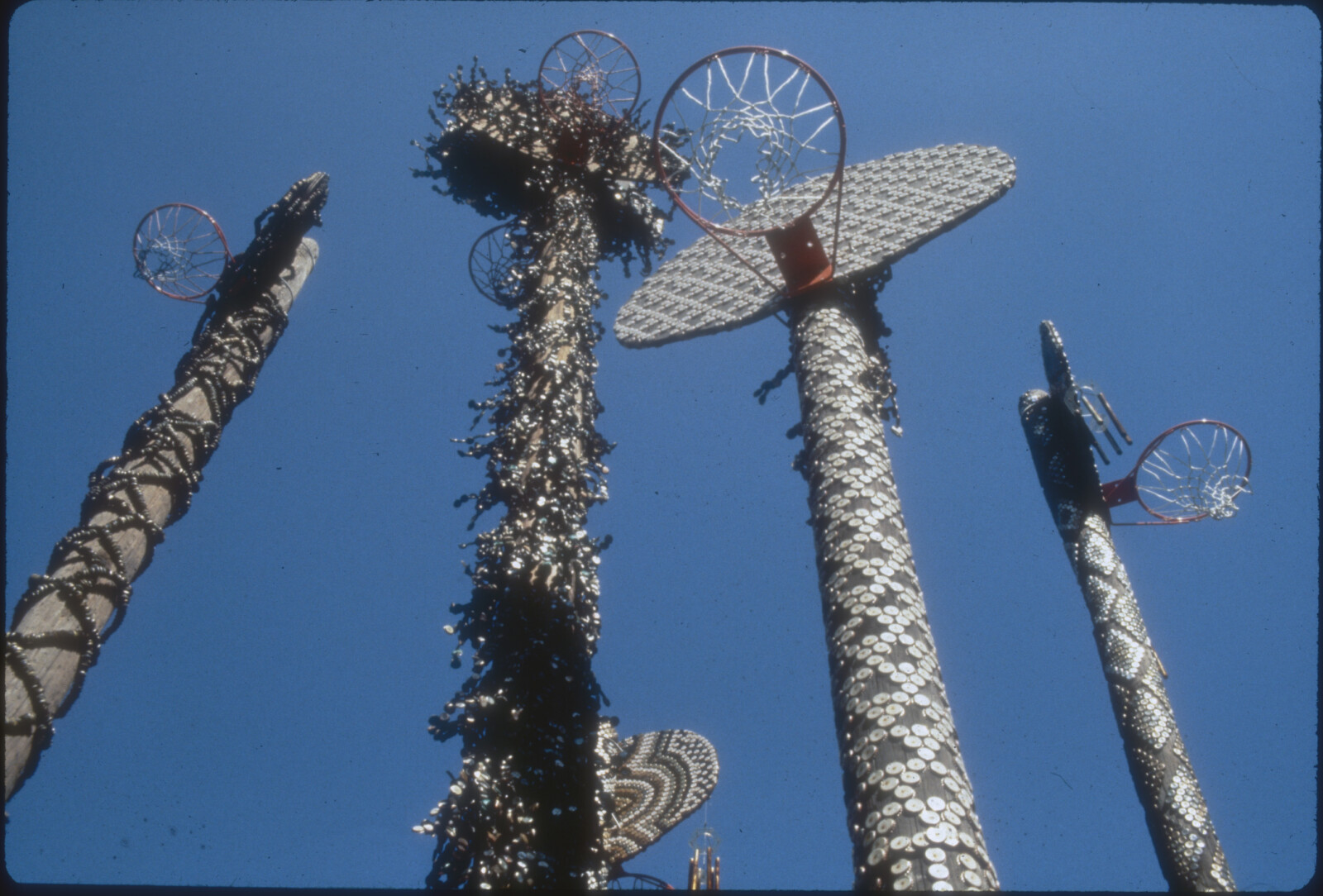
For the 1986 installation in Brooklyn's Cadman Plaza Park, Hammons assembled five telephone poles topped with backboards, hoops, and nets. Public Art Fund, which commissioned the temporary work, records heights of twenty to thirty feet and an exhibition running from April 10, 1986, to March 27, 1987. Bottle caps cover the poles and backboards in elaborate patterns.[1]
The result can look exuberant and forbidding at once. My reading is that its force comes from holding those sensations together: an object associated with opportunity becomes magnificent precisely where it becomes difficult to use.
What happens when the target rises
The title offers encouragement with a catch. Public Art Fund interprets Higher Goals as an invitation to extend ambition beyond prescribed limits. It also records Hammons comparing the few places on a basketball team with the many people who want them. Aspiration and selection already occupy the same account.[1]
In the sculpture, that tension becomes a physical arrangement. The hoop retains its familiar proportions and purpose; the supporting pole changes the terms of the encounter. A player can recognize the task perfectly while confronting a target placed beyond the conditions under which that task normally makes sense. Skill and effort cannot be considered separately from the height someone has set.
The Whitney Museum's Artists Among Us podcast places the work within the commercial appeal of basketball stardom to young Black men. Its narrator, Carrie Mae Weems, reads the elevated baskets as frustrated hopes made visually compelling.[3] This gives the sculpture a social pressure that the cheerful instruction to aim higher cannot contain.
Yet the work does not require us to laugh at the person who wants to shoot. The desire is recognizable. What becomes strange is the arrangement offered to that desire. We can admire a beautiful target and still ask why access to it has become so implausible.
The surface rewards a slower look
Hammons made the poles on site over eight weeks. According to Public Art Fund, each received more than ten thousand bottle caps, nailed into patterns.[1] The small units matter: monumentality here has been accumulated through repeated acts of attachment.
In the photograph above, the surfaces refuse uniformity. At left, a loose lattice exposes the wood beneath it. The broad pole nearer the right has a much denser skin of pale circles. The dark central column bristles outward, breaking its own outline. Above them, nets draw thin lines against the sky. Each support makes a different route for the eye.
That variation slows the quick recognition of sporting equipment. You can identify a basket almost immediately, then spend much longer following the patterned shaft underneath it. The part normally treated as a support becomes an object of attention in its own right.
Andrea Gyorody's account for the Hammer Museum connects the installation's designs with Islamic, African, and Native American sources. She also situates Hammons's use of discarded materials within assemblage traditions and a practice attentive to Black cultural experience.[2] These connections should not become a claim that every pattern has one fixed translation. They establish a wider field of reference than a basketball court alone can supply.
The caps bring another change of scale. Something made to seal a bottle has become a visible unit in a towering surface. Their repetition allows everyday material to carry ornament without becoming anonymous: even from this low angle, the little circles remain legible. The sculpture keeps the modest component and the imposing whole in view together.
Before the poles stood up
The work's audience began forming before installation was complete. In the Whitney's podcast, Glenn Ligon recalls repeatedly seeing a man attaching bottle caps to a telephone pole in the park. He recognized the activity as art only after the pole was raised. Looking back, he emphasizes the importance of making the work publicly, where the process could be witnessed.[3]
That recollection changes the photograph. Its upward view gives us the finished vertical drama, but Ligon supplies an earlier, horizontal duration: a person working, a passerby noticing, a puzzling action encountered again. The eventual recognition grew out of an existing relationship with the place.
Hammons described the value of such encounters in his conversation with Kellie Jones, first published in Real Life in 1986 and adapted in Art Papers in 1988. Street art, he said, had no automatic precedence over the other things people met during their day. He also recalled using an earlier Higher Goals installation in Harlem as a way to introduce himself to people who knew the work.[4]
The Brooklyn commission had institutional support, but the encounter Ligon describes began with ordinary curiosity. A person did not need to arrive knowing that an artwork was waiting. Its making could become part of a familiar walk.
Return to those hoops against the blue sky. They still solicit the imaginary shot, and the bottle caps still reward attention. The photograph gives us a position below an extraordinary structure. The accounts of its making give us another position altogether: beside someone at work, close enough to wonder what he is doing, before anyone has decided what it means.
Sources
- Public Art Fund, David Hammons: Higher Goals — commission record, exhibition dates, dimensions, construction, interpretation, and source of the archival installation photograph.
- Andrea Gyorody, “David Hammons,” Hammer Museum, Now Dig This! digital archive, 2016 — assemblage context, cultural references, and the installation's patterned surfaces.
- Whitney Museum of American Art, “Episode 1 — The Dawn of Day's End,” Artists Among Us, May 5, 2021 — published transcript, including Glenn Ligon's recollection of watching Higher Goals being made and Carrie Mae Weems's interpretation.
- Kellie Jones, “Interview: David Hammons,” Art Papers, July/August 1988, adapted from Real Life, autumn 1986 — Hammons on street audiences and the earlier Harlem installation.