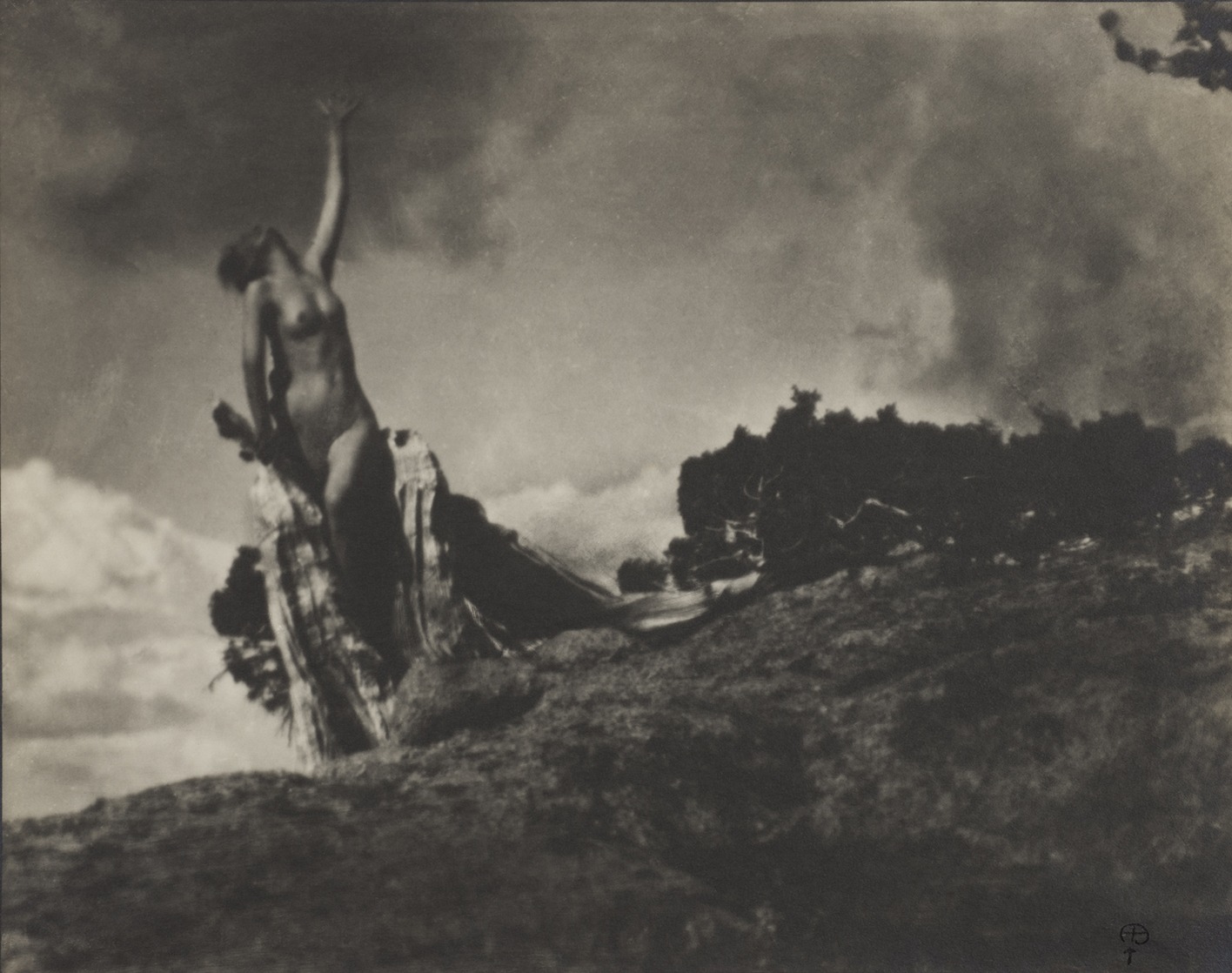
The woman seems to grow out of the broken tree. In Anne Brigman's Soul of the Blasted Pine, an arm reaches into the sky while the damaged trunk grips the lower body. Rock, wood, and flesh make a single ascending shape. The tree looks exhausted; the gesture keeps going. It is possible to read the figure as a spirit escaping the timber, or as its surviving strength made visible. Neither reading quite settles the image.[1]
Brigman made photographs in which women could occupy a landscape with this kind of imaginative authority. Born in Honolulu in 1869 and later based in California, she used herself and friends as models, arranging bodies among trees and rocks. The Smithsonian describes her affinity for the appearance of charcoal drawing: photographic description could yield to mood, gesture, and an expressive silhouette.[3]
Her career turns on a productive complication. These visions of freedom required decisions about where to stand, what to show, and how to finish a picture. Then the photographs entered a world of editors, critics, and galleries, where her intentions were open to reinterpretation.
Getting into the picture
The Nevada Museum of Art's research dates Brigman's first photographs to 1901; five prints appeared in a San Francisco salon the following January. She had grown up in a Protestant missionary family in Hawaii and moved to California as a teenager. Her early subjects included mothers, children, and garden scenes. The mountain work emerged from that conventional beginning, rather than arriving as a fully formed rebellion.[2]
The change becomes clearer if we think about the place of the photographer. A person behind the camera chooses the view; a model occupies the position prepared for her. Brigman's use of her own body brought those roles together. Her practice made authorship bodily: she could devise a figure's relation to the setting and also inhabit that relation herself. This is an interpretation of her working method, rather than a claim that every nude she photographed is a self-portrait.[3]
That distinction matters. Reading all the figures as disguised autobiography would erase the other women who helped make the images. A landscape photograph could also be a collaboration, with friends lending their bodies to a scene that none of them had simply stumbled upon.
A real mountain, an invented world
The staging was persuasive enough to confuse some early viewers. The Smithsonian records that critics suspected artificial trees and painted scenery. When Camera Work published Brigman's photographs in January 1909, its editors insisted that the settings were outdoors in California. The apparent theater had a physical location.[5]
Yet the existence of a real tree does not make a photograph an unplanned record. The Getty's photography catalogue describes how Brigman worked by hand on both negatives and prints. Such interventions belong to the construction of the image. The camera supplied material that she could continue shaping after the exposure.[4]
That working process offers a useful way into Pictorialism, the photographic movement with which she was associated. Softness can be an active choice. A softened edge lets an arm resemble a branch; a darkened passage joins a body to a trunk. For Brigman, the expressive possibilities of a photograph extended beyond identifying its subject. Her manipulated surfaces ask us to notice how an image has been made to feel.[4]
The tension remains visible in Soul of the Blasted Pine. The pose suggests release, while the tree continues to hold the figure. Freedom appears as effort within a resistant setting. That is why the picture retains its force after its theatrical surprise has worn off.[1]
Recognition came with another reading
Alfred Stieglitz gave Brigman's work an influential eastern audience. The January 1909 issue of his journal Camera Work opens its photographic plates with five of her images, beginning with Soul of the Blasted Pine. Later in the same issue, J. Nilsen Laurvik's commentary places her figures within nature's emotional and spiritual power. The journal offered both photographs to look at and a language in which to discuss them.[5]
The professional recognition was real: Brigman joined the Photo-Secession in 1903 and became a Fellow in 1906. But the Nevada museum's account of her 1910 New York visit describes friction with Stieglitz's circle, particularly its sexual interpretations of the female body. Her promised solo exhibition never happened. Being welcomed as an artist did not guarantee that her hosts understood what she wanted her photographs to express.[2]
This episode sharpens the question raised by her self-staging. Control over the making of a picture cannot secure control over its reception. A woman could choose her pose, her setting, and her photographic treatment, then find the resulting image recruited into someone else's account of modern womanhood.
The landscape outlasted the emblem
Brigman's career also deserves room beyond its most dramatic tree-bound figures. Getty's [Female Nude Standing on Large Rock Over a Lake], dated 1923, places a body among gentler lakeside forms. The museum emphasizes its poetic treatment of landscape and the formal relationship between the figure and its surroundings. Read alongside the broken pine, the work suggests that communion could take quieter forms than a gesture of struggle.[6]
Following her move from Oakland to Long Beach in 1929, Brigman photographed the seaside. The Nevada museum traces her renewed attention to the shoreline, sand, and ocean. Those subjects suggest a shift in scale: a stretch of beach can hold the eye without a human figure supplying its drama.[2][7]
Poetry became another way to work through these concerns. The Cleveland Museum of Art dates the publication of Songs of a Pagan, combining her photographs and poems, to 1949. Brigman died in 1950 while working on another book, Child of Hawaii. Her late career kept moving between image, place, and language.[7]
Seen across that longer span, her achievement rests on a sustained freedom to compose. She could put a person into a tree, let a figure answer the curve of a shore, or attend to the marks left in sand. The mountain was a place she entered with a camera and an idea; the finished photograph gave that encounter a form other people could see, question, and never entirely possess.
Sources
- Nevada Museum of Art, Anne Brigman: A Visionary in Modern Photography (2018–2019) — exhibition overview and image 7, identifying the Wilson Centre print reproduced here.
- Nevada Museum of Art, Anne Brigman: A Visionary in Modern Photography, exhibition text panels (2018), PDF pp. 2–3, 9–10, and 16 — early life, first photographs, Photo-Secession status, the New York visit, and coastal work.
- Smithsonian American Art Museum, “Anne Brigman” — artist biographies on Pictorialism, models, landscape, and the contemporary dispute over studio scenery.
- Katherine Ware, entry on Anne Brigman, in Masterpieces of the J. Paul Getty Museum: Photographs (1999), p. 68 — Pictorialism and handwork on negatives and prints.
- Alfred Stieglitz, ed., Camera Work, no. 25 (January 1909), Modernist Journals Project — the five Brigman plates and contemporary commentary on pp. 47–48.
- J. Paul Getty Museum, [Female Nude Standing on Large Rock Over a Lake] (1923), object 95.XM.73 — collection record and interpretation.
- Cleveland Museum of Art, Camera Work: Soul of the Blasted Pine (1909), object 1995.199.25.g — collection record and Anne Brigman biography, including her later work and 1949 book.