The Bayeux Tapestry is about to become newly visible to many viewers. The Bayeux Museum says the work is closed from public display during its renovation cycle and is scheduled to be loaned to the British Museum from September 2026 to July 2027, with a return planned for the new Bayeux museum's reopening in October 2027.[2] That institutional moment is useful, but the better reason to look again is material. This object is often remembered as a medieval comic strip about 1066. It is stranger and more demanding than that. It is a long political image whose force comes from thread learning how to move.
The first correction is basic and decisive: the Bayeux Tapestry is not technically a woven tapestry. The Bayeux Museum identifies it as narrative embroidery, roughly 68.3 metres long, made from pictures and inscriptions across nine joined linen panels.[1] The scenes are worked in wool thread on linen cloth, using a limited palette and a small group of stitches.[1] That restriction gives the work its energy. It has no oil-paint atmosphere, no marble volume, no deep architectural perspective. It has line, fill, color, interval, and scale. From those few terms, it builds a conquest.
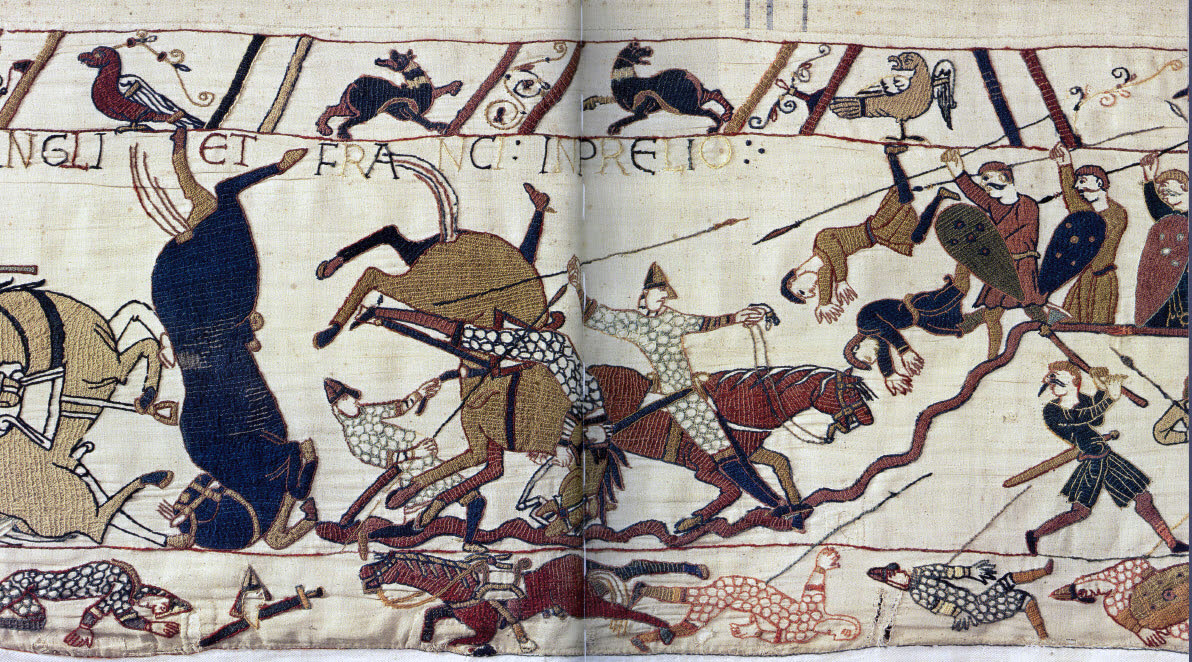
Image context: the cover detail shows mounted fighters in the Battle of Hastings sequence. It is not a decorative medieval texture. The horses, riders, borders, and compressed ground make visible the article's central claim: the embroidery's drama lives in how wool line organizes bodies under pressure.[4]
Thread acts as outline and muscle
The Bayeux Museum describes four main stitch types in the work: stem stitch, chain stitch, split stitch using two threads, and couching stitch, often called the Bayeux stitch, for filling colored surfaces.[1] That distinction matters because the image depends on a division of labor inside the thread. Some stitches draw. Others pack color into bodies, garments, horses, shields, and ships. The object does not simply represent motion. It manufactures motion by deciding where thread becomes contour and where it becomes mass.
Look at the horses in the battle detail. Their bodies are not modeled with soft tonal shading. They are organized by hard outlines, flat fields, angled legs, colored overlaps, and repeating curves. The official museum page notes that the work conveys movement in the charging cavalry and gives depth and texture through the varied colors used in the horses' legs.[1] That is the technical point. A green or red leg is not naturalism failing. It is a leg being made readable inside congestion. Color separates one limb from another so the charge can keep its speed.
This is why the embroidery feels more kinetic than many more illusionistic battle pictures. A painting can dissolve bodies into smoke, shadow, or atmospheric distance. The Bayeux Tapestry has to keep every force legible inside a narrow band. It solves that problem by making each line carry structural weight. The reins, weapons, legs, inscriptions, and borders all stay crisp enough for the eye to sort quickly. The speed comes from clarity under crowding.
The narrow strip makes the viewer walk
Scale is the second technique. A nearly 70-metre object cannot be seen in one act.[2][3] It has to be encountered in time. The viewer moves along it, and the narrative advances at walking speed. That is why the work's long horizontal format matters as much as its subject. The conquest is not arranged as a single climactic tableau. It unfolds as departure, oath, sea crossing, omen, council, preparation, cavalry, impact, and aftermath.
The Bayeux Museum's story page gives one useful inventory: 58 scenes, 626 characters, and 202 horses.[3] Those figures are not trivia. They explain the density problem the embroiderers solved. The work has to carry military action, ceremony, architecture, ships, animals, messengers, weapons, bodies, and written labels without losing forward motion. A square painting would concentrate that material. The Bayeux format stretches it into sequence.
That sequence is not smooth in the modern cinematic sense. It has jumps, compressions, odd emphases, and abrupt changes of speed. But that unevenness is part of the visual intelligence. The narrow band lets the work shift between episode and procession. Ships can appear as a fleet, horsemen can gather into rhythm, and a death scene can arrive after the eye has already learned to read bodies as moving signs. The medium trains the viewer before the story reaches its violence.
Borders are not background
The top and bottom borders are easy to treat as ornament, especially in reproduction. In the object, they are part of the pacing system. They hold animals, plants, bodies, and small scenes close to the main narrative, creating a second register that tightens or complicates the central action. In quiet moments, the borders can feel like patterned containment. During battle, they become pressure. The central scene has little room to breathe because the whole field is alive.
That matters because the Bayeux Tapestry is both image and argument. The Bayeux Museum frames it as a work that told a story to audiences who could follow images even when literacy was limited, and as a piece of propaganda for conquest.[1] The borders support that public function. They keep attention moving while the main band turns political succession into visible inevitability. A viewer does not only read named figures and Latin inscriptions. A viewer absorbs pace, crowding, pursuit, omen, and force.
The result is a medium that never behaves as mere illustration. Embroidery has a physical tempo. Thread passes through cloth. Filled areas accumulate. Repeated gestures build figures one small decision at a time. When those decisions are spread over a monumental strip, labor becomes narrative pressure. The conquest looks continuous because the making is continuous.
Why the technique still feels sharp
The Bayeux Tapestry survives because it is historically irreplaceable, but it still grips viewers because its technique refuses passivity. It is not a neutral window onto 1066. It is an engineered strip of textile attention, using wool on linen to make political memory advance body by body and horse by horse.[1][2][3]
That is the reason the coming British Museum display matters beyond diplomatic symbolism. The work has been discussed for centuries as evidence, national memory, propaganda, treasure, and fragile survivor. All of that remains true. But its artistic intelligence sits in the stitches. The thread does not merely fill in a story already decided elsewhere. It gives the story its pace, pressure, and pulse.
If the Bayeux Tapestry were only a long record of who crossed the Channel and who fell at Hastings, it would still be important. Its deeper achievement is formal. It turns a narrow linen band into a moving machine for looking, and it does so with a handful of stitches, ten colors of wool, borders that keep pressing inward, and horses that never quite stop running.
Sources
- Bayeux Museum, "Tapestry or embroidery?" - official technical account of the work's linen panels, wool thread, dyes, stitches, and embroidery status.
- Bayeux Museum, "Discover the Bayeux Tapestry" - official overview of the story, display context, online scene-by-scene access, renovation closure, and 2026-2027 British Museum loan.
- Bayeux Museum, "What is the Bayeux Tapestry about?" - official story page with the conquest narrative, scene count, character count, and horse count.
- Wikimedia Commons, "File:Bayeux Tapestry Horses in Battle of Hastings.jpg" - source page for the photographed battle detail used as the article image.