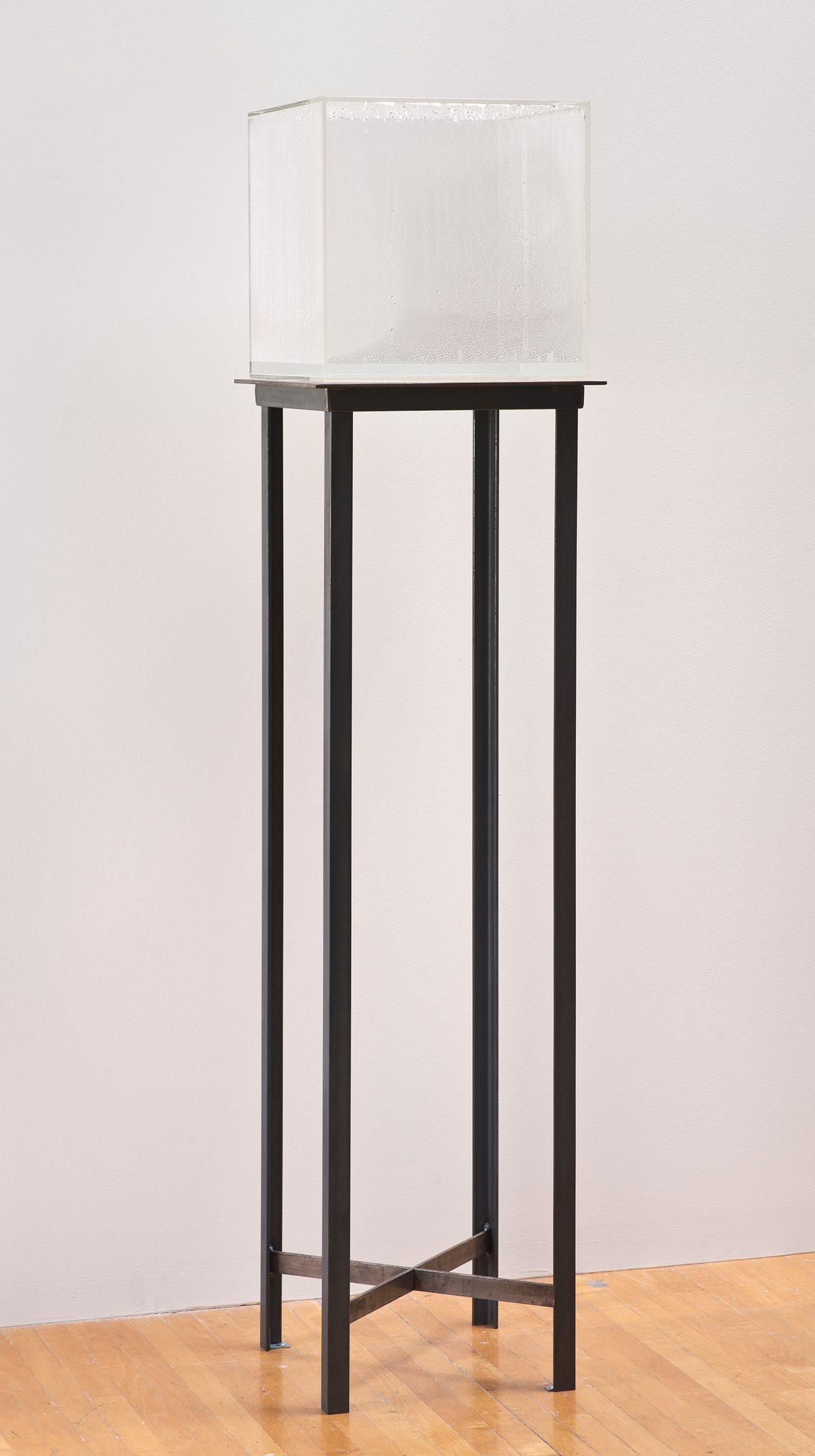
Image context: this is The Museum of Contemporary Art, Los Angeles's photograph of Haacke's actual sculpture. Its plain gallery setting matters. The cube does not depict weather somewhere else; light, temperature, and air around this particular object help produce the wet surface the camera records.[1][2]
At first, Hans Haacke's Condensation Cube seems to offer almost nothing to look at: six transparent planes, sharp joins, a shallow reserve of water, no modeled figure, no expressive mark. Then the box clouds. Pinpoint droplets gather on its inner walls. Some merge into heavier beads; some descend, leaving clear tracks that mist over again. What looked like an empty volume turns out to be crowded with events.
The work's central contradiction is easy to state and difficult to exhaust. The cube is sealed, but it is not isolated. Its acrylic walls keep the water in while admitting light and transmitting heat. The room does not enter as dust, fingers, or fresh water, yet its conditions cross the boundary as energy. A spotlight, a cooler wall, a draft, or a shift in ambient temperature changes where moisture appears and how quickly it moves.[1][2]
That makes transparency more than a sleek modern surface. It lets us see a boundary failing to become independence. Condensation Cube does not contain a little image of nature; it makes a physical process happen in real time, under conditions the artwork cannot entirely command. The result is a sculpture whose form is exact and whose appearance is never final.
The first subject is the wall
MOCA dates its small Condensation Cube to 1963–65 and describes it as a 30.5-centimeter cube made from clear acrylic plastic and distilled water.[1] Those materials sound almost aggressively neutral. The cut acrylic sheets provide straight edges and a clean view through the object; distilled water seems to arrive without color, sediment, or story. The geometry promises control.
Condensation makes that promise visible by interrupting it. Droplets do not float freely in the center. They cling to the inside face of the acrylic, turning an apparently invisible wall into a mottled skin. Seen from one angle, front and back planes overlap, so several wet surfaces occupy the same field. A bead can appear suspended until a slight movement of the viewer reveals which plane holds it. The box teaches the eye to stop looking through the wall and start looking at it.
This is why the water is not simply content placed inside a container. It reveals what the container does. The wall separates liquid and vapor from the gallery's air, transfers heat across the temperature difference, supports droplets through adhesion, and gives gravity a vertical surface on which to draw. Every streak is a temporary record of forces meeting at that boundary.
Haacke's own account, preserved by the Generali Foundation, follows the process closely: light warms the sealed interior; fine droplets form, enlarge, combine, and eventually become heavy enough to run down the wall; their tracks then begin filling with new condensation. Air currents around the box and the angle and intensity of light affect the rate, while the overall process continues without resolving into one permanent pattern.[2] The description reads less like instructions for making an image than like a score for allowing matter to keep revising one.
A closed object with an open metabolism
Calling the cube “alive” can become a shortcut. It has no cells, reproduction, appetite, or intention. Yet the comparison matters because the work challenges the idea of sculpture as inert substance by making a system that remains responsive after fabrication. MACBA describes its own larger version not only as methacrylate and distilled water but also as the climate of the exhibition space.[3] Climate is not background information. It is listed as material.
The distinction between a closed container and an open relation is the conceptual hinge. Matter is largely contained, but exchanges of heat and light continue. The water cycles among the pool at the bottom, invisible vapor, and droplets on the walls without escaping the work's basic boundary. Its visible distribution nevertheless depends on conditions beyond that boundary. Sealing the cube makes this dependence clearer: because no hand is rearranging the droplets, their changes point insistently toward the surrounding physical field.
Even the viewer enters differently here. No button waits to be pressed, and touching would add nothing to the proposition. A nearby body contributes heat only minutely; a crowd can also belong to the room's changing conditions. MOCA notes that the arrival of a visitor affects the activity within the cube, however imperceptibly.[1] Participation is therefore stripped of theatrical agency. We alter the system simply by occupying the same climate.
That is a more unsettling relation than conventional interactivity. An interactive artwork often rewards a deliberate gesture with an observable result: press, pull, speak, watch. Condensation Cube offers no clean chain between one person and one droplet. Our influence joins light, ventilation, room temperature, time, and the object's existing state. We matter, but we are not granted mastery or even proof of our individual effect.
The image has an age
At a distance, condensation can resemble a uniform veil. Close up, it contains several times at once. Newly formed droplets appear as fine points. Older beads have merged with neighboring droplets. Heavy ones slide, and the cleared paths they leave begin to close behind them. The surface holds traces of events that started at different moments.[2]
This gives the cube something a polished geometric object is not supposed to possess: an immediately visible age. Not age as damage measured across decades, but age distributed across a single afternoon. One streak may be seconds old while the cluster beside it has been thickening for hours. Tomorrow's surface will inherit today's moisture without repeating today's arrangement.
The artist emphasized that the constellation of droplets cannot be predicted exactly, even though it changes within physical limits.[2] That boundary is crucial. The work is not random in the sense of anything being possible. Water does not suddenly turn blue or run upward. Temperature, phase change, adhesion, coalescence, and gravity constrain what can happen. But those rules do not specify a single composition in advance.
Haacke therefore relocates authorship rather than abandoning it. He chose the dimensions, material, seal, and water, designing a setup in which variable events remain legible. Physics supplies each passing arrangement. The museum supplies another set of conditions: placement, lighting, ventilation, and the decision to keep the system functioning. The viewer encounters the combined result at one unrepeatable stage.
The cube looks like Minimalism—and behaves otherwise
The timing sharpens the visual joke. Haacke began making water-filled acrylic containers in the early 1960s. MIT's reconstruction of his 1967 exhibition places Condensation Cube beside a wider body of works driven by wind, water, freezing, grass growth, and other physical processes. The center notes that he showed the cube at New York's Howard Wise Gallery in 1966, while his later MIT works were described as systems whose components communicated with one another and with their environment.[4]
The transparent box shares the industrial clarity and elementary geometry associated with Minimal art of the same decade.[1][3] But a Minimalist-looking cube normally seems to insist on being fully present: here is its shape, here is its material, here is the room it occupies. Haacke gives that stable form an interior weather that refuses the same tense. The outline can be grasped at once; the work cannot.
It would be too simple, though, to cast process as warmth defeating cold geometry. The straight box is what makes the unstable droplets readable. Without its severe boundary, condensation would dissolve into ordinary room moisture. Without the changing water, the acrylic might remain only an elegant enclosure. Control and contingency are not opponents in the work; each gives the other a visible edge.
The title also keeps the reading disciplined. This is not Picture of Rain or Cloud in a Box. Condensation names a transition and a location: vapor becomes liquid on a surface. Cube names the fixed structure that receives it. One word is process, the other form. The artwork exists in their grammar.
Conservation cannot freeze the right moment
The many dates attached to versions of Condensation Cube expose another consequence of that grammar. MOCA's example is dated 1963–65.[1] MACBA holds an edition dated 1963–67.[3] The Generali Foundation identifies a 1963–65 conception produced in 2001, while the Belvedere's biography distinguishes smaller and larger versions developed across 1963–67.[2][5] The dates reflect differing catalog conventions as well as multiple editions and later productions. Across them, the shared concept depends on continued physical performance.
From the work's operating logic, a conservation consequence follows. Preserving one ideal arrangement of every visible element would be impossible here and contrary to the process the museums describe. Fixing the droplets would stop the change that makes them meaningful. On this reading, what needs continuity is not one wet pattern but the condensation-generating setup's capacity to produce changing patterns.
This makes the museum's role unusually exposed. Gallery climate is normally managed so quietly that it disappears behind the art. In Condensation Cube, the institution's light and temperature show up on the object. A perfectly stable display would still produce a surface at a particular stage; an altered display produces another. The work turns environmental control from invisible support into co-authorship.
Haacke's later career became famous for revealing social, political, and economic systems. The Belvedere's account connects the early physical and biological experiments to that later institutional critique without treating one as a disguised illustration of the other.[5] Condensation Cube does not secretly represent a real-estate network or museum donor. It establishes the harder habit on which those investigations depend: look past the bounded object, identify the relations keeping it active, and ask which surrounding conditions have been made to seem natural.
Return, finally, to the apparently empty box. Its sharp outline has not changed, but “inside” and “outside” no longer feel secure. The seal is real. So is the dependence. Water stays within the cube while the gallery keeps writing across its walls. That is the work's lasting pressure: a boundary can be perfectly visible, materially effective, and still unable to make a world self-contained.
Sources
- The Museum of Contemporary Art, Los Angeles, “Hans Haacke, Condensation Cube, 1963–1965” — official object record and photograph, with material, dimensions, collection data, and an account of its environmental responsiveness.
- Generali Foundation, “Hans Haacke, Kondensationswürfel, 1963–65” — official collection record, installation-climate metadata, image credit, and the artist's description of droplet formation, growth, movement, and unpredictability.
- MACBA, “Hans Haacke, Condensation Cube, 1963–1967” — official collection entry on the work as physical system, its relation to exhibition climate and the viewer, and the museum's edition data.
- MIT List Visual Arts Center, “Hans Haacke 1967” — institutional history of Haacke's early wind-and-water works, the 1966 Howard Wise Gallery presentation, and the 1967 systems exhibition reconstructed at MIT.
- Belvedere, “Comprehensive biography of Hans Haacke” — museum chronology distinguishing the small and large condensation cubes and situating the early physical systems within Haacke's longer practice.