
At first, Cornelia Chapin's Paris home movies appear almost too modest to carry art history. There is no narrator, no score, and no polished studio demonstration. The black-and-white film watches people handle tools, work around blocks, visit animals, and share space with a bear cub. Light shifts. Actions repeat. The unidentified camera operator does not announce a masterpiece. That informality is precisely what makes the footage rare.
The Archives of American Art catalogs six silent 16 mm reels made between 1934 and 1936, their dates established from codes along the film stock. They show Chapin, her teacher Mateo Hernández, and others in a Paris studio and at zoological gardens that may have been the Bois de Vincennes or the Bois de Boulogne. The final reel ends with Chapin and Hernández managing a bear cub acquired as a living model.[2] These are not later reenactments of a sculptor's method. They are moving images from the period in which Chapin was learning to make direct carving the basis of her work.
“Direct carving” can sound self-explanatory: take up a tool and cut the final material. The historical claim was sharper. Instead of first resolving a sculpture in clay, translating it into plaster, and then transferring that design to stone or wood, the carver committed decisions to the block itself. Advocates connected that commitment to “truth to materials,” the idea that sculpture should disclose the properties of what it was made from.[4] Yet the phrase can harden into doctrine. Chapin's film restores uncertainty, time, and bodily effort to it.
Chapin arrived in Paris in 1934 to study with Hernández as his only pupil. From then on, the Harvard finding aid for her papers records, her exhibited sculpture was carved directly from life in stone or wood, without preliminary models or sketches.[5] Animals became her principal subjects. Her career was not marginal in its own moment: she exhibited as a sculptor from 1930, won a prize for Young Elephant, and in 1936 became the only foreigner and the only woman sculptor elected that year to the Sociétaire of the Salon d'Automne.[4][5] What later became less visible was not simply her résumé. It was the method joining animal observation to hard material.
The film below comes from the Marion Sanford and Cornelia Chapin papers at the Archives of American Art and was uploaded by the archive's official Smithsonian channel.[1][2] Its survival is part of its meaning. A VHS access copy made in 1991 kept the content available, but a 2016 assessment found the original film badly deformed by advanced vinegar syndrome. A National Film Preservation Foundation grant supported new film-to-film preservation elements and a fresh digital copy in 2018.[3][4] We can now see more of Chapin's process because conservators returned to the vulnerable object rather than accepting an already diminished copy.
The block keeps every decision
Watch first for stance rather than subject. Chapin and Hernández do not face a pliable model on a stand. They position themselves against resistant mass. A hand sets the tool; the other supplies force. The body approaches, strikes, checks, and begins again. Each blow is small beside the block, but each one removes material that cannot simply be pressed back into place.
That irreversibility does not make direct carving a test of fearless instinct. The footage shows the opposite: repetition is a form of thought. A pause can be as consequential as a cut because it measures what the previous action has changed. The carver must keep several scales active at once—the shallow bite of the tool, the swelling volume of a shoulder or belly, and the whole silhouette that the block may still become.
The method is often described as if it eliminated mediation. Chapin's films reveal that it merely relocates it. There may be no clay maquette between animal and stone, but there are still eyes, memory, changing viewpoints, tool profiles, fatigue, and the block's own grain or fracture. “From life” does not mean mechanically copying what sits in front of the artist. It means making a durable form from observations that never hold still long enough to become a template.
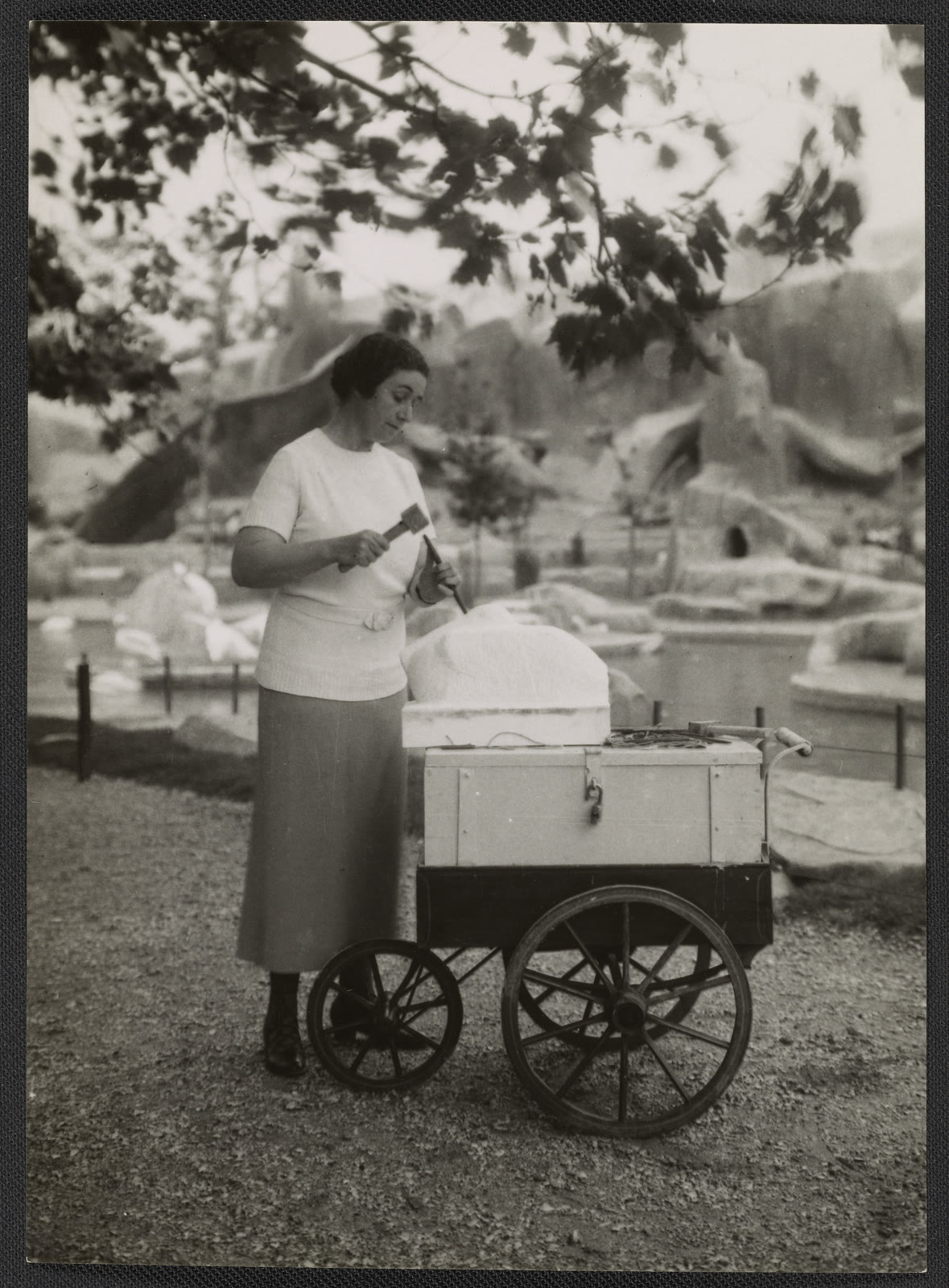
The circa-1936 cover photograph makes that labor unusually clear. It shows Chapin at a Paris zoo, hammer and chisel in hand, beside an unfinished pelican sculpture on a wheeled work cart.[7] The animal form is already readable, but its surface remains a terrain in progress. Finished sculpture can hide the sequence and setting that produced it; photograph and film return the tool, the mobile studio, and the living habitat to the object.
At the zoo, the model refuses to pose
The zoo sequences make Chapin's choice of animals more than a matter of taste. At a sculpture cart, the artist works within sight of living subjects rather than bringing a fixed anatomical study into the studio.[3][4] The arrangement sounds direct, but it multiplies difficulty. An animal shifts weight, turns, rests, disappears behind another body, or changes the contour the artist had just begun to understand.
That instability helps explain the compact force of Chapin's animal sculpture. A moving creature cannot be captured by one privileged outline. The carver has to accumulate a body across time: the way mass settles over legs, how a neck enters a torso, where weight appears stored, and which features survive a change of angle. Simplification is not the opposite of close looking. It is what close looking becomes when many fleeting views must be reconciled inside one block.
The archive is appropriately careful about location. Its catalog suggests either the Bois de Vincennes or the Bois de Boulogne, both places Chapin is known to have used, rather than converting likelihood into certainty.[2] That boundary matters. Archival footage feels authoritative because it shows that something happened, but it does not automatically identify every enclosure, person, or gesture. Good viewing keeps what the film reveals separate from what later description has inferred.
There is another boundary a present-day viewer should notice. These scenes belong to 1930s zoological culture, where captive animals could be treated as available models. The film gives no reason to romanticize that condition. What it does show is that the animal exceeds its assigned role. Its movement interrupts the artist's plan, forces observation to restart, and keeps the sculpture from becoming a simple exercise in control.
The bear cub changes the scale of the studio
In the last three minutes cataloged by the Archives, a bear cub appears with Chapin and Hernández.[2] The National Film Preservation Foundation identifies the cub as the future model for Chapin's Paquita of 1941, later installed at the Smithsonian's National Zoo.[4] The scene is memorable not because it supplies an adorable footnote, but because it collapses the safe distance between artist and animal.
A plaster model can wait indefinitely. A cub explores. It makes the studio into a negotiated environment rather than a one-way production line. The sculptor must observe proportion and behavior while also responding to a living presence with its own momentum. In that encounter, “direct” acquires a second meaning: not only tool against material, but artist exposed to the unpredictability of the subject.
This is where the home-movie form outperforms a finished publicity photograph. A still can pair Chapin with a sculpture and certify authorship. Moving footage preserves awkward intervals—the approach, withdrawal, reset, and distraction through which work actually develops. It does not make sculpture transparent, but it prevents the polished object from pretending it arrived without duration.
Preservation changed the evidence
The 2018 preservation did more than sharpen an image. The Archives compared the new scan with the old VHS-derived digital copy and found a fuller frame, a richer range of grays, clearer low-light studio detail, and visible information at the zoo that the earlier version had lost. Returning to the reels also helped staff establish their correct sequence and refine the dates from physical edge codes.[3]
That history offers a useful warning about digital access. A video can be online and still be a poor witness. Every generation of copying makes choices about crop, contrast, order, and detail; those choices can quietly become mistaken for properties of the original. In Chapin's case, film preservation recovered not a cosmetic upgrade but evidence: more surrounding space, more legible bodies, and a more accurate chronology.
The rescue also changes whose labor can enter art history. The NFPF notes that surviving period footage documents male sculptors more often than women, making Chapin's reels exceptional twice over: they preserve a scarce method and a practitioner less consistently represented in the moving-image record.[4] PAFA's account places her among women sculptors who flourished in the 1930s and 1940s while encountering gendered critical language around their work.[6] The films do not erase that history, but they make it harder to imagine direct carving as an exclusively male lineage of heroic encounters with stone.
Marion Sanford, Chapin's close companion and artistic partner, donated the films with their shared papers to the Archives of American Art.[4] That chain of care matters as much as the unknown person who first loaded the camera. Chapin's work survives here through a network: subject, sculptor, teacher, filmmaker, donor, archivist, laboratory, foundation, and viewer. The footage complicates the fantasy of solitary creation even while it records intensely physical individual work.
What the moving image gives sculpture
Chapin's home movies are not a tutorial and should not be watched as proof that direct carving is purer than other methods. Their value is more exact. They show that removing an intermediate model does not remove thought; it makes thought visible as pacing, pressure, risk, and revision within the final material. The stone is not a passive receiver of an idea already complete elsewhere.
They also restore time to an art form commonly encountered after time has been cleaned away. A finished animal may appear inevitable, its mass calm and self-contained. The film lets us see inevitability being constructed from unstable observation and irreversible cuts. The living animal moves; the sculptor returns; the block keeps the accumulated answer.
That is why preservation belongs inside this story rather than after it. Chapin let a camera witness sculpture emerging from material, but the camera's record nearly contracted into a cropped, low-detail surrogate while the reels deteriorated. Recovering the fuller image gives direct carving back its essential surroundings: tools, other bodies, zoo paths, studio darkness, and the pauses between blows. Sculpture begins in stone, the film insists, but seeing that beginning depends on another material surviving too.
Sources
- Archives of American Art, Smithsonian Institution, “Cornelia Chapin home movies, Paris studio and zoo, 1934–1936,” YouTube video.
- Archives of American Art, Smithsonian Institution, “Home movies of Paris studio and zoo, between 1934 and 1936” — item record with reel format, participants, locations, date evidence, and bear-cub sequence.
- Megan McShea, Archives of American Art, “For Preservation Purposes: Cornelia Chapin's Home Movies” (October 25, 2018) — preservation history and comparison of the VHS-derived and rescanned copies.
- National Film Preservation Foundation, “Artist's Spotlight: Cornelia Chapin” (March 25, 2021) — career, direct-carving context, film preservation, and animal models.
- Schlesinger Library, Harvard Radcliffe Institute, “Papers of Cornelia Chapin, 1822–1959” — archival finding aid with biography, direct-carving practice, exhibitions, and collection scope.
- Pennsylvania Academy of the Fine Arts, “Cornelia Van Auken Chapin and her Giant Frog” (October 14, 2021) — institutional context on women direct carvers, animal sculpture, reception, and public work.
- Archives of American Art, Smithsonian Institution, “Cornelia Chapin working on a sculpture of a pelican in Paris, circa 1936” — catalog record and provenance for the archival cover photograph.