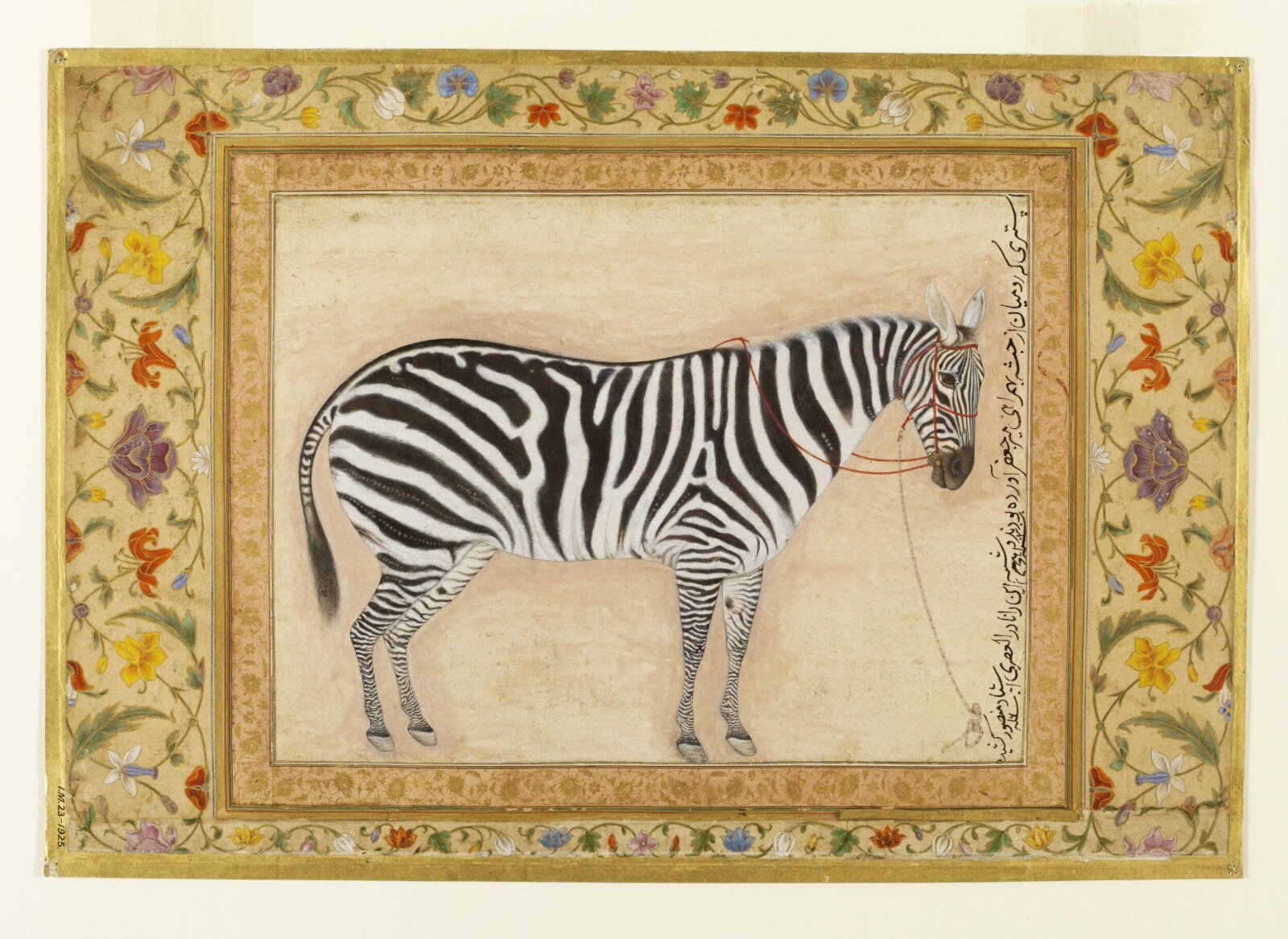
At first, the stripes seem to have done all the work. A zebra stands in profile on nearly empty paper, and its black bands arrive with the force of a pattern no artist could improve. Then the eye begins to notice how much has been arranged around that astonishment: the thin red harness, the tether running to a post, the column of Persian in the emperor's own hand, the flowers added by a later reign.
Mansur's A Zebra, painted at the Mughal court in 1621, is not simply a record of what an unfamiliar animal looked like. It is a record of looking under particular conditions. The animal had traveled from Ethiopia through human networks before reaching Emperor Jahangir. It was inspected, painted, and intended to travel again as a gift to Shah Abbas of Iran.[1][2] The sheet holds one pause in that itinerary.
That pause is why this small painting—roughly 18 by 24 centimeters before its later mounting—feels larger than a natural-history study.[1] Mansur makes the zebra's body available to prolonged attention. Everything else on the folio reminds us who arranged the encounter, who certified it, and who could send the living subject away.
Stripes made anatomical
The zebra faces right, almost perfectly side-on. Profile is useful when a body must be made legible: one clean contour gives the length of the back, the depth of the belly, the angle of the hocks, and the lifted alertness of the head. Yet a zebra makes profile difficult. Its coat keeps trying to turn volume back into surface.
Mansur solves that problem stripe by stripe. Across the barrel of the torso, the bands descend in long curves. Near the haunch they bend, tighten, and change direction. They narrow down the legs, break around the joints, crowd the face, and become softer interruptions beneath the belly. Pattern is not laid over anatomy like decoration. It is made to explain anatomy.
This is where exactness becomes drama. A less attentive image could reduce the animal to a black-and-white emblem. Mansur instead makes repetition register difference. No two bands do quite the same job. The viewer follows them around mass, and the apparently flat coat becomes a way of feeling bone and muscle beneath hair.
The painter had spent decades learning how to make close observation survive on paper. He began as a named artist in Akbar's workshop, contributing to imperial manuscripts before becoming celebrated under Jahangir for independent studies of animals and plants. A Metropolitan Museum of Art catalogue describes his mature method as fine brush line and thin pigment washes, often setting a creature against a sparingly described ground.[3] Jahangir's own memoir shows how that attention could become court procedure: its zebra entry moves from visual description to physical inspection and then to a decision about where the animal should go.[4]
But the zebra gives that practice a new visual problem. Jahangir had never seen one. Its stripes appeared so implausible that some at court suspected paint had been applied to a horse.[2] Mansur's answer is not theatrical amazement. It is patient differentiation. The closer he looks, the less the animal resembles a trick.
The empty field is not neutral
The V&A describes undyed paper covered in places by a light pinkish wash, with earlier outlines concealed beneath it.[1] That nearly vacant field removes habitat, weather, and anecdote. There is no Ethiopian landscape to claim as memory and no crowded court to reconstruct the moment of arrival. The zebra occupies an inspection space.
Emptiness gives the animal authority. Its ears, muzzle, hooves, tail, and coat can be studied without competition. Yet the red harness stops the image from pretending that looking happened without control. The line around the head is delicate, but it is unmistakable; the tether finishes at a post. Against so little background, those few red marks become almost as forceful as the stripes.
Black and white belong to the animal. Red belongs to the encounter.
That distinction changes the painting's emotional temperature. The zebra is neither shown roaming nor staged as a violent trophy. It stands, alert and contained. Mansur gives it the concentration of a portrait while leaving the machinery of possession visible. The restraint is small enough not to dominate the image, but too bright to overlook.
The result is more honest than a supposedly neutral specimen picture. The work does not show “a zebra” outside history. It shows this zebra as the Mughal court could see it: transported, tethered, and temporarily held still.
The emperor writes beside the animal
Along the right edge of the original painting, Jahangir wrote a short Persian inscription. It records that Turks traveling with Mir Ja'far had brought the animal from Ethiopia, calls it a kind of mule, credits “Wonder of the Age” Master Mansur with drawing its likeness, and gives the year.[1]
The word “mule” is revealing. It does not prove careless observation; it records a category straining to absorb new evidence. The body is more precise than the available name. Mansur's stripes, hooves, ears, and proportions keep specifying what the emperor's noun cannot.
The inscription also behaves like a chain of custody. It names a place of origin, intermediaries, artist, patron, and date. Its position beside the zebra makes text and image verify one another: the painting supplies the appearance, while the handwriting supplies an authorized history of encounter.
Jahangir's presence is therefore visual even though his body is absent. His hand appears as script. The emperor does not need to stand next to the animal because the note performs sovereignty more efficiently: it identifies, credits, dates, and places the image inside the chronology of his reign. The painting looks observational; the inscription tells us that observation has an owner.
A likeness made before departure
The zebra arrived during the extended Nowruz celebrations of March 1621. After satisfying himself that its stripes were natural, Jahangir decided to send the animal to Shah Abbas, a ruler with whom he exchanged rare and valuable gifts.[1][2][4] Mansur's picture thus fixes a presence that the court did not plan to keep.
This gives “likeness” a practical urgency. A living diplomatic gift can depart, sicken, die, or be transformed by the stories told about it. A painted likeness stays available for memory, memoir, comparison, and display. The V&A argues that the sheet was probably intended for an illustrated copy of the Jahangirnama, although no completed illustrated volume survives.[1][2] The painting became a portable remainder of a portable animal.
A second Mughal zebra portrait, now at the Museum of Fine Arts, Boston, faces the other direction and has been proposed as another view of the same animal. The identification remains cautious rather than certain.[1][5] Even that possibility sharpens what Mansur was doing. One profile may make a symbol; opposing profiles begin to suggest sustained examination. Either way, the V&A folio is not a spontaneous snapshot of wonder. It is a carefully finished answer to an encounter that court movement and diplomacy were about to end.
The route matters: Ethiopia, unnamed Turkish travelers, Mir Ja'far, the Mughal emperor, Mansur's paper, and the intended Persian recipient. The zebra's arrival revealed the reach of early modern exchange, but not as an abstract map. Distance is registered in the very need to paint. The farther the animal has traveled, and the sooner it may leave, the more valuable an exact image becomes.
Flowers change the tense
The painting did not remain in its first form. It passed to Jahangir's son Shah Jahan, whose reign added the broad border of colored flowers and scrolling green leaves. The folio was paired with illuminated calligraphy on its reverse and entered a royal album; much later it became part of the dispersed group known as the Minto Album.[1]
Look carefully and two moments coexist. In the center, Mansur's pale field concentrates on an unprecedented animal. Around it, a later workshop turns the page into a garden of controlled abundance. The inner image says: this was seen. The border says: this was kept.
The flowers do more than beautify evidence. They change its status. A sheet likely connected to imperial memoir becomes an album object designed for intimate, selective viewing. Observation is recast as inheritance, and the rarity first claimed by Jahangir is folded into Shah Jahan's culture of collecting.
There is also a subtle contest between two kinds of nature. Mansur's zebra is singular, irregular, and bound to an event. The border's blossoms repeat as ornamental order. One came unexpectedly across continents; the others were added to make the folio belong. Yet the border never absorbs the animal. Its darker, denser decoration makes the open central field feel even more exposed.
Exact, but never innocent
It is tempting to call the painting scientific and stop there. The work supports part of that description: Mansur's disciplined profile and differentiated markings preserve an observed body far more specific than the court's uncertain vocabulary.[1] His practice deserves to be understood as knowledge-making, not merely exotic decoration.
But “scientific” can become misleading if it washes the tether, inscription, and gift exchange out of view. Mansur observed with extraordinary care inside an imperial system that gathered rare beings, commissioned their likenesses, and circulated both animals and images as signs of relationship and reach. Accuracy and power are not rival explanations of the picture. They occupy the same sheet.
This is the painting's lasting tension. The zebra exceeds the category offered to it, yet it cannot step outside the apparatus that made its image possible. Its stripes turn and divide with an individuality the court initially struggled to believe. The red line holds its head. Jahangir's line of text holds its history. Shah Jahan's flowers hold the picture inside a dynasty.
Mansur made those forms of holding visible without allowing them to become the same thing. The border can possess the folio, the inscription can authorize the encounter, and the tether can restrain the body. None can simplify the stripes. Four centuries later, they still make the eye slow down and discover that wonder is not the opposite of evidence. In this painting, wonder is what demanded evidence—and empire is what arranged for it to be made.
Sources
- Victoria and Albert Museum, “Painting: A zebra,” IM.23-1925 — official object record with image, dimensions, materials, physical description, imperial inscription, provenance, and album history.
- Susan Stronge, “The arts of the Mughal Empire,” Victoria and Albert Museum — court workshop context, the Jahangirnama, the zebra's 1621 arrival, inspection, intended diplomatic journey, and Mansur attribution.
- John Guy and Jorrit Britschgi, eds., Wonder of the Age: Master Painters of India, 1100–1900, Metropolitan Museum of Art, 2011 — scholarly catalogue entry on Mansur's career, technique, animal studies, and work for Jahangir.
- Jahangir, The Jahangirnama: Memoirs of Jahangir, Emperor of India, translated and edited by Wheeler M. Thackston, Freer Gallery of Art and Arthur M. Sackler Gallery, 1999 — Smithsonian Libraries digital edition; pp. 360–61 record the zebra's inspection and intended gift journey.
- Virginia Museum of Fine Arts, India's Great Mughals: Art, Power, and Opulence large-print exhibition guide, 2026 — institutional comparison of the V&A folio with the related zebra portrait in Boston.