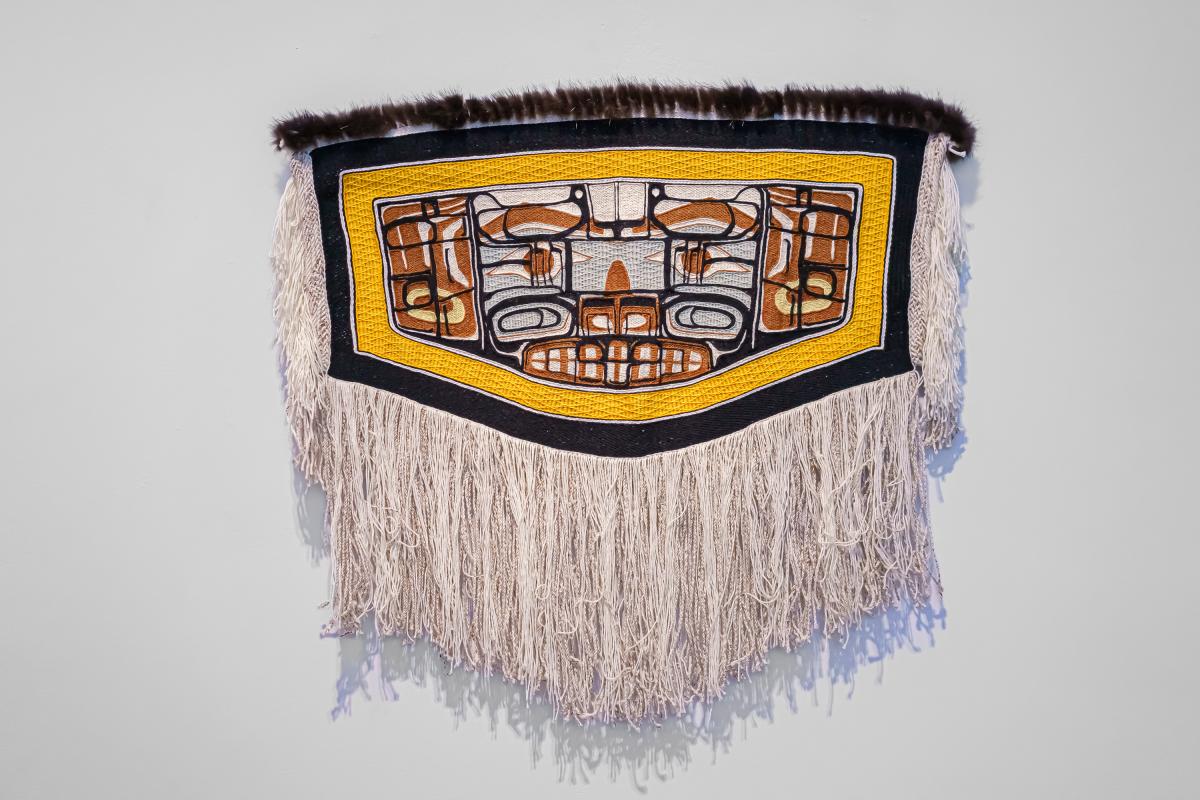
Image context: the cover is a museum installation photograph of Lily Hope's Between Worlds (Child's Robe), not a generic textile pattern. Hope built its ancestor faces by thickening and layering design boundaries within contemporary Chilkat practice. The still image lets the eye follow those boundaries, but it also withholds something essential: the robe's fringe and five-sided field were made to answer a moving body.[3]
A Chilkat robe contains two kinds of motion. The first is held inside the cloth. Black lines swell around eyes, divide, rejoin, and carry a creature's body across a surface that seems to have no obligation to the textile grid. The second begins when the robe is worn. Its long fringe lags behind a turn, catches up, and reverses; the woven field bends across shoulders while the design remains legible at the scale of a room.
Those motions are not separate effects—one graphic, one theatrical. They grow from the same technical decision. Chilkat weaving does not build an image by filling a rigid rectangle row after row. It prepares a resilient hanging warp, works distinct areas of color through twining, and uses raised braided lines to make curves travel horizontally or vertically. The finished robe can therefore carry a highly controlled formline design while remaining supple enough to perform.
That is why a Chilkat robe can look astonishingly modern in a museum case and still be misunderstood there. Flat display makes the image easy to inspect, but it turns a mobile ceremonial work into something like a painting. To understand the medium, the eye has to move closer to the fiber and then imagine the whole construction leaving the wall.
The warp is engineered before the first curve
The familiar phrase “wool blanket” hides the structure. The traditional material system used mountain-goat wool for the visible weft, while the vertical warp combined wool with shredded cedar bark. The bark formed a strong inner core; wool softened and covered it. Many surviving historic robes also contain commercial sheep-wool yarn, so “traditional material” should not be mistaken for a description of every old object.[6] Burke Museum's account describes women preparing goat wool and cedar after seasonal harvesting, then spinning yarn and building the robe through twined weaving related to basketry.[1]
Contemporary materials may change without making that structure irrelevant. Hope's Between Worlds (Child's Robe) uses merino wool rather than mountain-goat wool, but its warp is still thigh-spun with cedar bark.[3] The Smithsonian American Art Museum describes the preparation as a sequence of boiling inner bark, separating it into fine strands, and rolling those strands together with wool roving under steady hand pressure on the thigh.[3] Before any eye or U-shaped form appears, the artist has already calibrated strength, thickness, flexibility, and tension by touch.
That composite warp solves more than a durability problem. Cedar stiffens the hanging strands, helping them support the raised surface braids that carry curving outlines, while the wool exterior lets the field remain visually continuous.[6] Once weaving covers the warp, the structural core largely disappears. The finished design looks as if it were drawn entirely in wool, yet the crisp raised curve depends in part on plant fiber hidden inside.
The warp is also not stretched into a conventional four-sided loom with a fixed lower edge. It hangs freely from an upright support, allowing the weaver to complete separate parts of the image without forcing every colored passage to cross the full width.[1] Graded warp lengths and the shaped woven field produce the robe's lower V or U profile; unwoven warp ends contribute to the fringe, which can also include added wool-only strands.[6] What seems like an unusually fluid picture begins with a support system that permits local decisions.
A curve is assembled, not swept across the surface
At close range, the basic action is twining. In a plain two-strand stitch, weft elements pass around the passive warp and twist around one another, enclosing it. Repeated densely, that action creates a firm, weft-faced surface: the horizontal working threads dominate what the viewer sees, while the vertical foundation retreats.[1]
The difficult leap is from secure cloth to a curving image. A continuous horizontal row naturally favors bands. Chilkat formline needs ovoids, split-U shapes, interior eyes, and swelling contours that can climb, narrow, turn, and close. Weavers answer that conflict by working small design areas independently and joining them into a larger field. Color does not have to march from one side of the robe to the other merely because the textile is wide.[1]
Braided twining gives the boundary additional authority. Burke describes a three-strand braided cord secured in different directions so that a raised outline can travel vertically as well as horizontally.[1] The line is therefore not simply a dark color change. It has thickness, twist, and relief. It can divide adjoining fields, conceal or strengthen a join, and keep a curved contour visually continuous even when the areas on either side were woven as separate problems.
This explains the peculiar energy of the surface. A painted curve can be laid down in one gesture; a Chilkat curve is accumulated through many small crossings, changes of direction, and joins. It looks sweeping from across the room because its construction is exacting up close. The apparent freedom of the line is the result of constraint understood so well that the grid no longer announces itself.
Formline is knowledge, not a library of shapes
Technique alone does not authorize an image. The ovoids, U forms, faces, joints, fins, and feathers associated with northern Northwest Coast formline participate in systems of crest identity and clan relationship. SAAM notes that many designs carry particular rights and responsibilities; making them well involves cultural understanding, not merely copying an attractive arrangement.[2]
Even the name “Chilkat blanket” needs context. Burke traces the English market term to traders encountering many robes among the Chilkat Tlingit near Klukwan, while also recording oral histories that place the weaving form's development among Tsimshian peoples before its movement among Tlingit, Haida, and other Northwest Coast communities. The same account gives naaxiin as a Tlingit name connected to fringe worn around the body.[1] No single museum label can contain that history of origin, adoption, ownership, exchange, and renaming.
Historically, a painted pattern board could mediate between design and weaving, with men preparing the crest composition and women translating it into fiber.[1] Treating that division as an eternal rule, however, would freeze a living practice. Contemporary artists design, weave, teach, combine methods, and negotiate permissions under present conditions. The important continuity is not a fixed job description. It is the disciplined relationship among material skill, visual grammar, community standing, and responsibility.
Hope's Between Worlds makes that point through invention rather than imitation. Its thick boundaries form ancestral faces within a structure based on the Diving Whale pattern. The work uses inherited methods to picture transmission itself: ancestors appear as the new robe takes form, looking back toward the artist and future weavers.[3] Innovation here is not escape from tradition. It is an argument made fluently inside its technical and ethical demands.
The robe completes the line on a moving body
The museum wall encourages a centered, frontal reading. It reveals the broad border, bilateral balance, nested faces, and downward point. It also makes the fringe hang as a quiet set of verticals. In ceremony, those same strands become a time-based edge. They trail the wearer's turn and continue after the torso changes direction, making acceleration visible.
Burke's historical account emphasizes that these were prestigious dancing robes, worn over the shoulders by women and men on significant occasions rather than conceived as flat décor.[1] At the 2023 opening of Sharing Honors and Burdens at the Renwick Gallery, Tlingit dancers and performers processed through the museum while Lily Hope and her sister Ursala Hudson presented contemporary work rooted in Chilkat and Ravenstail weaving.[2] That activation did not merely add cultural atmosphere to static objects. It restored the relationship among textile, wearer, music, and gathering for which fringe is a working component.
The woven curve thus moves twice. First, sectional twining and braided outline make it turn across the warp without collapsing into a stair-step. Then the whole designed field rides a body, its pentagonal edge and loose strands converting gesture into delayed waves. The image is stable enough to carry identity and supple enough to refuse stillness.
Continuity is part of the technique
A technique this slow is vulnerable wherever apprenticeship is broken. Sealaska Heritage Institute describes how colonial collecting, restricted access to subsistence economies, commercial pressure, and the decline of master-apprentice training moved many Northwest Coast works into museums while weakening the systems that made them.[5] Preservation cannot therefore mean keeping old robes physically intact while treating the knowledge in them as finished.
Hope's own apprenticeship makes the alternative visible. She learned from her mother, Clarissa Rizal, who trained with the master weaver Jennie Thlunaut; Hope in turn teaches and frames the robe as a form of documentation carried by community.[3][4] The chain is neither automatic nor nostalgic. It requires material access, years of close instruction, permission, patient repetition, and people willing to make room for new practitioners.
That living chain also prevents the medium from being reduced to a recipe. Cedar in the warp, two-strand twining, braided outlines, and sectional construction explain how a Chilkat curve can exist. They do not determine which clan crest or inherited design an artist has the right or permission to use, or what obligations that design carries into a gathering. Those answers live with artists and communities, not in the stitch alone.
Seen this way, the robe in a gallery is not a stranded remnant of a lost process. It is evidence of concentrated decisions still being taught, revised, danced, and watched. The technical marvel is not simply that wool can impersonate a drawn line. It is that fiber, structure, image, body, and responsibility can be made to turn together.
Sources
- Burke Museum, Christy Christodoulides, “Unpacking a phrase: The Chilkat blanket” (2012) — museum account of naming, cultural transmission, ceremonial motion, cedar-and-wool construction, sectional twining, and braided outlines.
- Smithsonian American Art Museum, “Chilkat and Ravenstail Weavings: Honoring Traditions” (2023) — curatorial overview of formline permissions, the two weaving systems, Lily Hope and Ursala Hudson, and the Renwick opening performance.
- Smithsonian American Art Museum, “Contemporary Native American Art in Focus: Between Worlds (Child's Robe)” (2023) — work record, apprenticeship context, thigh-spun cedar-and-wool warp process, contemporary design choices, and source page for the installation photograph.
- Smithsonian Folklife Festival, Lauren Hogg, “When We Put Our Hands and Hearts in One Place: Chilkat Weaving with Lily Hope” (2024) — artist interview on weaving as documentation, community practice, teaching, and intergenerational responsibility.
- Sealaska Heritage Institute, “SHI's Art Department: Heritage Forward” — Indigenous cultural institution's account of Northwest Coast art, collecting and apprenticeship disruption, community authority, and programs supporting continued evolution.
- Ellen Carrlee and Anna Brown Ehlers, “Chilkat Blanket Restoration: A Case Study in Alaska Native Authority in Museum Conservation,” Alaska Journal of Anthropology 18, no. 1 (2020), 86–100 — conservator and master-weaver account of warp stiffness, braids, fringe construction, historic materials, and Indigenous authority over treatment.