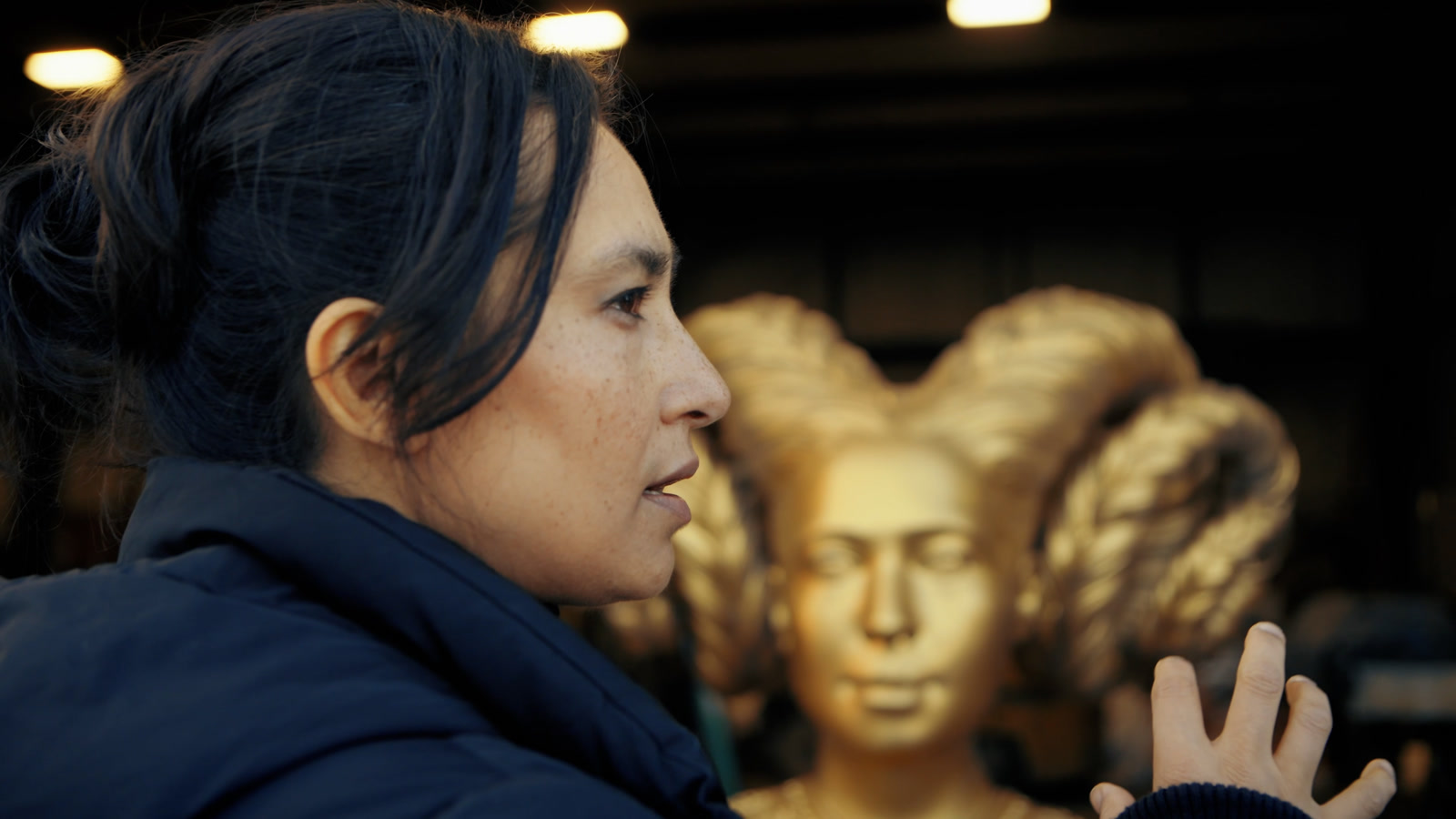


Image context: the cover is a photographic production still, not a symbolic portrait. Sikander stands beside the gold-painted head of Witness while it is still surrounded by the practical world of fabrication. That unfinished setting matters to both films in this collection: authority is assembled, given a surface, moved into position, and therefore remains open to being remade.[2]
A small image can carry an empire. A large sculpture can refuse to make power look settled. Shahzia Sikander's work makes both propositions feel physical.
The two Art21 films gathered here are separated by a decade and by medium. The first, released in 2013, enters Sikander's studio through The Last Post (2010), a ten-minute digital animation in which an East India Company figure and his pictorial world repeatedly dissolve.[1][3] The second, released in 2023, follows the fabrication and installation of Witness and considers its counterpart, NOW, two public sculptures made for Havah…to breathe, air, life in New York.[2][5]
It would be easy to treat the pairing as a career story about getting bigger: manuscript painting becomes animation, then animation becomes monument. That is not quite what the films show. Sikander uses scale to change where authority is staged, but size alone never supplies the argument. Her more persistent actions are layering, breaking apart, reorienting, and rooting a figure without fixing it in place.
Those actions have a long material history. Before arriving at RISD in 1993, Sikander had studied and then taught manuscript painting at the National College of Arts in Lahore; The Scroll (1989–90) was her thesis there. At RISD she explored gouache and ink on tracing paper while developing a new personal vocabulary.[4] The museum's record for Self-Rooted (1994) identifies layered paper and looping, self-nourishing roots as early parts of that vocabulary, which would return much later in public sculpture.[6]
Film 1: the Company man cannot hold the frame
Art21's short film is not a substitute for the full ten-minute The Last Post. It is a studio encounter with the work's construction: Sikander discusses how animated movement grew from narrative and layering already present in her painting and installation practice.[1] The distinction is useful. Instead of asking only what the finished animation depicts, the film asks what a painted form can do once its layers acquire duration.
At the center of The Last Post is a faceless European man in a red waistcoat, adapted from late-eighteenth-century paintings of East India Company officials. Around him, Indian court architecture, Chinese cut-paper silhouettes, ornamental forms, and a watercolor map of South Asia appear, shift, and break apart. The Smithsonian American Art Museum links this unstable pictorial world to the Company's historical fusion of mercantile, military, and state power across South Asia and China.[3]
The key formal action is not enlargement but loss of pictorial obedience. A court interior would ordinarily organize bodies into a hierarchy; a map would turn territory into a bounded surface; a colonial portrait would stabilize rank through costume and pose. In Sikander's animation, those visual systems no longer cooperate. Architecture becomes permeable, the map cannot remain a neutral backdrop, and the official's red coat makes him conspicuous without making him secure.
That is why dissolution matters more than simple destruction. Sikander does not erase the Company man once and declare the history finished. She lets recognizable fragments disperse, collide, and return in altered relations. The official keeps re-entering a field he can no longer command. This is an interpretive inference from the work's movement, but it is grounded in a precise historical choice: the protagonist is not a generic European villain; he invokes a corporation whose commercial, administrative, and military identities were difficult to separate.[3]
Du Yun's score intensifies that instability. Electronic pulses and explosive sounds do not merely decorate the shattering image. They make rupture arrive as an event in the viewer's body, preventing the animation's exquisite line and ornament from becoming a safely distant style.[3] Sikander's use of manuscript-derived imagery is therefore neither preservation under glass nor a digital upgrade of an old technique. Animation releases the latent conflicts inside a layered page.
Scale, in this first film, is temporal and relational. A form associated with close viewing enters a projected environment, but its new force comes from sequence: one image can interrupt another, an official can lose his ground, and a motif can return carrying a changed political charge. The frame gets larger only to become less stable.
Film 2: a self-rooted figure enters civic space
Ten years after Art21's The Last Post film, Melting Boundaries moves from projected disintegration to the heavy logistics of public sculpture. The camera follows Sikander through fabrication and installation, including the lowering of Witness into Madison Square Park. Nearby, NOW occupied the roof of the Appellate Division courthouse among nine historic male lawgivers. The two works share a visual language, but they do not share a site or an identical job.[2][5]
That difference is important. Witness stood in the park as an eighteen-foot figure made from milled foam, steel, fiberglass, paint, and glass tile. NOW, an eight-foot patinated bronze rising from a lotus base, entered the courthouse's architectural lineup and became its first female figure.[5] One met viewers at ground level; the other intervened in a pre-existing skyline of legal authority.
Watch what the film makes visible around the finished forms: studio hands, joins, surfaces, rigging, street-level sightlines, and the pause before a suspended sculpture reaches its base. Monumentality is revealed as coordinated labor rather than an effortless appearance of permanence. That practical record sharpens Sikander's description of her work as an anti-monument. The sculptures do not reject durability or public presence; they reject the idea that inherited authority should arrive looking natural and complete.[2]
In Witness, a steel hoop skirt carries a mosaic whose geometry responds to the courthouse's stained-glass dome. The figure's open eyes counter the familiar blindfolded allegory of Justice, while a jabot at her neck recalls the lace collars through which Ruth Bader Ginsburg altered the visual code of judicial robes. Her braided hair curls like ram's horns, and root-like appendages extend from the body. The park commission described those roots as a portable form of self-possession: the figure can carry them with her.[5]
The roots are not a symbol invented to make a 2023 commission legible. In Self-Rooted, nearly three decades earlier, Sikander paired two female forms on layered tracing paper—one upright and buoyant, the other horizontal and grounded—and gave them looping roots that nourish themselves.[6] Seeing that earlier work prevents a crude equation of large scale with liberation. The public sculpture does not rescue a once-powerless miniature figure. It moves an already complex, mobile form into a civic argument about who is pictured as a source of law and judgment.
NOW makes a different intervention. Its lotus base and open-eyed allegorical body join the courthouse roof rather than reproducing the park sculpture's rooted skirt. Placement gives it friction: the work shares a ledge with Confucius, Justinian, Moses, and other male lawgivers, making an exclusion visible by interrupting it.[5] Yet a new figure cannot by itself repair the institutions below. The strength of the project lies in refusing that easy claim. Representation becomes a public question, not a victory announced by scale.
Breaking the frame, changing the ground
Together, the films show two directions of pressure. The Last Post subtracts stability from inherited authority. The Company man remains recognizable, but map, architecture, ornament, and sound stop supporting his command.[1][3] Melting Boundaries gives a self-rooted female vocabulary new material weight and civic placement, then lets the surrounding park, courthouse, viewers, and legal iconography complicate what that placement can mean.[2][5][6]
This is not a straight ascent from small painting to important sculpture. The roots predate the animation; animated dissolution continues inside the later sculptures' mosaic, braided, botanical, and legal references. Nor is one medium more political than another. Projection can destabilize a historical figure without moving a stone, while a monumental object can remain critical only by exposing the terms of its own installation.
Sikander's most durable method is to deny a figure its assigned job. The Company official cannot stay sovereign over the frame. The female allegory does not remain blind, ornamental, or dependent on one patch of ground. Power loses its fixed shape—and once that happens, scale becomes less a measure of size than a way to ask who may occupy an image, a history, or a public site.
Sources
- Art21, “Shahzia Sikander: The Last Post,” Extended Play — official YouTube film on the relationship between Sikander's layered painting practice and her 2010 animation.
- Art21, “Shahzia Sikander: Melting Boundaries,” Extended Play — official YouTube film documenting the fabrication, installation, and civic stakes of Witness and NOW.
- Smithsonian American Art Museum, “Shahzia Sikander: The Last Post” — work metadata and institutional analysis of the Company man, trans-Asian imagery, animation, and Du Yun's score.
- Rhode Island School of Design, “Sikander Show Opens at RISD Museum,” 2021 — early-career chronology from Lahore student and faculty member to RISD, including The Scroll and experiments on tracing paper.
- Madison Square Park Conservancy, “Shahzia Sikander: Havah…to breathe, air, life” — official commission record for the works' sites, materials, dimensions, iconography, and relationship to the courthouse.
- RISD Museum, Shahzia Sikander: Extraordinary Realities exhibition guide — object record and label for Self-Rooted, documenting its layered tracing paper, doubled female form, and self-nourishing root motif.