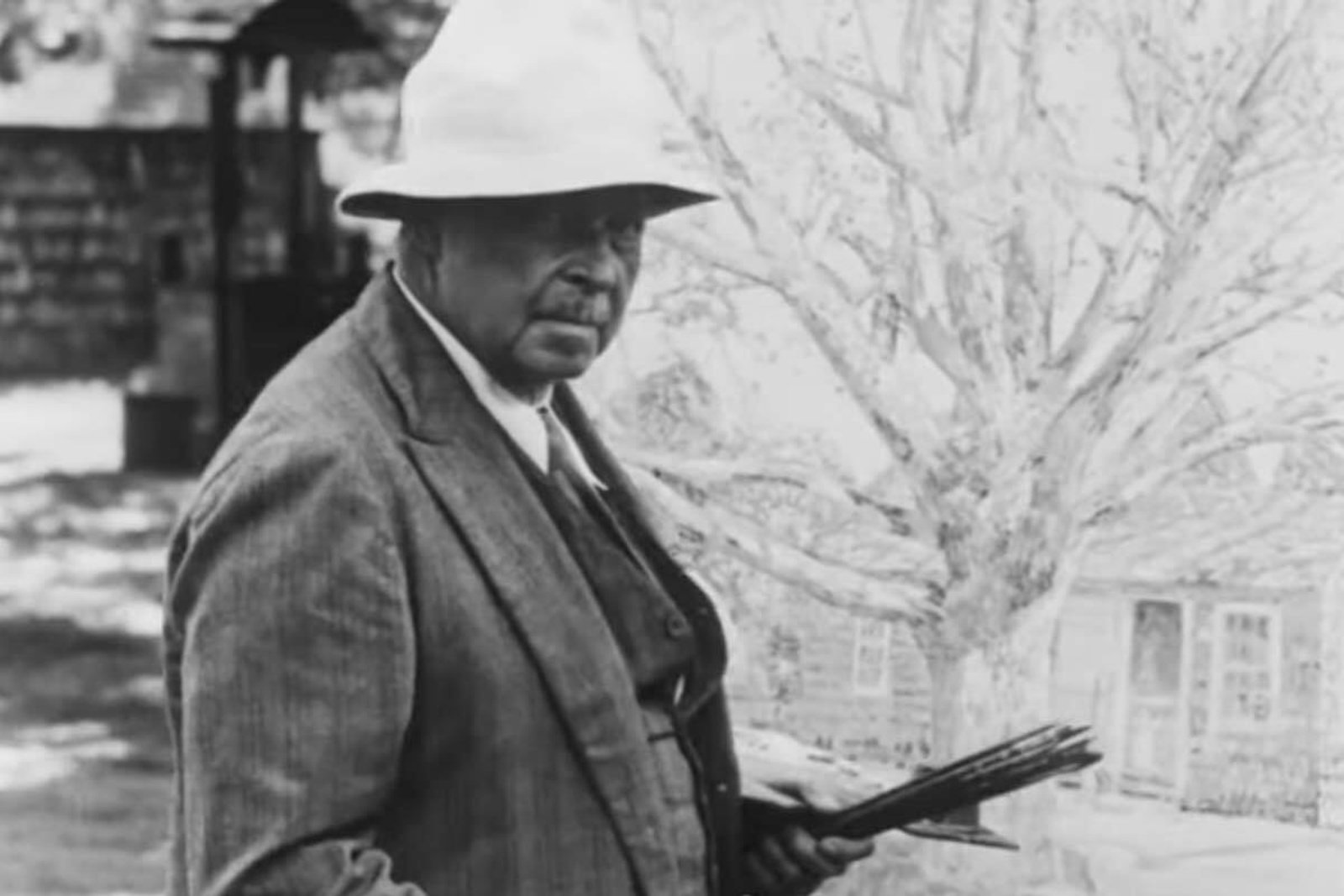
Archival films about painters often get treated as gifts of intimacy. The camera enters the studio, the artist appears in motion, and viewers feel they have moved closer to the truth of the work. The Met's Childe Hassam, Artist: A Short Personal Sketch, 1932 is more revealing than that, but for a slightly harder reason.[1][2] It shows how an artist late in life helped package his own historical meaning. Swimming, golf, preparatory drawings, studio work, domestic ease, and a museum visit are edited into a single proposition: Childe Hassam is not merely an American Impressionist who happened to live well. He is presented as if his way of life were itself proof of the art.
That proposition matters because by 1932 Hassam already belonged to an earlier chapter of modern painting. The Met's 2004 exhibition page describes him as the leader of American Impressionism, the movement's most prolific promoter, and the painter who translated French Impressionist lessons into a distinctly American mix of New York modernity and New England nostalgia.[3] Born in Dorchester in 1859, trained in Boston, shaped by Paris in the late 1880s, and then established in New York, Hassam spent decades turning city streets, resort gardens, rocky coasts, and patriotic banners into a coherent public style.[3] The film therefore does not capture a young painter still inventing himself. It captures an elderly, already canonized artist participating in the stabilization of his own legend.
That is why this footage is stronger as an archival object than as a biographical curiosity. The From the Vaults page summarizes the sequence in an almost breezy list: Hassam goes for a swim, plays golf, reviews preparatory drawings, paints in his studio, and strolls through The Met to visit Coast Scene, Isles of Shoals (1901), the first of his canvases to enter the Museum's collection.[2] Read casually, those details can sound like charming surplus. Read historically, they reveal a careful sequence of associations. Physical vigor, cultivated leisure, artisanal preparation, finished painting, and institutional recognition are all folded into one late-career image of what American art should look like when embodied by a gentleman-painter.
Image context: the cover uses The Met's archival promotional image for the film rather than one of Hassam's paintings. That choice fits the argument. The article is about an artist image being built in front of the camera, and the black-and-white portrait makes that act of self-presentation visible before the video even begins.[2]
The provenance is unusually clean. The Met produced the silent film in 1932, preserved it in its moving-image archive, and reissued it through the museum's From the Vaults series in 2020 with a new score by Ben Model.[1][2] That chain matters because the clip is not a stray upload or a documentary excerpt ripped from television. It is a museum-backed archival object that records not only Hassam's body and studio, but also how a major institution wanted viewers to see him.
1) The title cards make a public identity before the painting starts
The opening title cards are the first clue that this film is about presentation as much as process.[1] They identify Hassam as a "true American," anchor him in Dorchester, and stress the Americanness of his subjects before showing much studio labor at all. That framing aligns neatly with the exhibition history The Met later laid out: Hassam as the artist who made New York into a central Impressionist subject while also coding New England as a repository of older, steadier national values.[3] The film does not argue this through criticism. It argues it through sequencing and tone. Before viewers are asked to consider brushwork, they are asked to accept a type.
That type is reinforced by the house and grounds. Early in the film, the estate setting and quiet domestic interiors do not feel incidental.[1] They build an atmosphere of settled abundance around the painter. The effect is subtle but important. Impressionism, which had once arrived in the United States as a new imported language, is here shown as fully naturalized. It belongs to lawns, summer light, country air, and an artist whose surroundings seem to confirm that aesthetic balance has become a social condition.
This is what gives the film its peculiar late quality. The exhibition page notes that by the 1920s East Hampton had become Hassam's summer headquarters and that his reputation rode the rise of American Impressionism before modernism and regionalism later eclipsed it.[3] Seen from 1932, the film feels like a last confident arrangement of those terms. It fixes Hassam within a world where cultivated ease still carries artistic authority.
2) Swimming, golf, drawings, and studio work form one continuous argument
The footage's most interesting decision is that it refuses to separate leisure from labor.[1][2] Hassam swims in the ocean, walks the grounds, and plays golf; then he reviews drawings and paints in the studio. None of this is framed as a break from artistic seriousness. The sequence suggests that bodily routine, outdoor perception, and pictorial work belong to the same discipline. The artist is shown not as a tormented modern subject wrestling with form, but as someone whose art grows out of tempo, repetition, and practiced ease.
That image fits the historical Hassam presented by the Met's exhibition materials. The 2004 page quotes a contemporary description of him as a man who "lived with gusto," rode surf, played golf, kept a good cellar, and worked joyously well into old age.[3] In the film, that account becomes visual method. The painter's authority comes partly from the sense that he inhabits the world correctly: he moves through weather, property, recreation, and work with the same composed assurance.
The still-life segment sharpens that point. The exhibition page identifies Long Island Pebbles and Fruit (1931) as the painting Hassam is seen working on in the 1932 film.[3] That matters because it keeps the footage from dissolving into vague "artist at work" atmosphere. We are watching a very late painting, made when Hassam's artistic identity was long settled. The table arrangement, the preparatory drawings, and the deliberate pacing all suggest a painter interested in order and refinement rather than crisis. Even the studio scene carries the logic of arrangement: materials, objects, and gesture are presented as parts of a cultivated whole.
3) The museum walk turns a living painter into a usable canon
The film's most striking move comes when Hassam leaves the studio and enters The Met.[1][2] This is not filler footage. It changes the meaning of everything that comes before it. A silent portrait of an aging painter could have ended outdoors or at the easel, leaving viewers with a pastoral image of creative longevity. Instead the film stages an institutional return. Hassam visits Coast Scene, Isles of Shoals, the first of his works to enter the Museum's collection.[2]
That painting is an ideal choice for the film's argument. The Met's object page describes the Isles of Shoals as one of Hassam's favorite retreats from 1884 until about 1915 and notes that he painted the coastline in clear, luminous color and patterned brushstrokes reminiscent of Monet's coastal scenes.[4] In one canvas, the museum can show regional loyalty, French inheritance, and painterly fluency all at once. When the elderly Hassam walks toward it, the film performs a compact historical closure: the man, the American landscape, the Impressionist method, and the museum collection are made to ratify one another.
This is where the archival footage does something text alone cannot. It makes canon formation visible as choreography. Hassam is not only remembered; he is shown inspecting the place where he has already been remembered.[1][2][4] The museum walk presents collection status as a natural culmination of a life in art. Yet because the moment is staged, viewers can also see the work of persuasion underneath it. The institution does not simply inherit a reputation. It helps script it.
4) Why the film still matters
The strongest reason to watch this footage now is that it complicates a familiar museum pleasure. Archival artist films are often consumed as unfiltered access, but Hassam's short portrait works better when read as a constructed public afterlife.[1][2] It preserves gestures, rooms, and habits, yet it also preserves an argument about how American Impressionism wanted to remember itself in the early 1930s: healthy, ordered, socially assured, regionally rooted, and already at home in the museum.
That does not make the film false. It makes it historically rich. The exhibition page's broader account of Hassam's career, from Boston and Paris to New York, New England, and East Hampton, shows how much labor stood behind that polished identity.[3] The object page for Coast Scene, Isles of Shoals shows the specific visual language the museum chose to anchor his legacy.[4] The archival film brings both strands together and lets viewers see the conversion in real time: a painter's habits become a persona, the persona becomes a tradition, and the tradition enters the museum as if it had always belonged there.[1][2][3][4]
Sources
- The Met, "Childe Hassam, Artist: A Short Personal Sketch, 1932 | From the Vaults," YouTube video, published July 24, 2020.
- The Metropolitan Museum of Art, "Childe Hassam, Artist: A Short Personal Sketch, 1932" - From the Vaults feature page.
- The Metropolitan Museum of Art, "Childe Hassam" - 2004 exhibition page with biography, New York and New England context, and note that Long Island Pebbles and Fruit (1931) appears in the 1932 film.
- The Metropolitan Museum of Art, "Coast Scene, Isles of Shoals" - collection entry on Hassam's 1901 painting and its Isles of Shoals context.