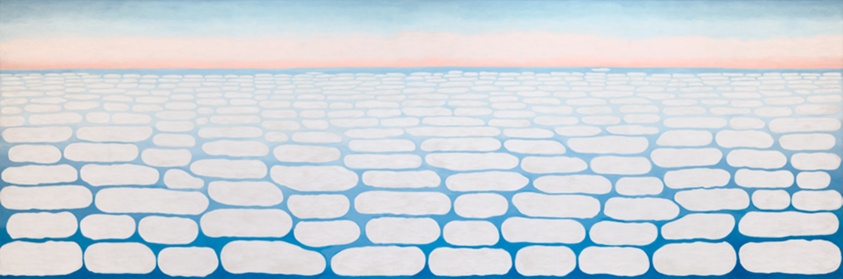
Georgia O'Keeffe's Sky Above Clouds IV does something that many paintings of landscape never even try to do: it takes a view that should feel distant and turns it into a surface you can almost stand on.[1][2] The subject is sky, but the sensation is strangely architectural. Clouds do not float in romantic disorder. They arrive in repeated white units, laid out across an enormous horizontal field, until altitude begins to feel less like atmosphere than like flooring.[1][4][5]
That reversal is the reason the painting still feels so contemporary in 2026.[1][2] O'Keeffe does not ask the viewer to admire weather as spectacle. She asks the viewer to inhabit a new scale of looking. What began as an airplane-window experience in the 1950s becomes, in this 1965 painting, a disciplined abstraction in which the horizon is no longer simply far away. It becomes a threshold that organizes the entire canvas.[1][2][3]
Image context: the cover image is the artwork itself from the Art Institute of Chicago. That exact match matters here because the essay depends on the painting's extreme width and on the repeated cloud units receding across the surface. A crop or atmospheric substitute would weaken the argument at the level of structure before the reading even began.[1][5]
The horizon is the real hinge
The first thing to notice is where the horizon sits. It is high, narrow, and calm, almost a band rather than a distant scene.[1][5] Beneath it stretches the long field of cloud forms, each one rounded and discrete, but also regular enough to feel counted. Above it the blue opens, but not as dramatic weather. It opens as pressure release. The painting works because the eye keeps moving between those two conditions: below, a repeating system; above, a sparse zone of air.
Whitney's audio guide for the related Sky Above Clouds III is useful here because it records O'Keeffe describing the sky from an airplane as so solid that it seemed one could walk right out to the horizon.[2] Sky Above Clouds IV makes that sensation pictorially credible. The cloud bank is not painted as vapor dissolving into uncertainty. It is painted as a plane with enough visual density to hold imagined weight. The horizon line matters because it is where the illusion flips. Beyond that line, sky remains sky. Below it, sky begins to behave like terrain.[1][2]
This is why the painting can feel both simple and unnerving. At a glance, it looks almost childlike in its repeated white forms. Under sustained attention, that repetition becomes the whole point. O'Keeffe is stripping the sky of anecdote and building a condition of seeing.
Repetition turns weather into structure
The cloud shapes are not identical, but they are disciplined enough to read as a rhythm rather than as meteorological incident.[1][5] They grow smaller as they recede, yet they remain insistently separate. The effect is less like a storm front than like a field of units extending beyond ordinary measure. O'Keeffe had explored this cloud motif earlier in smaller, less monumental formats, and the Art Institute notes that she moved from a more realistic treatment toward increasingly stylized versions on larger supports.[1] The Georgia O'Keeffe Museum's object page for Sky with Flat White Cloud makes that transition easier to grasp: the 1962 painting still gives one broad cloud mass meeting a banded sky, whereas Sky Above Clouds IV multiplies the motif until the viewer no longer reads one cloud but a system of recurrence.[4]
That shift matters because it changes the painting's emotional register. A single cloud can still feel lyrical, fleeting, private. Hundreds of cloud forms spread across twenty-four feet feel impersonal in a productive way. They push the painting toward order, duration, and bodily confrontation.[1][3] O'Keeffe is not just remembering what she saw from the plane. She is reorganizing it until memory becomes an abstract environment.
There is also a subtle refusal of theatrical weather here. No lightning, no storm drama, no sunset excess. The color structure is reduced: white cloud forms, a soft pinkish band near the horizon, then blue.[1][4][5] Because the palette is restrained, the spatial argument becomes easier to feel. The painting's monumentality is not a result of incident. It comes from measured repetition.
Monumentality changes the viewer's role
At the Art Institute, the work is listed at 243.8 by 731.5 centimeters: eight feet high and twenty-four feet wide.[1] That fact is not trivia. It is the key to the whole reading. A sky seen from an airplane window is ordinarily private and framed. O'Keeffe blows that view outward until it can no longer function as a personal glimpse. The painting becomes public, bodily, architectural.
The production story reinforces that transformation. The Art Institute says O'Keeffe painted the work in the summer of 1965, when she was seventy-seven, and links it to a cloud series developed from airplane travel during the 1950s.[1] The O'Keeffe Museum chronology adds a crucial material detail: that summer at Ghost Ranch she painted her largest picture in the garage.[3] Seen together, those facts explain why Sky Above Clouds IV does not feel like a sketch enlarged for prestige. It feels like a logistical decision. The scale had to be built, managed, and physically endured.
The later exhibition history deepens the point. The Art Institute records that after the painting appeared in a 1970 retrospective in New York and Chicago, it was judged too large to fit through the doors of the San Francisco venue.[1] That anecdote sounds almost comic, but it clarifies the work's ambition. O'Keeffe made a painting about sky that behaves like an object with civic consequences. You do not simply hang it anywhere. Architecture has to answer to it.
Late O'Keeffe is not fading out here
Because the painting comes from O'Keeffe's later career, there can be a temptation to read it as serene culmination, a kind of late simplification.[1][3] That misses how deliberate and sharp it actually is. The Whitney transcript on Sky Above Clouds III frames O'Keeffe's abstractions as a major, continuous part of her practice rather than a side note to flowers and bones.[2] Sky Above Clouds IV belongs to that abstract line. Its reduced forms are not signs of withdrawal. They are signs of control.
The painting also shows how O'Keeffe could translate travel into formal language without turning it into narrative illustration. Airplane travel is the precondition, but the painting does not describe a trip.[1][2] It abstracts the experience of looking down and out at once: down onto a seeming surface, out toward a horizon that no longer behaves like distance in the ordinary way. The result is almost paradoxical. A view associated with motion becomes a painting of astonishing stillness. Yet that stillness is active. It holds the viewer in a state of extended, leveled attention.
Why it still works
The painting still lands because it avoids two easy traps. It does not sentimentalize nature, and it does not use abstraction as obscurity. Instead, it uses abstraction to make perception more exact.[1][2][4] O'Keeffe narrows the variables until the viewer can feel one problem with unusual force: what happens when a sky stops reading as background and starts reading as a plane?
That is the painting's real modernity. Sky Above Clouds IV does not depend on novelty of motif. Clouds are among the oldest materials in painting. What feels new is the firmness. O'Keeffe makes the upper world look traversable without ever pretending it has become literal ground. She holds the image exactly at that edge, where air becomes pattern, pattern becomes structure, and structure becomes a bodily thought.[1][2]
60-second viewing drill
Try this sequence in front of the image:
- Find the horizon first and treat it as a hinge, not background.
- Scan one row of cloud forms from left to right before moving upward.
- Notice how the cloud units shrink without dissolving into haze.
- Step back and ask when the sky starts to feel less atmospheric and more like a surface.
- End by recalling the dimensions: the painting's scale is doing part of the seeing for you.[1]
Sources
- The Art Institute of Chicago, Sky above Clouds IV (object record with series context, dimensions, and exhibition history).
- Whitney Museum of American Art, "Georgia O'Keeffe, Sky Above Clouds III/Above the Clouds III, 1963" (audio guide transcript on the airplane-view origin and horizon effect).
- Georgia O'Keeffe Museum, Access O'Keeffe chronology (1965 entry noting Ghost Ranch and O'Keeffe's largest picture).
- Georgia O'Keeffe Museum, Sky with Flat White Cloud, 1962 (object record for an earlier cloud painting in the series).
- The Art Institute of Chicago, "12 Things to Know About Georgia O'Keeffe" (article page including Sky above Clouds IV image and descriptive alt text).