
Archival films about major sculptors often promise intimacy and deliver legend. The camera enters the studio, the artist issues a few memorable lines, assistants lift heavy things, and the viewer leaves with a softened aura around genius. The Met's Nevelson in Process, 1977 is more useful than that.[1][2] What it gives back is not mystery but structure. Louise Nevelson's sculpture is often summarized through a handful of familiar nouns: found wood, painted black, monumental wall pieces, late recognition.[1][3][4] The film shows a harder proposition. Her real medium is the room. Individual scraps matter, but only after she has forced them into a spatial order that can overwhelm, shelter, or reframe the body standing before it.[1][3][5]
That point matters because Nevelson's reputation is easy to flatten into a romance of salvage. The biographical facts encourage it. The Met's film note stresses discarded wood and scrap metal; it also reminds viewers that she was in her forties before selling work beyond artist friends and in her sixties before the press broadly granted her stature as a major American sculptor.[1][2] Those facts are true, but they can mislead when taken alone. The documentary keeps pushing away from a simple origin story of junk redeemed by vision. What emerges instead is a sculptor obsessed with enclosure, interval, edge, and how black can make unlike things submit to one atmosphere.[1][4]
The written record around the film sharpens that reading. The Nevelson Chapel site describes Chapel of the Good Shepherd as a "unique, comprehensive sculptural environment" at Saint Peter's Church, language that fits the film exactly because the opening sequence treats sacred commission as total setting rather than isolated object.[5] The Met's collection pages for Mrs. N's Palace and Black Crescent make the scale plain in another way: these are not tabletop assemblages but painted-wood structures measured in walls, feet, and bodily confrontation.[3][4] Once those works are held beside the 1977 footage, Nevelson stops looking like a collector of poetic fragments and starts looking like an architect of pressure.
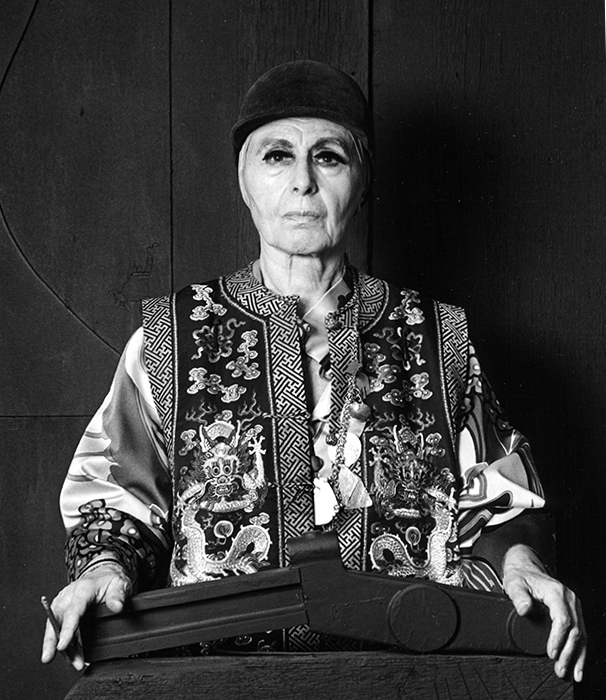
Image context: the cover uses Lynn Gilbert's 1976 photographic portrait of Nevelson from Wikimedia Commons. It belongs here because the film makes her public appearance part of the same artistic logic as the sculpture itself. Dark costume, severe glamour, and frontal control all anticipate the black, room-making authority of the work we watch her build.[6]
Historical context: Nevelson's sculpture had already moved beyond objecthood
By 1977, Nevelson was not searching for a first breakthrough. She was working after decades of turning found material into environments dense enough to feel architectural. The Met's short description frames her as a maker of elaborate and monumental sculpture from discarded material, and the collection pages confirm how literal that monumentality had become by the mid-1960s and 1970s.[1][3][4] Mrs. N's Palace, dated 1964-77, stretches nearly twenty feet across and fifteen feet deep.[3] Black Crescent, from 1971, stands more than eleven feet high.[4] These dimensions matter because they correct the common mental picture of assemblage as essentially intimate. Nevelson's practice grew outward until it could behave like a wall, a chamber, or a civic screen.
The chapel sequence at the start of the film makes that transition visible. Around the 0:50-1:20 mark, a voice describes a chapel as "an environment for the spirit," then names Nevelson as the artist engaged to create that environment.[1] The sentence is easy to miss, but it is the key to the whole documentary. The church commission is not presented as decoration added to architecture after the fact. It is presented as atmosphere-making. That aligns closely with the Nevelson Chapel site's own description of the project as a comprehensive environment.[5] In other words, the film begins by telling the viewer how to understand the rest: Nevelson's art is not simply something placed in a room. It is something that tries to decide what a room feels like.
The footage then folds that public ambition back into biography. Around 2:26-4:50, Nevelson names 1899 Kiev as her birthplace, recalls immigration, and says, with characteristic finality, that "the only reality that I recognize is my reality."[1] In a weaker film that line would serve as personality ornament. Here it does more. It explains why her work can absorb found material without ever becoming merely documentary. The salvaged object enters a private order first. Street wood does not remain street wood. It must cross into Nevelson's reality, which means scale, placement, and relation matter more than anecdote.
Video provenance
The embed below uses The Met's official upload of Nevelson in Process, 1977, published in 2020 as part of the museum's From the Vaults archive program.[1][2] The museum describes the film as an intimate portrait of the artist at work, and that framing is accurate so long as "portrait" is understood in a strict sense. The film does not only preserve Nevelson's face or voice. It preserves the way her studio decisions move toward public environment.
Around 10:05 to 11:05, the film explains why salvage is secondary and form is first
The documentary reaches its clearest statement of method when Nevelson speaks about street wood. Around 10:07, she says that many pieces came from the street and that people "left marvelous things"; seconds later, near 10:58-11:04, she makes the film's most important distinction: she is not in love with wood as wood, because "the forms" are what matter, and if she loved the material itself she would not paint it black.[1] That passage is worth more than a shelf of summary adjectives. It rejects two sentimental readings at once.
The first rejected reading is material nostalgia. Found wood can tempt viewers into believing that the truth of the work lies in weathered grain, urban memory, or the ethical charm of reuse. Nevelson herself blocks that move.[1] Black paint is not concealment in the cheap sense. It is discipline. It suppresses the small anecdotal seductions of the scrap so that contour, notch, recess, and interval can start behaving as one system. The Met's Black Crescent page helps this argument because its title almost overstates the point: black is not merely a finish added at the end, but the condition through which the disparate wooden elements become a single declarative shape.[4]
The second rejected reading is that assemblage depends on chance alone. Nevelson does not present herself as a passive discoverer of expressive junk. She handles pieces, shifts weight, tests balance, rejects lines that do not work, and keeps chasing a formal pressure that is visibly stricter than improvisational charm.[1] That is why the footage still feels contemporary. It shows editing as the center of assemblage. A found-object sculpture is not automatically open just because its parts were once elsewhere. In Nevelson's hands, openness gives way to command.
Around 13:49 to 14:02, the film turns construction into a bodily drama
The next decisive moment arrives near 13:49-14:02, when Nevelson describes making as "psychic labor pains."[1] The phrase matters because it prevents formal control from being mistaken for cool detachment. Her sculptures look finished, often even severe. The work of getting there, as the film presents it, is stressful, repetitive, and bodily. She says elsewhere in the same stretch that if one line did not please her, she would take a wall down and put it up again.[1] Perfection in this world is not smoothness. It is the endpoint of repeated reordering.
That is where the large-scale works in the written record become useful. Mrs. N's Palace is not only large; it carries duration in its date range, 1964-77, the same end year as the film itself.[3] The title suggests fantasy or personae, but the dimensions tell another story: whatever palace means here, it has to be built through accumulated decisions, not a single theatrical gesture. The documentary lets that accumulation stay visible. Assistants hold pieces in place. Nevelson changes her mind. The sculpture becomes less like an object composed once and more like a wall argued into existence.
The gendered charge of that "labor pains" metaphor also matters. Earlier in the film, around the 7-minute region, Nevelson speaks sharply about the assumptions built into being a mother or wife.[1] The documentary never turns into a didactic statement on women artists, but the pressure is there. She does not ask for a softened reading of ambition. She insists on authority, then describes creation through a language of pain, birth, and force. The result is not confession. It is a reminder that her environments were made against resistance, including the resistance of the culture that took so long to grant her scale.
Around 24:53 to the end, public sculpture becomes civic weather
The closing public sequence, with the toast to Sky Tree around 24:53, is crucial because it widens the frame without diluting it.[1] After all the studio adjustments, the work appears in civic ceremony: "we toast life in artwork everywhere and we celebrate Sky Tree."[1] A lesser documentary would use this as triumphant closure, proof that the private artist finally met the public. This film does something subtler. It shows that the same logic governing the studio still governs the commission. Sculpture remains environmental. It enters the city as weather, marker, and vertical interruption.
That continuity is why the chapel opening and the public toast belong together. Nevelson's art can inhabit sacred interior, museum gallery, and urban plaza without changing its deepest ambition.[1][3][5] In each case, it tries to control surrounding experience rather than simply occupy a designated slot. Black, scale, and repetitive modular pressure all help her do that. The salvage origin of the material is real, but by the time it reaches finished form the material has been stripped of casual life and reassigned to atmosphere.
Why this archival film matters now
The great value of Nevelson in Process is that it rescues Nevelson from two bad reductions. One is the decorative reduction, where her work becomes glamorous black assemblage for lobby walls and museum corners. The other is the salvage reduction, where the art is explained almost entirely through the poetry of discarded things.[1][3][4] The film defeats both. It shows a sculptor for whom black was a governing instrument, found wood was raw syntax rather than final meaning, and room-scale pressure was the real goal.
Seen from 2026, the documentary also feels unexpectedly fresh because so much current art writing returns to installation, environment, and the politics of space. Nevelson was already working there, but with a fiercer sense of edit than the word "environment" sometimes carries today. Her rooms are not loose experiences. They are hard-won orders.[1][5] The archive matters because it preserves that severity. It lets us watch salvage stop being debris, stop being biography, and become wall, chamber, and civic air.
Sources
- The Met, "Nevelson in Process, 1977 | From the Vaults," YouTube video, published March 27, 2020.
- The Metropolitan Museum of Art, "Nevelson in Process, 1977" - From the Vaults feature page.
- The Metropolitan Museum of Art, "Mrs. N's Palace" - collection entry for Louise Nevelson's painted-wood environment, dated 1964-77.
- The Metropolitan Museum of Art, "Black Crescent" - collection entry for Louise Nevelson's 1971 painted-wood sculpture.
- Nevelson Chapel, official site for Louise Nevelson's Chapel of the Good Shepherd at Saint Peter's Church.
- Wikimedia Commons file page for Lynn Gilbert's 1976 portrait photograph of Louise Nevelson used as the lead image.