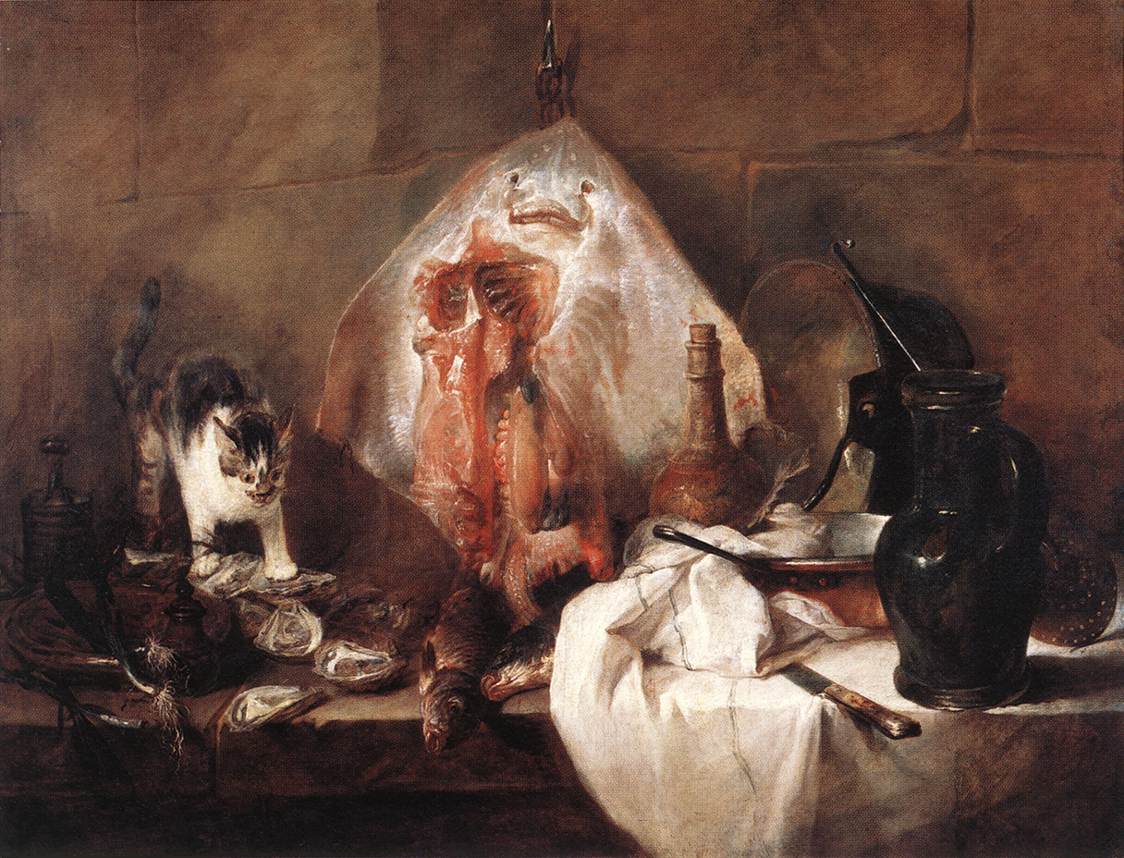
Jean-Simeon Chardin's The Ray does not begin by inviting pleasure. It begins by forcing the eye to cross a threshold of disgust.[1][4] A gutted skate hangs from a hook at the center of the canvas, opened so widely that its body reads at once as fish, mask, curtain, and wound. The painting is usually grouped under still life, yet it does not behave like a table of agreeable objects arranged for leisurely admiration. Chardin makes the kitchen feel theatrical and slightly dangerous. Copper gleams, linen spills forward, oysters lie cracked across the table, and a cat creeps in from the left as if the whole arrangement were still unstable enough to be raided.[1][2]
That instability is the key to the picture. What matters here is not simply that Chardin can paint flesh, shell, metal, and cloth with conviction. What matters is that he turns a scene of provisions into a scene of pressure. The hanging ray dominates the room so completely that every surrounding object seems to organize itself around a central tear. Still life becomes less a category of rest than a test of whether order can hold.
Image context: the article uses a faithful photographic reproduction of the Louvre painting rather than a cropped detail or a modern kitchen photograph. The argument depends on the whole composition staying visible at once: the ray's vertical drop, the cat's low approach, and the rightward drift from exposed flesh to utensils, linen, and pottery.[1][4]
The ray occupies the room like a torn curtain
The Louvre's object page gives the basic facts: The Ray dates to 1728, measures roughly 1.145 by 1.46 meters, and served as Chardin's reception piece for the Academie Royale.[1] Those details matter because the painting is larger and more public in ambition than many viewers expect from a still life. It was not designed as a minor decorative aside. It was built to announce a painter.
Chardin announces himself by placing the skate where a portrait painter might place a face or a history painter might place a hero. The pale body hangs frontally and almost symmetrically, taking up the center of the canvas like a banner that has been cut open. The top edge narrows toward the hook, then the body widens downward into a broad white field. That white is not clean. It is pearl-like at the edges and violently red at the center, where the opened cavity drops toward the table. The effect is difficult to classify. The animal is dead, but the composition makes it feel newly exposed, as if the act of opening had only just happened.
This is why the painting feels more dramatic than the label "still life" suggests. Chardin uses stillness to intensify confrontation rather than to soothe it. The ray does not recede into the inventory of kitchen goods. It interrupts the inventory. The picture's vertical axis is a split body, and everything else has to negotiate with that fact.
Copper, linen, and oysters do not calm the scene
Once the eye moves away from the hanging fish, the rest of the table might seem ready to restore order.[1][2] On the right, Chardin sets a dark ceramic jug against a copper pan, a bottle, a skimmer, and a thick white cloth whose folds spill over the edge of the table. Below, a knife lies diagonally across the linen. Oysters and small fish scatter across the foreground. In another painter's hands, these might have become a lesson in household abundance or tactile variety. Chardin does paint tactile variety, but he refuses to let it settle into comfort.
The white cloth is the clearest example. It catches light beautifully, yet its brightness does not neutralize the ray's red opening. Instead it carries that violence sideways across the table. The linen behaves like a continuation of the central body: another surface cut by shadow, crease, and edge. The knife reinforces the feeling. It is not being used; the work is already done. Yet its presence keeps the memory of cutting active in the scene.
The copper does something similar. The Metropolitan Museum describes Chardin's early still lifes as part of a naturalistic tradition sharpened by unusual pictorial structure and immediate material truth.[2] In The Ray, that truth is not only descriptive. Metal and pottery serve as counterweights to the rawness of flesh. They are solid, worked, durable, human-made. The fish is wet, opened, and temporary. Chardin does not ask the two states to reconcile. He lets them stay adjacent. That adjacency is the picture's tension.
The cat makes appetite visible
The cat at left is small compared with the ray, but compositionally it is indispensable.[4] Without it, the picture would still be severe, but it would be less alive. The animal steps forward cautiously, one paw raised, head lowered, body angled toward the table's spoils. It does not explode the arrangement. It tests it.
That testing changes how the viewer reads the food. Oysters, fish, and kitchen tools stop looking like objects posed after labor and start looking like matter still available to appetite. The cat turns the scene from display into event. A still life usually asks the viewer to believe the arrangement will hold long enough to be contemplated. Chardin introduces a creature whose entire role is to threaten that stability.
This is also where the painting becomes unexpectedly funny without losing seriousness. The ray is grotesque, the table is elegant, and the cat is opportunistic. The scale difference matters. The cat is tiny beside the hanging skate, which makes its ambition faintly comic. Yet that comedy does not relieve the painting. It sharpens it. Appetite is not abstract here. It has whiskers, paws, and timing.
Why the picture mattered in 1728
Chardin's career overview at the Met and the Louvre's English biography both emphasize the same point: The Ray was part of the pair of works that secured his admission to the Academie in 1728, and it made an immediate impression.[2][3] That historical fact helps explain the painting's mix of bravura and discipline. Chardin was entering an artistic culture that ranked history painting above still life. He responded not by pretending to be a history painter, but by making still life impossible to dismiss as merely minor.
He does that through scale, through structure, and through audacity of subject. The hanging skate is too frontal to be background. The table is too carefully organized to be accidental. The textures are too exact to read as shock for shock's sake. Chardin proves that a kitchen interior can sustain the same kind of compositional seriousness that academic culture usually reserved for nobler themes.[1][2][3]
That is why The Ray still feels modern. It does not flatter the viewer with prettiness, and it does not hide labor behind decorative finish. It shows food before refinement has fully cleaned it up. It shows order with appetite still pressing against it. And it builds all of that out of paint so controlled that disgust becomes form. The painting does not ask us to like what we see. It asks us to admit how forcefully it has been arranged.
Sources
- Musee du Louvre, "La Raie" - official collection entry with date, dimensions, medium, reception-piece status, and collection history.
- The Metropolitan Museum of Art, "Chardin" - exhibition overview on Chardin's early still lifes, his 1728 admission to the Academie with The Ray and The Buffet, and the material immediacy of his painting.
- Louvre, "Jean Simeon Chardin" - English biography page stating that The Ray caused an immediate sensation and tracing Chardin's rise within the Academie and the Louvre.
- Wikimedia Commons, "File:Jean Simeon Chardin - The Ray - WGA04738.jpg" - source page for the photographic reproduction used as this article's image.