Clara Peeters often enters art history through the doorway of rarity: one of the few professional women painters active in the early seventeenth-century Low Countries, a specialist in still life before the genre had fully hardened into convention.[1][4] That description is true, but it is not yet sharp enough. Peeters did not simply occupy an unusual demographic position inside a male trade. She used the still life itself to make authorship visible. In her paintings, polished metal becomes a place to hide a face, a knife blade becomes a place to sign a name, and expensive goods become a way of proving that the tabletop can carry ambition as forcefully as history painting or portraiture.[1][2][3]
That is why she still feels so modern. The pictures are quiet, but they are not modest. Their apparent subject is food, vessels, flowers, fish, and tableware. Their deeper subject is control: how a painter arranges surfaces, values, and reflections so thoroughly that the viewer ends up reading a meal as a statement of artistic identity.[2][3][5]
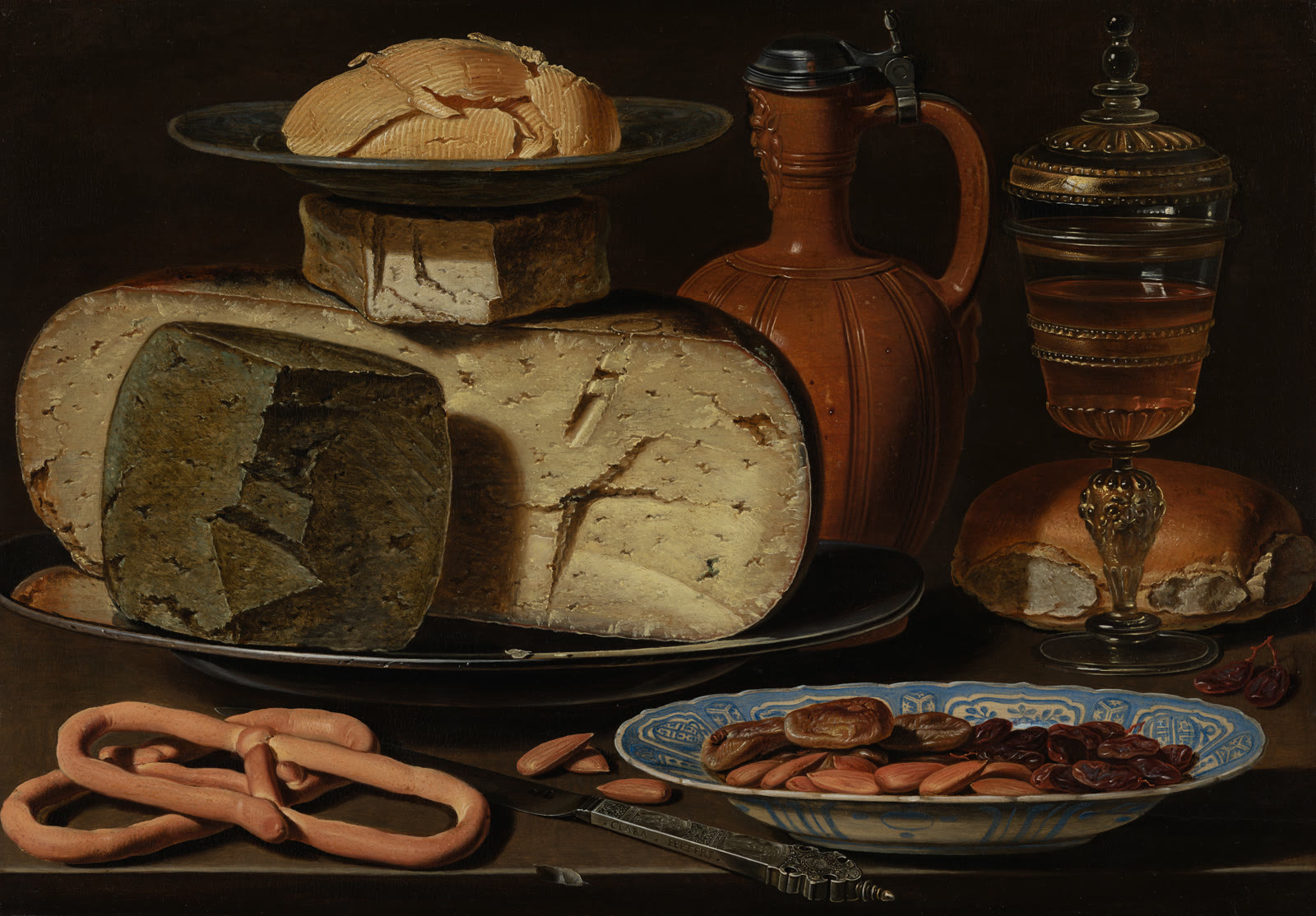
Image context: the hero image uses the Mauritshuis painting because it gathers Peeters's whole argument into one compact field. The bridal knife, the cheeses, the imported glass and porcelain, and the reflected face in the pewter lid all show that these paintings were never just inventories of things. They were instruments for turning things into evidence of authorship.[3][6]
Scarce documents, forceful surfaces
The archival record around Peeters is famously thin. The National Museum of Women in the Arts says definite details about her life remain scarce, though recent research points to a birth around 1587 in Mechelen and a marriage in 1605 to the painter Henrick II Peeters.[4] Her earliest dated oils, from 1607 and 1608, already show a level of finish that implies serious workshop training, and scholars have often linked her to Osias Beert in Antwerp.[4] That uncertainty matters, but it has also had one useful consequence. With Peeters, scholarship is pushed back toward the paintings themselves. They have to carry more of the biographical and professional argument than they do for many better-documented artists.
The Prado's artist page shows how much those objects can bear. It notes that nearly all of Peeters's works are still lifes and that her commitment to the genre reflected both the limits imposed on women artists and her own enterprising judgment.[1] When she began working in the first decade of the seventeenth century, still life was not yet the settled prestige field it would become later. Choosing it was not an act of retreat into a small corner. It was a wager on a form that was still expanding.
That is the first adjustment modern viewers need to make. Peeters did not pick a minor genre because she could not compete elsewhere. She recognized that the tabletop could become a laboratory of illusion, material intelligence, and market address. The paintings are small in scale compared with altarpieces or court portraits, but their ambition is not small at all.[1][4]
Still life was a professional lane, not a decorative afterthought
The still lifes Peeters developed are crowded with signals of value: gilt vessels, Venetian glass, Chinese porcelain, flower varieties, fish, game, cheeses, sweetmeats, and costly table tools.[2][3][4] NMWA notes that by 1612 she was producing painstakingly rendered still lifes full of precious objects and low-ledge arrangements set against dark grounds.[4] These are not neutral props. They stage a world in which wealth, trade, appetite, and visual sophistication are tightly bound together.
The Prado goes further by placing Peeters inside Antwerp's export economy.[1] Her paintings appear early in collections in the Northern Netherlands, Madrid, and later across Europe, suggesting that she cast a wide geographic net and may have circulated through dealers rather than only through local patronage.[1] That point changes the scale of the work. The table in a Peeters still life is not simply a private domestic surface. It is connected to shipping lanes, collector taste, and the movement of luxury goods and pictures alike.
This is one reason her pictures feel more public than the term "still life" sometimes allows. The imported vessels and foods are not there only to prove technical skill. They show that Peeters understood still life as a genre built to travel through a commercial world. The painting could move because the things inside it already belonged to a mobile economy of exchange, acquisition, and display.[1][3]
Reflection becomes a second signature
Peeters's boldest move was to turn those same objects into sites of self-assertion. The Prado's object page for Still Life with Flowers, a Silver-gilt Goblet, Dried Fruit, Sweetmeats, Bread sticks, Wine and a Pewter Pitcher states the point with unusual clarity: the artist painted her self-portrait three times in the gilt goblet and four times in the pewter jug.[2] The museum describes this abundance of signatures and reflected self-portraits as a form of assertion, perhaps sharpened by the fact that she was a woman working in a profession dominated by men.[2]
That phrase, "a form of assertion," is the hinge. The reflections are not cute hidden details for modern scavenger hunts. They are a declaration that the maker belongs inside the field of value she is depicting. Precious surfaces reflect her because she mastered them. The trick also lets her do two things at once. It advertises illusionistic bravura, and it inserts her body into a genre that otherwise threatens to disappear the artist behind things.[2]
The Mauritshuis painting sharpens the same logic in a slightly different key. On its object page, the museum notes that Peeters placed her full name on the silver bridal knife and painted herself in the pewter lid of the jug.[3] It calls the reflected portrait a "second signature," and that is exactly right.[3] The knife and the metal lid become twin authorizing devices: one textual, one optical. One says the name. The other proves the presence.
This is where Peeters stops looking merely ingenious and starts looking strategic. A bridal knife was already an object thick with social meaning, tied to marriage, household exchange, and display.[3] By signing it, Peeters folds that social meaning into artistic authorship. By reflecting herself nearby, she reinforces the point without having to interrupt the still-life fiction. The artist enters the picture not by breaking the genre but by inhabiting its brightest surfaces.
Why the banquet table feels larger than a meal
The Mauritshuis description of Still Life with Cheeses, Almonds and Pretzels is especially revealing because it attends to both symbolism and technique.[3] It notes the export value of cheese and butter in the early modern Netherlands, the minute rendering of damage and texture, and the way Peeters lavished attention on soft butter curls, glass reflections, and irregular surfaces.[3] That attention makes the picture feel economically thick. Value is not abstract. It is felt through material precision.
The same is true in the NGA's small copper painting of flowers, insects, and a snail, where a signature on the ledge and almost microscopic observational exactness turn a tiny format into a concentrated demonstration of control.[5] Even when the table gives way to a bouquet, Peeters keeps insisting on the same principle: painting is a matter of surfaces so exact that they seem to hold light, moisture, and touch in reserve.[5]
Taken together, these works show why Peeters matters beyond the usual "first woman still-life painter" shorthand. She understood that still life could carry scale without large size. It could stage trade without narrative anecdote. It could announce a maker without turning into an explicit self-portrait. And it could convert the supposedly secondary world of objects into a direct argument about who gets to sign, reflect, and circulate inside a professional art market.[1][2][3]
Why this profile holds now
Peeters remains compelling because her pictures keep the politics of authorship inside the pleasures of looking. They never collapse into slogans. They stay delicious, polished, and exact. Yet under that composure lies a clear professional logic. She used a genre associated with food, domesticity, and collectible luxury to make herself legible as an artist whose skill could not be absorbed back into the objects she painted.[2][3][4]
That is the real force of those tiny reflections. They say that the table has an owner, but the owner is not the banquet's host. It is the painter. And once that point comes into focus, Clara Peeters's still lifes stop looking like quiet side rooms in Baroque art. They start looking like some of the century's smartest arguments about how artistic identity can enter the marketplace without surrendering itself to it.[1][2][3]
Sources
- Museo Nacional del Prado, "Clara Peeters" - artist page on her still-life specialization, early collecting history, and place in Antwerp's export economy.
- Museo Nacional del Prado, "Still Life with Flowers, a Silver-gilt Goblet, Dried Fruit, Sweetmeats, Bread sticks, Wine and a Pewter Pitcher" - object page on the 1611 painting's multiple reflected self-portraits and illusionistic challenge.
- Mauritshuis, "Still Life with Cheeses, Almonds and Pretzels" - object page on the bridal knife signature, reflected self-portrait, and export-era meanings of the depicted goods.
- National Museum of Women in the Arts, "Clara Peeters" - artist profile on scarce biographical records, early dated oils, and the development of her still-life language.
- National Gallery of Art, "Still Life with Flowers Surrounded by Insects and a Snail" - object page on Peeters's signed copper flower painting and its detailed observational surfaces.
- Wikimedia Commons, "File: Clara Peeters - Still Life with Cheeses, Almonds and Pretzels - 1203 - Mauritshuis.jpg" - source file used for the article image.