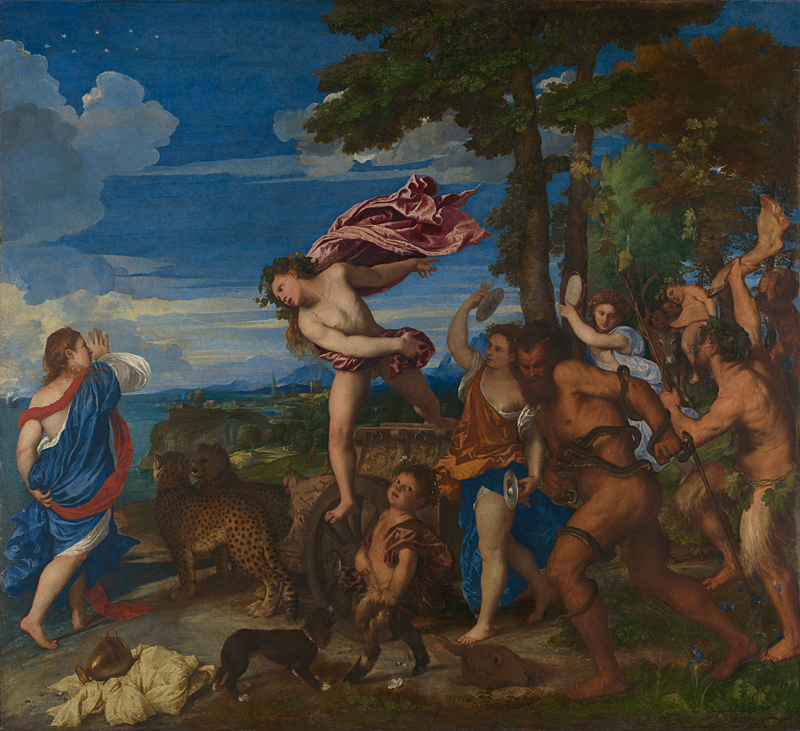
Titian's Bacchus and Ariadne is often introduced as a brilliant mythological spectacle: saturated Venetian color, exotic animals, drunk revellers, and one of the most famous love-at-first-sight scenes in Renaissance painting.[1][4] All of that is true, but it can blur the sharper fact that gives the picture its grip. The painting is organized around a violent change of direction. Ariadne is still inside one story, the story of abandonment, while Bacchus and his train crash in from another. Titian does not paint their union as a settled event. He paints the split second when one narrative has not yet ended and the next has already arrived.[1]
That timing matters because Ariadne has not finished looking after Theseus. On the National Gallery's account, the Cretan princess has been abandoned on Naxos, and the ship carrying her former lover is still visible in the distance at the lower left.[1] Bacchus, by contrast, does not approach cautiously or ceremonially. He leaps from his cheetah-drawn chariot so abruptly that the whole picture seems to hinge on the force of that jump.[1][4] What makes the scene unforgettable is that Titian lets both motions remain active at once: departure still in progress, arrival already irreversible.
Image context: the lead image uses the full painting because the article's argument depends on how the left, center, and upper-left of the composition speak to one another. Cropping out the sea would weaken abandonment; cropping out the stars would weaken the promise that transforms the scene from panic into myth.[1]
The ship is small because abandonment is already moving away
The first great decision in the painting is scale. Theseus's ship is tiny, almost easy to miss, yet it is essential.[1] Titian refuses to give the old relationship dramatic equality with the new one. He places it far out on the water, reduced to a hard fact rather than an emotional tableau. That choice changes the emotional temperature. We do not watch betrayal happen in close-up. We watch its consequence persist in Ariadne's body after the betrayer has nearly left the frame.
Her gesture keeps that older story alive. Ariadne's raised hand reads less like greeting than like the afterimage of protest, an instinctive motion toward what is already disappearing.[1][4] The body still belongs to loss. Smarthistory stresses that Titian constructs the painting through a diagonal surge from Bacchus and the revellers toward Ariadne, and that surge works precisely because she has not yet fully joined it.[4] She is caught between vectors: one hand and glance still tethered to the sea, the rest of the picture pulling her into a new mythological future.
This is why the blue robe matters so much. It isolates Ariadne against the brighter sky and sea, making her both legible and vulnerable.[1][2] The painting does not bury her inside the procession. It holds her apart long enough for the viewer to feel the threshold she occupies. She is still an abandoned woman on a cliff edge before she becomes Bacchus's immortal bride.
Bacchus enters as a leap, not a conversation
The second decisive move is Bacchus himself. The National Gallery's in-depth entry notes that Titian shows him suspended in mid-air in a way only rarely attempted by earlier artists.[1] That is not a flourish added on top of the story. It is the story's structural key. Bacchus does not persuade, reason, or gradually win entrance into the scene. He crosses distance by force of motion.
The leap turns desire into momentum. One leg is still near the chariot, the body pitches forward, the drapery flies back, and the god's gaze locks onto Ariadne with a kind of immediate recognition.[1][4] The picture therefore makes love look less like conversation than like interception. Titian catches the instant when Bacchus converts the air between them into an action. The scene is erotic, but it is also athletic and destabilizing. Ariadne's fear is not incidental. The National Gallery explicitly notes that she is initially afraid of him.[1]
That fear sharpens the painting by preventing it from becoming too smooth. The myth promises eventual transformation, but Titian does not skip the shock. He keeps Bacchus's entrance abrupt enough that the viewer experiences the event before resolving it into destiny. In that sense the painting is more exacting than a simple "happy ending" reading allows. It stages the future as an impact.
The procession turns the right side into pressure
Bacchus would not feel so sudden if the right side of the canvas were quiet. It is not quiet at all. The god arrives with a full bacchanalian train: satyrs, cymbals, tambourine, Silenus slumped on an ass, the child dragging a severed calf's head, and the snaking, striding bodies behind them.[1] These details are easy to treat as decorative mythological excess. In compositional terms, they do a more important job. They turn the entire right half of the picture into pressure.
The revellers do not simply accompany Bacchus. They make his appearance feel unstoppable. Smarthistory describes them as emerging in a diagonal that drives toward the foreground, and that thrust gives Bacchus his runway.[4] Even the grotesque details help. The dragging animal head, the lifted calf's leg, the barking dog, and the clashing instruments make this side of the painting tactile and noisy in the imagination.[1][4] Ariadne's zone, by contrast, is clearer, barer, more exposed. Titian sets private emotional shock against public mythic tumult.
Technical evidence strengthens that contrast rather than distracting from it. The National Gallery's 1978 conservation report notes Titian's lavish use of natural ultramarine and his habit of using colorful pigments at full strength, then intensifying selected areas with glazes.[2] The effect is not generalized richness. It is differentiation. The blue field around Ariadne and the sky's intensity help her hold visual authority against the crowded tumult pressing in from the right.
The stars make the future visible before the story catches up
The smallest but most consequential motif may be the ring of stars above Ariadne's head. The National Gallery's overview explains that Bacchus later throws her crown into the air, immortalising her as Corona Borealis, and Titian places that constellation in the painting before that transformation has taken place in narrative time.[1] This is a remarkable compression. The future has already appeared overhead while the human figure below is still reacting to abandonment.
That temporal overlap is the picture's deepest intelligence. Titian does not arrange the scene as a neat before-and-after sequence. He stacks times on top of one another. The past is sailing away at left. The present arrives from the right in a leap. The future is already glowing in the sky.[1][5] Once you see this, the painting stops being merely a vivid mythological anecdote. It becomes a machine for holding three moments in one image.
Britannica notes that the painting was made for Alfonso I d'Este's Camerino d'Alabastro in Ferrara as part of a series of bacchanals.[5] Commission context matters here because it explains why Titian does not treat classical story as scholarly illustration. He treats it as a room-scale event of luxury, movement, and sensual intelligence.[1][5] Yet the picture's real permanence lies not in courtly opulence alone. It lies in how accurately Titian understood the drama of reversal: the way one life can still be leaving even as another begins.
The painting remains so alive because nothing in it has fully settled. Ariadne has not yet calmed; Bacchus has not yet landed; the ship has not entirely vanished; the stars have already begun their promise.[1][4][5] Titian turns myth into a threshold image. He gives abandonment a visible exit, desire a visible trajectory, and immortality a visible sign, then binds them together in one of the most perfectly timed pictures of the Renaissance.
Sources
- National Gallery, London, "Titian | Bacchus and Ariadne | NG35" - collection entry and in-depth page with the painting's mythic narrative, commission context, constellation detail, dimensions, and description of Bacchus's leap.
- Arthur Lucas and Joyce Plesters, "Titian's 'Bacchus and Ariadne'," National Gallery Technical Bulletin 2 (1978) - conservation report on the 1967-69 cleaning, rolled-canvas damage, ultramarine, glazing, and paint structure.
- National Gallery, London, "Art in the Making: Bacchus and Ariadne" - conservation transcript on the cracked sky, thick amber varnish removed in the 1960s, and Titian's buttery handling of lead-tin yellow and white passages.
- Dr. Steven Zucker and Dr. Beth Harris, "Titian, Bacchus and Ariadne," Smarthistory - close-looking discussion of the diagonal thrust, bodily turning, and mythic encounter as a staged visual event.
- Encyclopaedia Britannica, "Bacchus and Ariadne" - overview of the painting's Ferrara commission and place within Titian's mythological cycle.