Louise Bourgeois is often introduced through biography first: Paris childhood, New York adulthood, feminism, trauma, spiders.[1] That route is familiar enough that a new profile built only around Maman and the Cells risks repeating the same architecture of unease. The sharper late-career question is what happened when Bourgeois moved from doors, cages, stairs, and monumental bronze toward cloth: old dresses, slips, handkerchiefs, printed bedspreads, stitched heads, and textile books that made memory tactile rather than merely spatial.[5][7]
This article therefore treats the spider and the Cells as context, not destination. Bourgeois had already shown that autobiography could become architecture. In the late fabric works, she pushed the same problem into a softer and more unstable material field. Cloth could be cut, saved, folded, worn thin, sewn back together, or deliberately left with seams exposed. Repair became a method rather than a comforting metaphor.[5][7]
That shift changes the pressure of the work. The giant spider Maman looks monumental and civic, while the Cells make memory into rooms one peers into under constraint. The fabric pieces return to the wardrobe, the bed, and the hand, but they do not become smaller in ambition. They ask what remains of a life when its most ordinary materials have absorbed touch for decades and then re-enter art as fragments, skins, witnesses, and tools.[3][4][5]
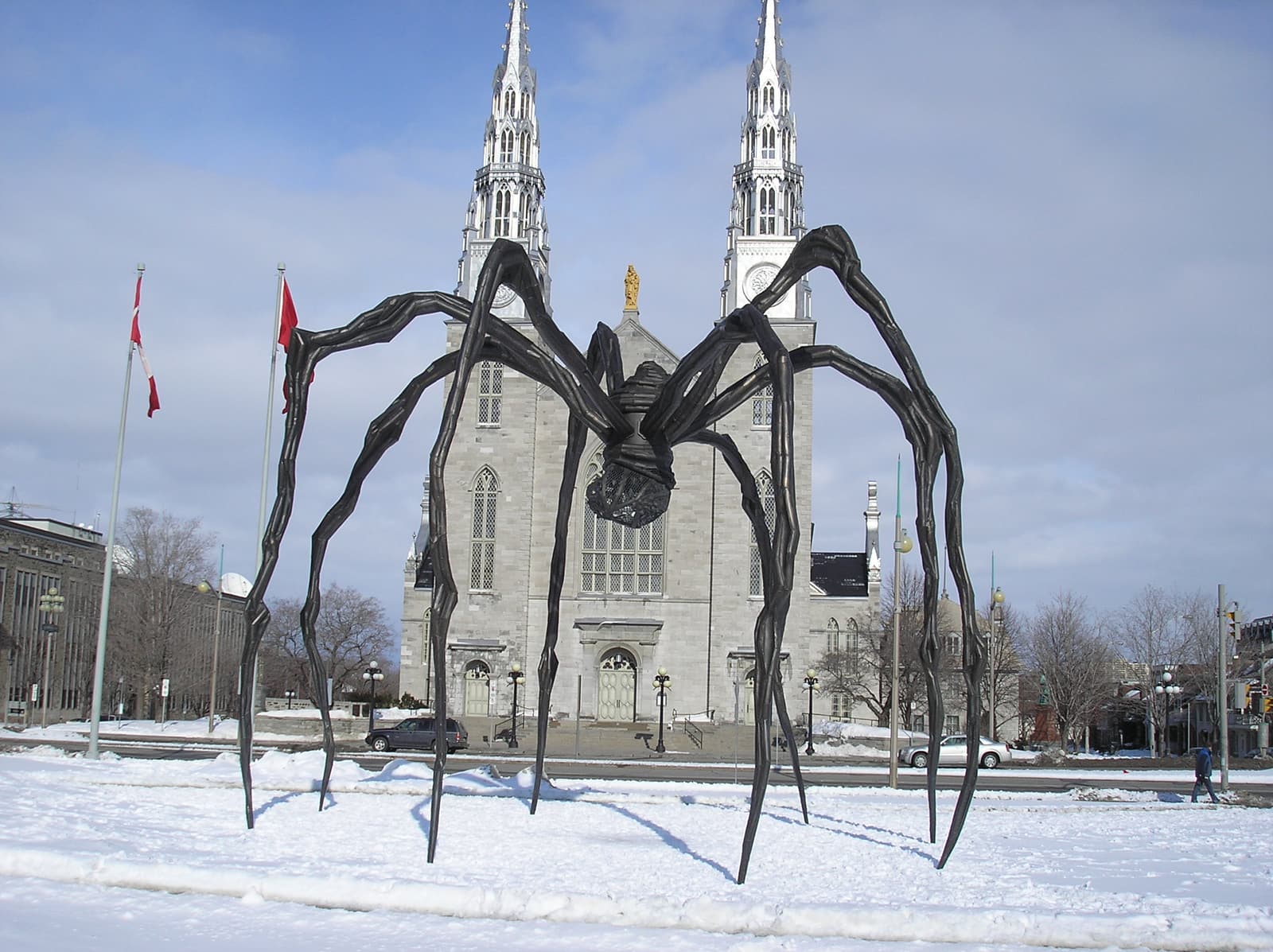
Image context: this article uses a real 2007 photograph of Maman in Ottawa as a bridge into the fabric works rather than as the article's endpoint. The sculpture stands in the open, yet its meaning stays tied to childhood, weaving, motherhood, shelter, and fear. The late cloth works bring that public-private tension back down to the scale of saved garments and stitched surfaces.[4][6]
She began by making absence stand up
One useful way into Bourgeois is to start before the spiders. The National Gallery of Canada's exhibition writing on her early work describes the Personages of 1949-50 as totemic wooden figures tied to the friends and family she left behind when she moved from Paris to New York in 1938.[2] That detail matters because it shows how early she found her central move. Separation becomes sculpture, not diary. Homesickness becomes vertical form.
The same Canadian text makes a second point that helps the whole career click into place: architecture remained important to her because buildings helped structure life and emotion.[2] That line explains why Bourgeois cannot be reduced to expressive symbolism alone. Even when a figure stands in for a person, it also behaves like a skyline, a post, a boundary marker. Memory in her work is never just content. It is arrangement.
That is part of what kept Bourgeois out of neat stylistic boxes. MoMA's artist page places her at the intersection of sculpture, installation, organic form, and feminist art.[1] Those labels are accurate, but they matter less than the continuity underneath them. From early carved figures onward, she was already treating bodies and spaces as interchangeable carriers of feeling. A person could become a column. A room could become a wound. A spider could become a mother without ever becoming merely illustrative.[1][2][4]
The Cells are where autobiography becomes architecture
If one series defines Bourgeois's mature achievement, it is the Cells. Guggenheim Bilbao's educational essay on Cell II describes the series as enclosed architectural spaces filled with made and found objects, some dear to the artist and some gathered from the street.[3] The same page notes two facts that are crucial for understanding the work: Bourgeois moved from her Chelsea house to a much larger studio in a converted Brooklyn garment factory in the early 1980s, and the expanded space let her scale up into these room-like installations.[3]
That change in workspace was not a simple practical upgrade. It enabled a sharper artistic proposition. Bourgeois herself said she wanted to create her own architecture rather than depend on the museum's space.[3] That sentence is the hinge of the profile. The Cells are not sculptures placed in rooms. They are rooms turned into sculpture. The viewer is made to peer in, move around, or feel excluded. Seeing becomes bodily and slightly compromised.
Cell II makes the point with special clarity. Guggenheim describes a small chamber framed by hinged doors, containing perfume bottles and a pair of clenched marble hands.[3] The specific objects matter, but the deeper point is the relation among them. Bourgeois does not stage memory as a clean recovered scene. She stages it as access under pressure. Mirrors, doors, cages, thresholds, and containers keep returning because recollection in her work is never neutral. It is always mixed with voyeurism, shame, protection, and the wish to control distance.[3]
The National Gallery of Canada's Bourgeois essay extends that logic to late work when it describes Cell (The Last Climb) as built around the spiral staircase from her Brooklyn studio and stresses her habit of remaking forms across decades.[2] That repetition is not an anecdotal quirk. It is the engine of the work. Bourgeois kept remaking certain shapes because she did not believe memory was solved once expressed. It had to be done, undone, and done again.[2]
Maman is not a mascot; it is a theory of care under threat
Because Maman is so famous, it is easy to let it harden into brand identity. The National Gallery of Canada's object page pushes against that flattening. It links the spider directly to Bourgeois's childhood in her parents' tapestry restoration workshop and says the work was inspired by her mother.[4] That connection matters because it keeps the sculpture from reading as pure menace. The spider is associated with weaving, maintenance, fertility, refuge, and home as much as with fear.[4]
That doubleness is exactly what gives the sculpture its hold. Bourgeois does not ask us to choose between tenderness and terror. She fuses them. The giant body arches overhead protectively and ominously at the same time. The eggs make the work maternal, but the scale makes it nearly predatory. The result is not symbolic balance in the polite sense. It is a demonstration that care itself can feel immense, sheltering, and frightening all at once.[4]
This is why Maman belongs in the same argument as the Cells. Both produce feeling through enclosure and exposure. One locks memory inside small chambers. The other throws it into public space at architectural scale. But the emotional contract is similar. You are brought close to something intimate while being reminded that it exceeds your control.[3][4][6]
Late fabric works show repair as both method and material
Bourgeois's later fabric pieces make this system even clearer because they bring the language of mending to the surface. MoMA's Fabric Works page traces that material back to her childhood in the family tapestry restoration business and explains that she associated sewing with symbolic repair.[5] In the 1990s, fabric moved from background memory to sculptural medium: old dresses, slips, nightwear, and handkerchiefs were cut, hung, printed on, or reassembled into figures and books.[5]
The medium change matters because it makes time palpable. Cloth carries wear differently from bronze or marble. It keeps folds, frays, softness, domestic scale, and bodily contact. MoMA's audio note on Self Portrait adds that Bourgeois had saved many clothes across her life because she felt they were her past, then began cutting them up into artworks so they would not be thrown away.[7] That is one of the clearest statements of her whole career. The point was not preservation as nostalgia. It was transformation as survival.
In that sense, the late fabric works are not a gentle coda to the harsher sculpture. They are the same argument in another register.[5][7] The Cells build psychic rooms out of doors, cages, mirrors, and stairs. The fabric works build psychic rooms out of clothing and touch. Both ask what it means to live with a past that cannot be discarded and therefore has to be materially reworked.
That is why the late fabric works deserve their own route through Bourgeois rather than a closing footnote in another spider profile. They show the same intelligence under different material laws. Bronze and rooms made memory architectural enough to enter, circle, and fear. Cloth made memory intimate enough to cut, touch, wear, save, and reassemble. In that late textile afterlife, repair is neither consolation nor decoration. It is the work's operating procedure.[2][3][4][5][7]
Sources
- The Museum of Modern Art, "Louise Bourgeois" - artist page with core biographical data and collection context.
- Becky Rynor, "Do, Undo, Redo: The mantra of a monolithic artist," National Gallery of Canada Magazine - exhibition essay on the Personages, architecture, material range, and the recurring logic of the Cells.
- Guggenheim Museum Bilbao, "Cell II" - official educational page on the Cells, Bourgeois's move to a larger Brooklyn studio, and her aim to create her own architecture.
- National Gallery of Canada, "Maman" - official object page connecting the spider to Bourgeois's mother and her parents' tapestry restoration workshop.
- The Museum of Modern Art, "Fabric Works" - thematic page on sewing as symbolic repair and the rise of fabric as a sculptural medium in Bourgeois's later work.
- Wikimedia Commons, "File:Maman in front of NGofC.JPG" - source page for the 2007 Ottawa photograph used as the article image.
- The Museum of Modern Art, "Louise Bourgeois. Self Portrait. 2007" - exhibition audio note on Bourgeois's late use of saved clothing and fabric printing.