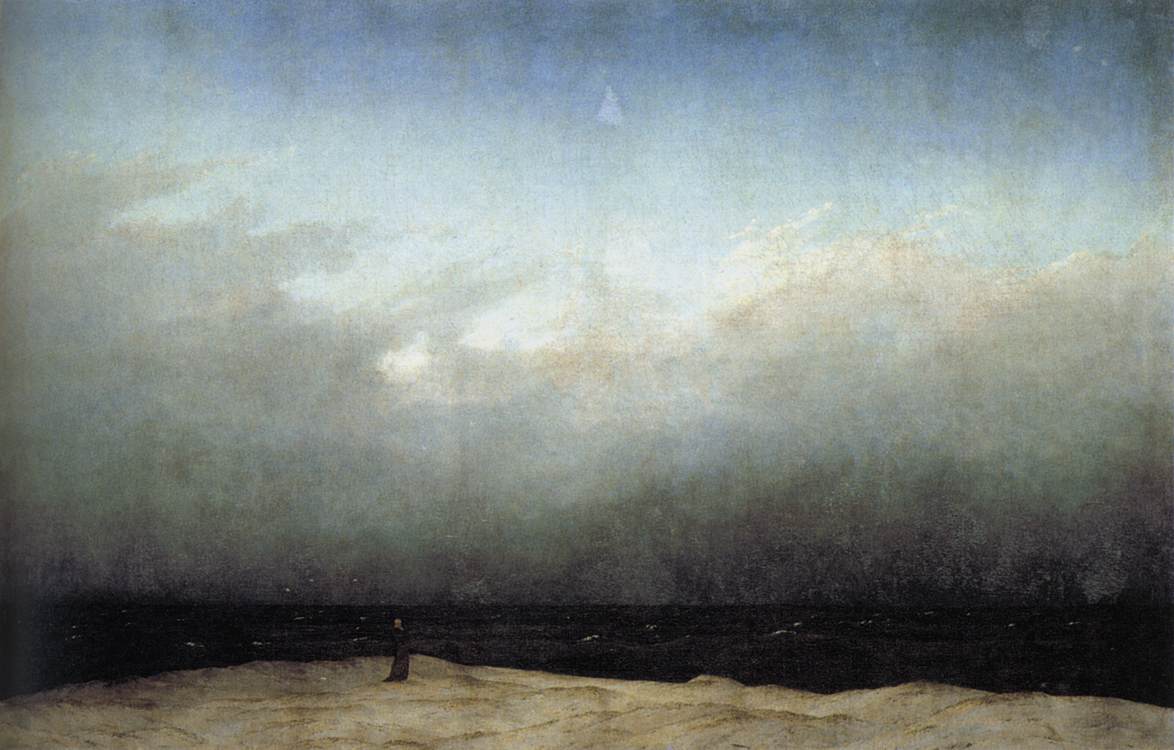
There are more dramatic seascapes than Caspar David Friedrich's Monk by the Sea. There is no storm, no wreck, no heroic gesture, and almost nothing that counts as incident. What makes the painting radical is that Friedrich keeps removing the usual aids by which a viewer settles into a landscape.[1][3][5] A narrow strip of dune, a dark band of water, an enormous sky, and one tiny figure from behind are asked to do nearly all the work. First shown in Berlin in 1810 and purchased together with Abbey in the Oakwood by the Prussian crown, the painting quickly became a testing ground for how much meaning a stripped landscape could bear.[3][4][5]
That is the strongest way to read it now: not as a vague Romantic loneliness machine, but as a painting built through disciplined subtraction.[1][2][3] The recent technical work from the Alte Nationalgalerie matters because it shows that the emptiness was not a naive first thought. Friedrich drew more than he finally showed. Infrared reflectography revealed ships in the underdrawing that he chose not to realize in paint.[2] Restoration also showed how fragile the surface was from the beginning: fine primed canvas, several ground layers, and paint often applied in one or two extremely thin layers.[1][2] The void in Monk by the Sea is therefore not a blank. It is a made decision, revised and materially defended.
Image context: the lead image is a Wikimedia Commons file-page reproduction of the painting itself. That is the only image that makes sense here, because the argument turns on Friedrich's exact visual reductions on the final surface rather than on a portrait of the artist or a later exhibition photograph.[6]
1) The horizon is lowered until the sky starts behaving like pressure
The most important formal fact is not the monk. It is the distribution of space. The painting is built from broad horizontal zones, with the shoreline and sea kept low enough that the sky takes over the canvas.[4][6] The Wikimedia Commons file description, drawing on long-standing object commentary, notes that roughly five-sixths of the surface is given to the cloudy sky, while the monk becomes the only decisive vertical element in the picture.[6] That imbalance changes the mood before interpretation even begins.
Many landscapes invite the eye to travel inward through paths, trees, architecture, or receding planes. Monk by the Sea does almost none of that.[6] The beach is thin. The water is a band, not a route. The horizon sits so low and the transitions are so reduced that the picture stops behaving like a panorama and starts behaving like a threshold. The Met's recent presentation of the work puts the effect well at a descriptive level: beach, monk, water, then enormous sky, with the horizon nearly dissolving into the atmosphere.[5] The scene does not open generously. It presses outward toward what cannot be measured.
This is one reason the work still feels more modern than many busier Romantic pictures. Friedrich is not piling up the sublime through spectacular effects. He is arriving there by reduction. The painting withholds furniture, incident, and scenic variety until scale itself becomes the event.
2) The withheld ships are the decision that makes the painting severe
The technical sources make the next step impossible to ignore. Under the visible surface, Monk by the Sea once contained ships.[2] The Alte Nationalgalerie's 2024 exhibition texts describe three highly detailed ships in the underdrawing, later omitted from the final paint layer, and interpret that choice as an early example of Friedrich's strategy of emptying, simplifying, and focusing.[2] That finding does more than add a conservation curiosity. It clarifies the whole picture.
With ships present, the monk would be looking at something legible: travel, commerce, distance, weather, human activity. Without them, the painting becomes harsher and stranger. The figure is no longer attached to narrative expectation. He is not waiting for arrival, scanning traffic, or standing in a picturesque coastal scene. He is set before horizon and atmosphere almost by themselves.[2][5][6]
This is also where Heinrich von Kleist's famous response matters.[3] The 2006 Alte Nationalgalerie exhibition on Sentiments upon Viewing Friedrich's Seascape places the painting in the context of the 1810 Berliner Abendblätter text that Kleist reworked from comments by Clemens Brentano and Achim von Arnim.[3] The important point is not simply that the work attracted literary attention. It is that the painting forced language into a new register. The near-emptiness was already being experienced as conceptually difficult in its own moment. Friedrich had taken away enough visual guidance that viewers had to confront the act of looking itself.
3) The monk is tiny, but he is not incidental
Because the painting is so reduced, the figure matters with unusual precision. The monk is not there to provide anecdote or costume charm. He is the measure by which the whole painting becomes human.[3][6] The 2024 exhibition texts from Berlin summarize the classic reading cleanly: the small figure in the almost empty, boundless landscape came to signify man's solitude and lostness before nature's infinity.[2] That remains persuasive, but it needs one adjustment. The monk is not only a symbol of smallness. He is also a device for scale.
Without the figure, the painting might dissolve into near-abstraction: horizontal bands, atmosphere, tone. With the figure, the viewer can feel the exact disproportion between a body and what exceeds it.[4][6] Friedrich keeps the monk near the bottom edge and does not let him dominate even locally. The figure interrupts the bands just enough to anchor identification, then immediately yields back to the field around him.
That is why the pairing with Abbey in the Oakwood is so important.[2][4] Berlin's exhibition texts present the two paintings as a deliberate pair from Friedrich's breakthrough moment in 1810, linking Monk by the Sea to a broader question about where human beings stand between knowledge and faith in the face of death.[2] Read beside that companion, the monk is neither a tourist nor a decorative witness. He is the minimal human term in a painting about limit.
4) Restoration proves that this emptiness is materially exacting
One trap with Monk by the Sea is to imagine its austerity as easy. The restoration record says the opposite.[1][2] The Alte Nationalgalerie's conservation project describes both Monk by the Sea and Abbey in the Oakwood as paintings on very fine primed canvas with several ground layers and extremely thin paint application, which made them unusually prone to damage from the start.[1] By 1900 their condition had already deteriorated heavily, and later restoration campaigns added discolored retouching, overpainting, and varnish that obscured the original appearance.[1]
The 2017 publication note on the restoration is especially useful because it explains what the cleanup changed for viewers.[2] Removing overpaint and discolored varnish simplified the compositional structure, uncovered original paintwork, and restored blue values that had become difficult to see.[2] In other words, the picture's famous emptiness was not merely cleaned. It was made legible again.
That matters for criticism because Friedrich's reduction is exact, not generic. The painting depends on fine differences between sea, sky, shore, and figure. If the blue tonal structure is muddied or the surface is clogged, the whole argument gets blunter.[1][2] The void works only because Friedrich was careful. The more the painting removes, the more each remaining interval has to hold.
That is why Monk by the Sea lasts. It does not overwhelm the viewer with abundance. It unsettles by refusing abundance and then refusing the small narrative consolations that abundance usually carries.[2][3][5] The painting takes away ships, depth cues, anecdote, and scenic variety until one human figure stands before a field that seems almost beyond pictorial grasp. Its force lies there, in the severity of the choice. Friedrich did not simply paint solitude. He built a picture in which solitude becomes the only scale left.
Sources
- Staatliche Museen zu Berlin, "Caspar David Friedrich Project: Monk by the Sea and The Abbey in the Oakwood: technical analysis, conservation, restoration" - project page on the paintings' fragile canvas and paint structure, damage history, and 2013-2016 restoration work.
- Staatliche Museen zu Berlin, "New publication on the restoration of Caspar David Friedrich's Monk by the Sea and Abbey in the Oakwood" - restoration summary on infrared reflectography, imaging methods, varnish removal, and recovered blue tonal values.
- Staatliche Museen zu Berlin, "Sentiments upon Viewing Friedrich's Seascape" - exhibition page on the 1810 Berliner Abendblätter response by Heinrich von Kleist, Clemens Brentano, and Achim von Arnim.
- Staatliche Museen zu Berlin, Caspar David Friedrich: Infinite Landscapes exhibition texts (2024 PDF) - notes on Friedrich's paired paintings, the 1810 Berlin breakthrough, the monk as a figure of solitude, and the omitted ships in the underdrawing.
- The Metropolitan Museum of Art, "Monk by the Sea" - object page and exhibition presentation with date, dimensions, and curatorial commentary on the low horizon and erased ships.
- Wikimedia Commons, "File:Caspar David Friedrich - Monk by the Sea.jpg" - file page for the artwork reproduction used to prepare the article image, including dimensions and long-form object description.