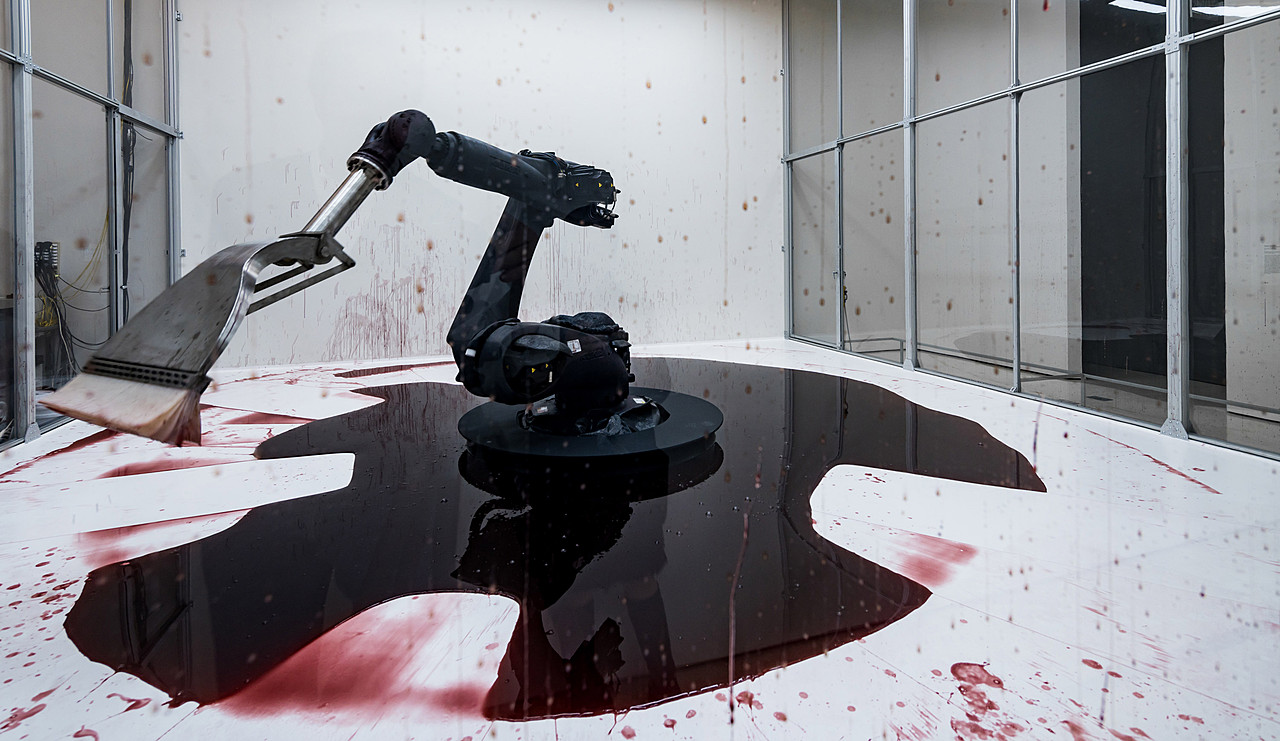
Sun Yuan & Peng Yu’s Can’t Help Myself now circulates online as the "sad robot" artwork: a machine endlessly scraping red liquid while viewers project exhaustion, entrapment, and emotional breakdown onto its movements.[5] That reading is understandable, but it is incomplete in exactly the way the work predicts.
This 2016 installation was not built as a generalized allegory of burnout. It was commissioned for the Guggenheim’s Tales of Our Time, an exhibition organized around geography, nation-state, territory, and boundaries.[1][3][4] The piece’s real engine is more specific and more unsettling: it stages border control as choreography, then lets spectators discover that enforcement systems can look strangely vulnerable once they are given a body.
Image context: the hero image shows the actual installation—robot arm, transparent enclosure, and red liquid field—because the article’s argument depends on the work’s full control-zone geometry rather than on the robot arm as an isolated object.[1][6]
1) The work is built like a control system before it reads like a character
The Guggenheim’s collection record is unusually precise about the medium: a Kuka industrial robot, stainless steel and rubber, cellulose ether in colored water, a lighting grid with Cognex visual-recognition sensors, and a polycarbonate wall with aluminum frame.[1] That matters because the work’s emotional power does not come from anthropomorphism alone. It comes from the fact that the machine is visibly part of a sensing-and-response loop.
The Guggenheim conservation identity report adds scale that short wall labels usually omit: a raised platform of about 7m × 7m, roughly 48 gallons of viscous red liquid, and a ceiling grid with 4 Cognex industrial cameras feeding the visual-recognition system.[7] Those numbers make the piece read less like theatrical effect and more like operational territorial maintenance.
Placed behind clear walls, the robot has one duty: keep a dark-red liquid within a predetermined area.[1][2] When ceiling-mounted sensors detect that the fluid has moved beyond the invisible boundary, the arm drags it back inward.[2] In other words, the basic grammar of the piece is territorial. Before it is tragic, it is juridical.
That is why the installation feels so contemporary. The work does not merely show a robot in distress. It shows a machine assigned to monitor drift, detect breach, and restore containment.
2) The human-like gestures are not decoration; they are the trap
What makes Can’t Help Myself hard to shake is that the robot does not move like neutral factory hardware for long. The artists modified the arm with a custom shovel and programmed 32 movements, some with names such as “scratch an itch” and “bow and shake.”[1][2] Once it temporarily regains control over the spreading liquid, it begins to perform these strange gestures, which make the machine appear to hesitate, preen, panic, or show off.[2]
That design is the work’s masterstroke. Sun Yuan said elsewhere that mechanical devices have increasingly entered human life and even human bodies; in the Guggenheim teaching materials, the artists’ agent logic is made explicit: the robot becomes a stand-in for will, with a level of endurance no human performer can match.[2] The result is not simply "a robot that seems alive." It is a control device given just enough behavioral excess to trigger sympathy.
The sympathy is real. But it is produced by programming, not discovered beneath it.
3) The red liquid is less a symbol of damage than a test of perimeter governance
Viewers often remember the red fluid as theatrical blood. The Guggenheim’s own educational and audio materials make the framing more exact. The liquid does invite violent association, but the piece’s curatorial interpretation ties those associations to migration, border crossing, surveillance culture, and the machinery of territory.[2][3]
In the audio guide, cocurator Xiaoyu Weng explicitly connects the work to "illegal immigration and border crossing," adding that border infrastructures are not merely walls but "invisible battlefields."[3] On the exhibition page, Tales of Our Time is framed around artists examining hometowns, remote borderlands, islands, territory, and national boundaries as unstable constructs.[4]
Seen through that lens, the red material does not function mainly as atmosphere. It is the thing the system must continually classify as either inside or outside. The work becomes powerful because the boundary is invisible but relentlessly enforceable. The robot is not cleaning up a spill. It is policing a zone.
4) The cage changes who looks trapped
The polycarbonate enclosure is one of the piece’s smartest physical decisions. Teaching materials for the work emphasize that viewers gather outside the transparent walls and watch the machine inside, creating a moral question: who is more vulnerable, the human who built the machine or the machine controlled by a human?[1][2]
That question works because the installation distributes captivity in two directions at once.
The robot is visibly confined, reduced to repetitive labor in a boxed arena. Yet it is also the only active agent empowered to decide whether the red mass has crossed the line. It is simultaneously prisoner and guard, spectacle and enforcer. For viewers, that split produces the eerie feeling that the machine is trapped by the very logic it must maintain.
This is where the work leaves conventional robot pathos behind. The installation is not moving because the machine looks "almost human." It is moving because the machine has inherited one of modern politics’ ugliest jobs and cannot stop performing it.
5) The internet’s sentimental afterlife misses the point and proves it
By 2022, videos of the installation had spread widely across TikTok and Twitter, where users treated it as a portrait of depression, trauma, or overwork.[5] ARTnews documented both the emotional identification and the corrective backlash: some viewers insisted the piece was about "robot sadness," while others pushed back that it concerned automated surveillance and border control instead.[5]
The official Guggenheim framing leaves little doubt that territory and surveillance are central to the piece.[1][2][3][4] So the viral "sad robot" reading is a misreading in one clear sense.
But it is also revealing. Contemporary viewers reach for burnout language because the work’s enforcement loop now resembles ordinary life under dashboards, alerts, moderation queues, exception handling, and always-on monitoring. The robot’s repetitive gestures feel intimate to people whose own work consists of keeping unstable systems within tolerance bands.
That does not replace the border reading. It shows how fully border logic has leaked into everyday labor aesthetics.
Short-form video also helps this sentimental reading travel. Most viral clips frame the robot arm and the red liquid tightly enough that the transparent enclosure starts to disappear as structure and survive only as background glare. Once that control-zone geometry drops out, viewers are left with a quasi-performer looping expressive gestures in a red field. The crop does not invent the emotion, but it does remove part of the jurisdiction diagram that tells you what the emotion is attached to.[5][6]
A useful way to watch the piece again is in three passes: first track the enclosure, then the sensor-and-boundary logic, and only after that watch the gestures that appear once the liquid is briefly re-contained. That viewing order restores the political geometry that viral clips flatten.
6) Why Can’t Help Myself still lands in 2026
The work remains sharp because it binds together four things that are too often discussed separately.
- Computer vision as a way of defining acceptable space.[1]
- Automation as endless maintenance rather than triumphant efficiency.[1][2]
- Territory as an invisible rule set that must be repeatedly enforced.[3][4]
- Empathy as something viewers can extend even to the machine running the system.[5]
That combination explains the installation’s strange afterlife. People do not keep returning to it because it predicts a generic AI future. They return because it shows a more exact condition: control systems now operate through bodies, gestures, interfaces, and spectatorship. The machine looks exhausted because perpetual containment is exhausting work, even when the worker is mechanical.
So yes, Can’t Help Myself became the internet’s saddest robot. But that is not the piece’s sentimental core. It is the evidence. Sun Yuan & Peng Yu built an artwork in which a border-control machine becomes legible as a suffering performer. Once that translation happens, the real discomfort begins: the viewer has to ask whether the machine looks humanized, or whether human life has started to look more and more like the machine.
Sources
- Solomon R. Guggenheim Museum, Sun Yuan and Peng Yu | Can't Help Myself (collection record, medium, commission framing, vulnerability question)
- Solomon R. Guggenheim Museum, Teaching Modern and Contemporary Asian Art: Sun Yuan & Peng Yu (territory/boundary prompt, 32 programmed movements, enclosure logic)
- Solomon R. Guggenheim Museum, Can’t Help Myself by Sun Yuan & Peng Yu (audio-guide transcript with Xiaoyu Weng on surveillance, border crossing, and territory)
- Solomon R. Guggenheim Museum, Tales of Our Time (exhibition framework on geography, nation-state, and boundaries)
- ARTnews, Alex Greenberger, ‘Me Watching Y’all Cry Over a Robot Scooping Red Paint’: Sun Yuan and Peng Yu Installation Becomes Bizarre Viral Hit on Social Media (viral afterlife, misreadings, Venice context)
- Guggenheim image asset used for article visual reference (installation image URL surfaced via official page metadata)
- Guggenheim Conservation Department, Identity Report Computer-based Artwork: Can't Help Myself (technical layout, volumes, camera grid)