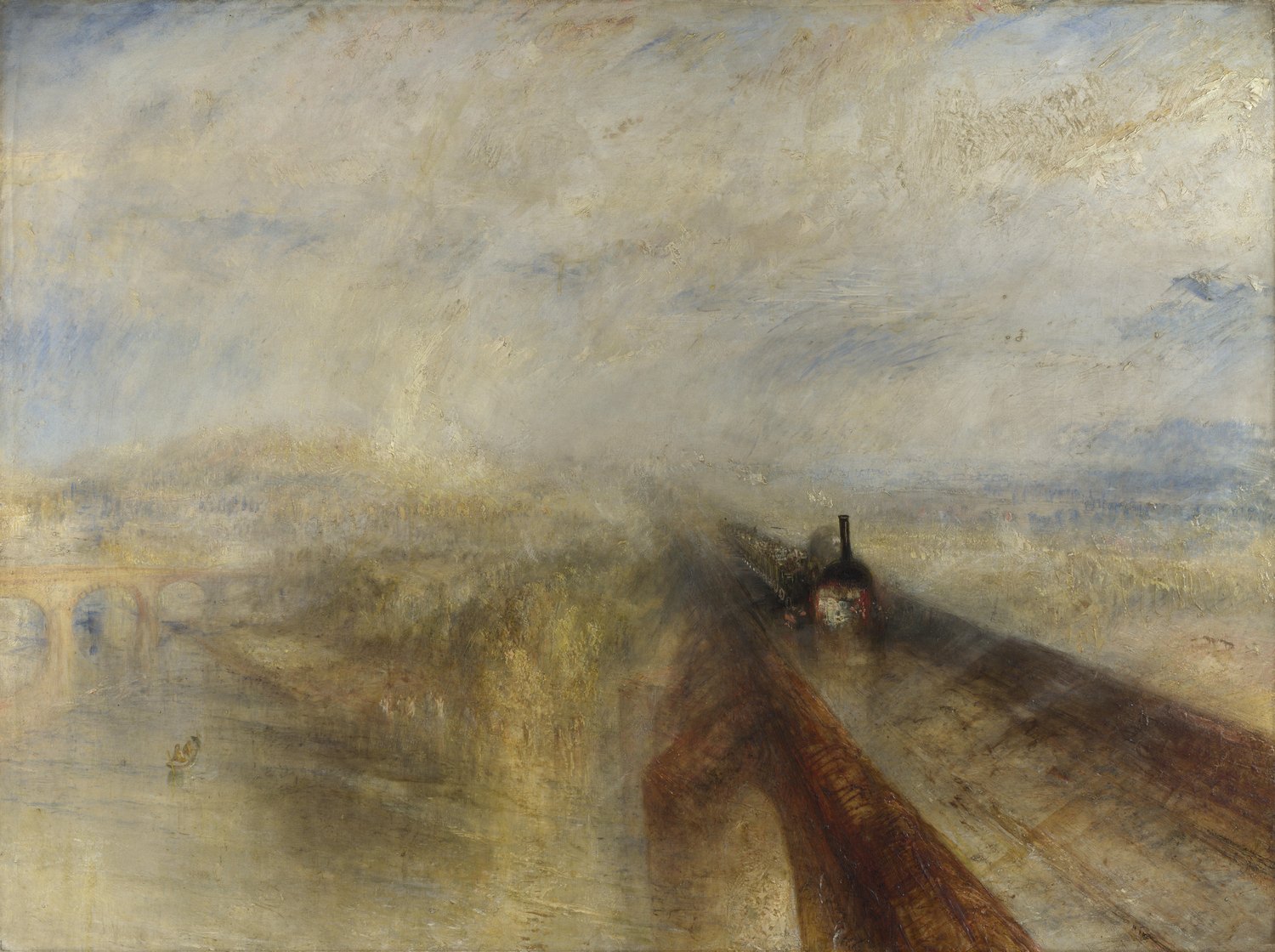
J. M. W. Turner’s Rain, Steam and Speed – The Great Western Railway is often introduced as “the train painting,” which is accurate in the most literal sense and misleading in the most important one. The locomotive is present, but Turner refuses to give it the clean mechanical clarity a viewer expects. What arrives instead is a picture where speed is not drawn as engineering first. It is drawn as atmosphere.[1][2]
That choice is why the painting still feels modern. Turner does not stage the railway as a neat victory over nature, and he does not sentimentalize nature as a pure victim of industry. He mixes bridge, weather, smoke, river light, and animal life into one unstable visual field, then asks the viewer to feel modern acceleration before fully parsing it.[1][3][4]
The National Gallery’s catalog entry gives the work a compact factual spine that helps the close reading stay grounded: 1844, oil on canvas, a Great Western Railway train crossing Maidenhead Railway Bridge, with the small hare detail still noted even if it is now harder to see than in Turner’s day.[1] The remarkable thing is how little Turner lets those facts harden into a tidy engineering picture. He keeps the metadata legible while making the sensation unstable.
The bridge is a funnel for looking
The most disciplined structure in the painting is Brunel’s Maidenhead Railway Bridge, completed in 1839 and already famous for its unusually broad brick arches.[1][5] Turner uses that architecture less as civil-engineering documentation than as a perspective machine. The long diagonal of the viaduct narrows hard into distance, so the eye is pulled forward before it has time to settle.
This matters because the bridge imposes order at the exact moment the rest of the image starts dissolving. The arches are there, the track is there, the direction of travel is legible—yet none of that feels stable for long. Turner lets the built world provide the minimum amount of structure needed for the weather to become dramatic without becoming abstract.
The train is powerful because it is barely visible
The locomotive sits at the center, but it is not presented like a polished machine portrait. It pushes through haze as a dark wedge with a bright front and trailing steam, more apparition than diagram.[1][2] That decision is the opposite of descriptive bravura. Turner withholds informational neatness in order to amplify bodily force.
You do not read the train by counting parts. You read it by feeling how quickly it seems to break through the painted surface. The front of the engine carries the picture’s greatest pressure, while the surrounding rain and vapor keep softening edges that should, in a technical illustration, remain crisp. Modern technology appears here as something half formed in vision: undeniable, but not yet fully containable.
Rain, steam, and sunlight are deliberately confused
The painting’s title names three conditions—rain, steam, speed—but the crucial move is that Turner makes the first two hard to separate. Moisture in the sky, vapor from the engine, and atmospheric haze over the river all bleed into each other.[1][2] The result is not just dramatic weather. It is a collapse of categories.
That collapse gives the picture its peculiar charge. The train is a machine, but it does not sit outside the landscape as a clean industrial object. It enters the same fluid system as rain and light. Turner’s late handling—broad strokes, smeared passages, and areas where form is drawn out of color rather than enclosed by line—lets the viewer experience industry as a condition of the air.[2][3]
This is one reason the work keeps escaping simple ideological labels. It is too exhilarated to be a pure lament, too unstable to be a clean hymn to progress.
The hare is the painting’s hidden counterweight
The National Gallery notes that Turner painted a hare along the track, once more visible than it is now, and tied it to an older measure of natural speed.[1] That detail matters far beyond anecdote. The hare gives the picture a second velocity system.
On one level, the comparison is obvious: animal swiftness versus mechanized transport. On another, it is more unsettling. The hare is so easy to miss that it behaves like a vanishing memory of pre-industrial tempo. The train does not merely outrun it; modernity almost erases the terms by which the older world would register the contest.
That is an extraordinary decision for a painting that otherwise seems to rush forward. Turner inserts a small, fragile rival measure of life and lets it hover at the edge of disappearance.
Why the picture still feels ahead of its time
Romanticism often turned to storms, mountains, shipwrecks, and other sublime situations where human control visibly thins.[3][4] Turner keeps that sublime pressure, but relocates it inside infrastructure. The frightening thing is no longer only the sea or the sky. It is the new speed with which engineered systems enter ordinary perception.
That is why Rain, Steam and Speed still feels fresher than many later industrial images. It does not reduce the railway to an emblem with one moral caption attached. It shows modern motion as a sensory problem first: how do you see something that is changing the scale, tempo, and texture of the world while it is still arriving?
Turner’s answer is brilliant precisely because it remains unresolved. The bridge holds. The train comes on. The rain keeps swallowing edges. And the whole painting trembles between recognition and blur, which is to say between old seeing and modern seeing.
60-second viewing drill (for first-time readers)
Try this sequence in front of the image:
- Lock onto the bridge first: use the arches as your stability anchor so you can feel exactly when the rest of the image starts to dissolve.
- Find the train by pressure, not outline: track where the forward force is strongest before you identify mechanical details.
- Hunt the hare last: when you notice how easy it is to miss, the painting’s second speed system clicks into place.
Sources
- The National Gallery, Rain, Steam, and Speed - The Great Western Railway (collection entry, work description, bridge and hare details)
- Wikipedia, Rain, Steam and Speed – The Great Western Railway (work metadata, compositional details, painting description)
- Encyclopædia Britannica, J.M.W. Turner (artist context, late style, atmosphere and color emphasis)
- The Metropolitan Museum of Art, Heilbrunn Timeline Essay, Romanticism (Romantic sublime and landscape context)
- Wikipedia, Maidenhead Railway Bridge (bridge location, Brunel attribution, completion/opening timeline)
- Tate, Sublime (Burkean sublime definition relevant to Turner’s weather-and-force context)
- Wikimedia Commons file record, Turner - Rain, Steam and Speed - National Gallery file.jpg (image record and technical caption)