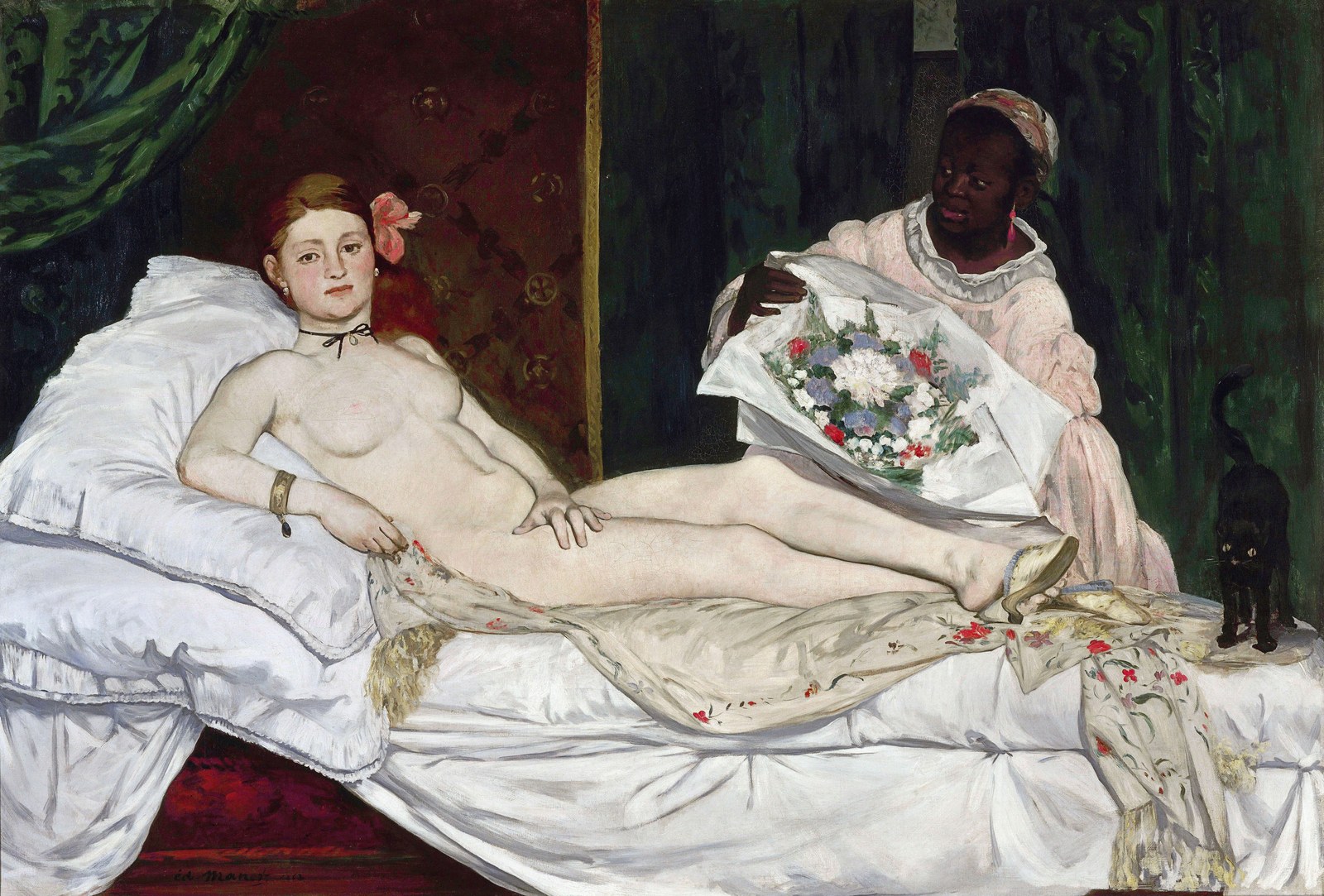
Édouard Manet’s Olympia (1863) is still often introduced as a scandalous nude, but that shorthand misses the picture’s real precision.[1][2] The shock at the 1865 Salon did not come from nakedness alone. Parisian viewers already knew how to look at naked bodies in painting when those bodies arrived under mythological cover.[1][3] What Manet changed was the contract of looking. Through scale, gaze, hand position, attendant figures, and a deliberately unsoftened paint surface, he made the reclining nude feel less like timeless beauty than like a present-tense social encounter with money, class, and access already in the room.
Image context: the hero image keeps the full canvas rather than zooming into Olympia alone because the argument depends on room-wide social geometry — Olympia, Laure, the bouquet, and the cat all help turn the nude into a scene of exchange rather than an isolated body.
1) Old-master format, modern exposure
The Musée d’Orsay’s object record keeps the basic facts plain: Olympia is a large oil on canvas, 130.5 × 191 cm, painted in 1863 and shown at the Salon in 1865.[1] That size matters. A canvas of this scale belonged to ambitious public painting, not to a private erotic aside.
The Met’s Manet essay makes the point historically: the work’s debt to Titian’s Venus of Urbino sharpened, rather than softened, the scandal, because a goddess remained acceptable while a recognizable modern prostitute did not.[2] In other words, Manet did not abandon the high-art tradition; he used its format and then withdrew its protective alibi.
That is why the painting still feels confrontational now. It occupies the visual space of prestige while refusing the moral cover that prestige usually supplied.
2) The gaze does not seduce first; it establishes terms
The first thing many viewers remember is Olympia’s stare. Britannica’s summary is crisp here: her direct gaze places the spectator in the position of a client.[3] That is the crucial shift. She is not drifting in dream space, not surprised, not allegorical, not available as a vague ideal. She knows she is being seen, and the painting makes that knowledge part of its structure.
This is where Manet’s modernity becomes exact rather than slogan-like. The gaze is frontal, but it is not warm. It reads as alert accounting. The painting turns eye contact into social definition: who has entered, who is assessing whom, who controls the threshold.
Many academic nudes ask the viewer to admire. Olympia asks the viewer to recognize that admiration is taking place inside an unequal urban economy.
Accessory details push the same way. Britannica notes the orchid in her hair, ribbon choker, bracelet, and mule slippers — signs that read as contemporary coding rather than mythological costume, which is why the figure lands less like Venus restored than like a woman already located inside a Parisian economy of display and payment.[3]
3) The left hand is the picture’s hardest sentence
If the gaze establishes the encounter, the left hand governs it. Critics often describe the picture in terms of provocation, but the hand gives the composition its actual grammar. In the Titian comparison that shadows every reading of the work, the reclining body offered a more continuous flow of sensual invitation.[1][2] Manet breaks that continuity.
Olympia’s hand is placed with a firmness that reads less as passive cover than as active boundary. It does not erase sexuality; it prices and controls access to it. The body is visible, but not surrendered. That difference explains why the figure feels so unlike the softened museum-nude template that nineteenth-century Salon audiences were used to accepting under classical names.[2][3]
The picture’s intelligence sits exactly there: exposure and refusal are staged at the same time.
4) Bouquet, maid, cat: the room is social before it is symbolic
The painting is often reduced to one body, but the secondary actors keep the room from floating into abstraction. Behind Olympia, the maid Laure enters with a bouquet; at the foot of the bed, a black cat snaps the lower edge of the scene into nervous life. These elements matter because they prevent the painting from becoming timeless or solitary.
Britannica notes two useful things at once: the flowers can be read within the client economy surrounding Olympia, and the Black servant has increasingly been understood as a structurally important figure rather than decorative background.[3] Smarthistory’s framing is useful here too: the canvas reads not simply as Olympia alone but as a portrait of Olympia and Laure together, which helps explain why the room never settles into one-body timelessness.[4] Denise Murrell’s interpretation, summarized by Britannica, is especially clarifying: the maid competes for attention and registers the racial and social reality of post-abolition Paris rather than simply serving as exotic accessory.[3]
Seen that way, the bouquet is not a pleasant extra. It is an arrival signal. Someone has sent something. Someone is expected. Someone pays. Even the cat helps: where an older nude tradition often stabilized the scene with domestic reassurance, Manet inserts a quick, upright, almost abrasive note at the canvas edge. The room is charged with service, exchange, and watchfulness.
5) The paint surface refuses ideal flesh
The Musée d’Orsay describes Manet’s handling as “strong” and “uncompromising,” and that language is exactly right.[1] The body is not dissolved into pearly atmosphere. Mid-tones do not cushion every transition. Black ribbon, pale skin, white sheets, bouquet darks, and background voids are pushed into clear separations that keep the image slightly hard.
That hardness is one reason the picture was read as vulgar. The problem was not only what Manet painted, but how little he did to idealize it for comfortable consumption.[1][2] Instead of turning flesh into myth, he leaves the body looking insistently present, almost cut against the surrounding field. Modernity here is a surface problem as much as a subject problem: paint no longer exists to flatter inherited categories.
Once you see this, the scandal stops feeling like overreaction by prudish viewers and starts feeling structurally legible. Manet had taken one of painting’s most protected genres and removed the soft-focus agreements that kept it culturally stable.
6) Why Olympia still lands in 2026
The picture survives endless reproduction because its mechanism is still contemporary. It understands that looking is never innocent once status, race, labor, and money are present in the frame. It also understands that modern pictures do not need more narrative to become socially dense; they need sharper control over who sees, who returns the look, and who gets turned into background.
That is why Olympia still feels quicker than many later scandal-paintings. Manet does not ask for outrage or sympathy first. He builds a room in which the viewer discovers, almost immediately, that the act of looking has already been seen and priced.
Sources
- Musée d’Orsay, Olympia - Edouard Manet (object record, dimensions, 1865 Salon context, Titian/Goya/odalisque references)
- The Metropolitan Museum of Art, Rebecca Rabinow, Édouard Manet (1832–1883) (Salon reception, Titian comparison, modern-subject framing)
- Encyclopædia Britannica, Olympia (direct gaze/client framing, slipper/orchid details, Denise Murrell note on the maid)
- Smarthistory, Édouard Manet, Olympia (Olympia-and-Laure framing, modern beauty, and close-looking context)
- Wikimedia Commons file record, Edouard Manet - Olympia - Google Art ProjectFXD.jpg (image source metadata)