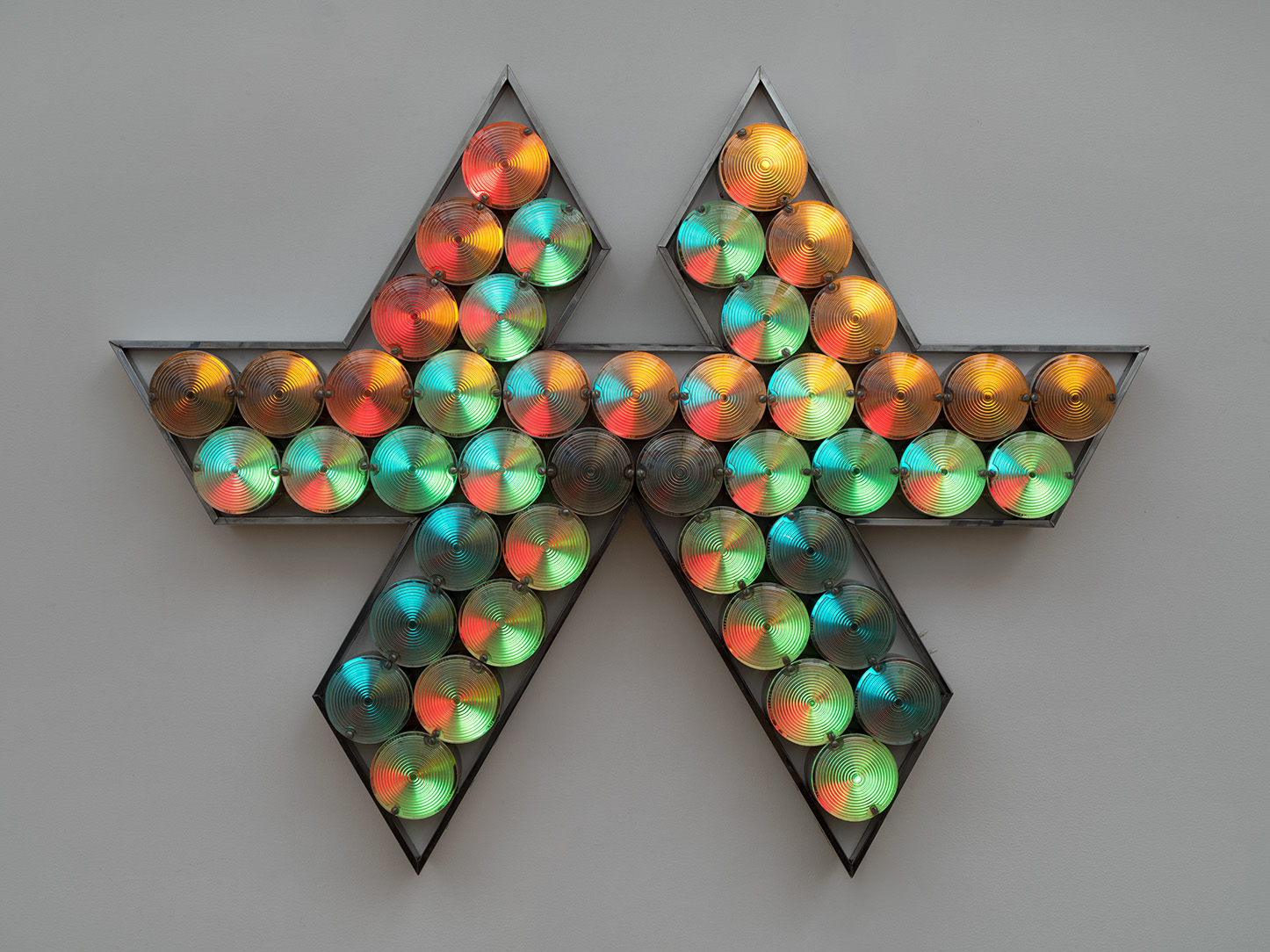
Image context: John Berens's documentary photograph shows Tom Lloyd's actual 1968 sculpture Clavero. The concentric lenses, aluminum frame, and colored light are all physically present, but the exposure can preserve only one arrangement of illumination. That limitation is useful: Lloyd's sculpture is not fully visible until time enters it.[1][6]
A still image makes Clavero look settled. An angular aluminum star hangs against a pale wall; rows of circular lenses glow red, green, blue, amber, and white. The frame is crisp enough to suggest a logo, while the lights carry the familiar visual charge of a traffic signal or theater marquee. Then the sequence changes. One group extinguishes, another flares, and the apparently stable shape begins to behave like an event.
Tom Lloyd's light sculptures were built in the mid-1960s from ordinary electrical parts and an unusual division of labor. Lloyd designed the forms, chose the colors, and composed the light programs. Alan Sussman, an engineer at the Radio Corporation of America, helped turn those plans into functioning objects with colleagues at RCA. Inside or behind each work, a motor-driven cylinder switched circuits on and off according to a sequence specific to that sculpture.[4][6][7]
Lloyd did not necessarily want viewers admiring that apparatus. When he installed the large 1968 work Veleuro in a collector's apartment, he concealed its control box and cables. The decision did not make the engineering incidental. It made the engineering perform as art: mechanism disappeared so that rhythm, color, delay, and recurrence could occupy the wall.[7]
The program was a material
Calling these works “light sculptures” can make their electricity sound like a finish applied to metal. Their deeper material is timing.
The Studio Museum's record for Moskee explains the analog system plainly. A motor turned a cylinder carrying the program, and that cylinder determined when groups of bulbs switched on and off. Lloyd varied the distribution from object to object. Moskee used an evenly distributed program to create a comparatively uniform pattern; Rodogon alternated smaller groups held for longer intervals with larger groups flashed briefly.[4] Two objects assembled from similar bulbs and housings could therefore possess different temporal characters.
Veleuro pushed that logic much further. Its 780 colored Christmas bulbs moved between a symmetrical and an asymmetrical sequence every two and a half minutes. The repetition was mathematically ordered but difficult for a viewer to recognize as an exact return. What looked at first like blinking became closer to phase: a rule generating enough variation to keep the eye uncertain.[7]
This was analog programming, not a digital animation translated into hardware. Circuit groups, motor speed, contacts, voltage, incandescent heat, lens color, and the geometry of the housing all met in one behavior. Lloyd's “code” could not be separated neatly from its machine. A sequence existed as a pattern on a turning cylinder, but it became perceptible only through relays, wires, bulbs, colored lenses, and the time a viewer gave it.[4][7]
That helps explain why hiding the box was an aesthetic choice rather than a denial of technology. Lloyd refused the easy spectacle of exposed machinery. The work's front did not illustrate how the system operated; it let operation become sensation.
The street entered as rhythm
The press release for Electronic Refractions II, Lloyd's 1968 exhibition and the Studio Museum in Harlem's inaugural presentation, named flashing traffic lights, automobile signals, and theater marquees as points of departure. It described a new art of color, light, and movement.[3] The connection was not a matter of copying one recognizable sign. Lloyd extracted a city's switching behavior: wait, release, pulse, repeat.
The parts kept that urban register close. His works used mass-produced incandescent Christmas bulbs and, in some cases, plastic Buick back-up-light lenses rather than a bespoke language of technological luxury.[6][7] The resulting sculptures looked futuristic without pretending to arrive from nowhere. Their future was assembled from things already circulating through stores, cars, streets, laboratories, and homes.
This matters because the technology story can otherwise become a familiar tale of a lone visionary receiving access to a corporate lab. The collaboration with Sussman and RCA was genuinely important, but Lloyd's work also returned technical knowledge to a social setting. The Studio Museum's 1968 release says that Electronic Refractions II was produced as the first project of its studio program, which supported experimentation while giving young people from Harlem an opportunity to work with professional artists.[3] Photographs of Veleuro under construction show Lloyd with apprentices soldering and installing bulbs in his Jamaica, Queens, studio.[7]
The sculpture, then, had two programs. One governed the lights. The other joined an artist, an engineer, a corporate research environment, a new Black museum, and young assistants around the act of making.
Abstraction did not mean withdrawal
Lloyd's geometry arrived during an argument about what politically committed Black art ought to look like. Figurative scenes, posters, slogans, and social realism offered direct public address. Lloyd chose colored light and programmed abstraction while also pressing museums to change and organizing for Black artists' access and visibility.[6][7]
That choice can be misunderstood in two opposite ways. One reading treats abstraction as escape from racial politics. Another makes every flash a coded political symbol. Lloyd's career supports neither shortcut. The light works did not depict a march, a leader, or a demand. Their political force lay partly in who claimed advanced technology as an artistic medium, who was invited into the workshop, which audiences mattered, and what kinds of work institutions were prepared to recognize as Black art.[3][6][7]
The Studio Museum placed that challenge at its beginning by opening with Electronic Refractions II on September 26, 1968.[2][3] Lloyd soon pushed the institutional question further. He joined the Art Workers' Coalition and shifted much of his attention from making objects to community leadership. In 1971 he founded the Store Front Museum in Jamaica, Queens, creating a neighborhood art space and cultural center rather than waiting for established museums to redistribute their authority.[1][2][6]
That turn complicates any neat story of an overlooked inventor. Lloyd was marginalized by a canon that gave far more durable attention to white peers working with light, but he also chose to spend artistic energy building conditions for other people. His reduced production was not simply disappearance. It was a transfer of labor from the luminous object to the cultural institution.
Conservation makes the hidden system visible again
The control box returns when a museum tries to preserve the work. A static sculpture can often survive a failed lamp and remain intelligible as a form. Lloyd's pieces lose more: damaged wiring, an absent motor, or an unreadable sequence changes what the artwork does.
The record of Moussakoo makes the problem concrete. The sculpture consists of four identical hexagonal units that may be arranged in different configurations as long as each touches another. Before the work entered the Studio Museum's collection in 1996, three of its four original motors had been lost. The sequence displayed now is therefore an interpretation of the original programming, not an untouched recovery.[5]
At the Weatherspoon Art Museum, Clavero had been shown only twice after entering the collection in 1981, most recently in 1988. Its wiring degraded and many bulbs stopped working; the sculpture spent more than a year at a specialist conservation lab before it could return to view. The same museum had installed its Dan Flavin sculpture twelve times over a shorter ownership period. That comparison does not by itself explain Lloyd's relative invisibility, but it shows how condition and canon can reinforce each other: the work that is difficult to activate becomes easier to omit, and omission leaves less knowledge available for the next repair.[6]
Conservators working on Veleuro restored its analog controller, recorded the original sequence digitally, and built a digital control box for exhibition. They also faced a conflict between fidelity and operation. Hundreds of incandescent bulbs drew immense power, produced damaging heat, and deformed lenses. After years of testing, the team adopted custom LEDs that approximated the original bulbs' color and brightness while cutting power use by about 90 percent.[7]
The result is neither pure replacement nor perfect stasis. The historic object keeps its frame, lenses, circuits, and documented behavior; a contemporary system helps it perform without cooking itself. Conservation has to decide which properties are indispensable and which technologies may change so those properties remain available.
That is why the current retrospective matters. The Frye Art Museum's presentation, on view through September 20, 2026, brings Lloyd's assemblages, works on paper, and programmed sculptures together after extensive Studio Museum research and conservation.[1][2] It does more than restore a name to a light-art timeline. It reveals an artist whose medium extended from a turning cylinder to a workshop, from a museum's first exhibition to a storefront in Queens.
Lloyd hid the control box because he wanted the surface to live as light. History has made the box visible again. We now need it to understand the precision of his sequences, the intimacy of his collaboration with engineering, and the judgments required to keep the works moving. But the argument was never inside the box alone. It was in Lloyd's insistence that abstraction, technology, Black audiences, apprentices, and institution-building could belong to the same artistic practice.
Sources
- Frye Art Museum, “Tom Lloyd” — current retrospective dates, exhibition framing, Clavero metadata, and source page for John Berens's artwork photograph.
- Studio Museum in Harlem, “Tom Lloyd: About” — retrospective overview covering Lloyd's RCA collaboration, the museum's 1968 inaugural exhibition, activism, and the Store Front Museum.
- Studio Museum in Harlem, “Electronic Refractions II” — archival 1968 exhibition dates and press-release text on signals, marquees, color-light-movement, and the museum's youth studio program.
- Studio Museum in Harlem, “Moskee” — object record explaining Lloyd's motor-driven cylinders and how programs differed among individual sculptures.
- Studio Museum in Harlem, “Moussakoo” — object record on its modular installation, missing original motors, and interpreted contemporary sequence.
- Elaine D. Gustafson and Connie H. Choi, “Demonstrating Care through Conservation,” Weatherspoon Art Museum — Clavero's technical history, RCA fabrication, exhibition record, repair, and Lloyd's community commitments.
- Reinhard Bek, Naeem Douglas, and Michelle Kuo, “Tom Lloyd's Light Sculptures Are a Form of Resistance,” MoMA Magazine — Veleuro's analog program, concealed apparatus, workshop history, and conservation choices.