The Blue Rider is often reduced to a convenient look: saturated color, simplified forms, a few famous animals, and the early road to abstraction. That shorthand is useful only up to a point. It turns a remarkably open network into a style package. The stronger historical claim is different. The Blue Rider mattered because its artists were trying to invent a new language for art, one able to carry inner life, spiritual pressure, and cross-cultural influence without demanding that every participant paint in the same manner.[1][2][3][4]
That is why the movement still feels alive. It did not ask for uniformity. It asked whether color, line, folk form, medieval reference, children's drawing, music, and print culture could all be reorganized into a more elastic modern vocabulary.[2][3][4] The result was less a school with one face than a laboratory for translation.
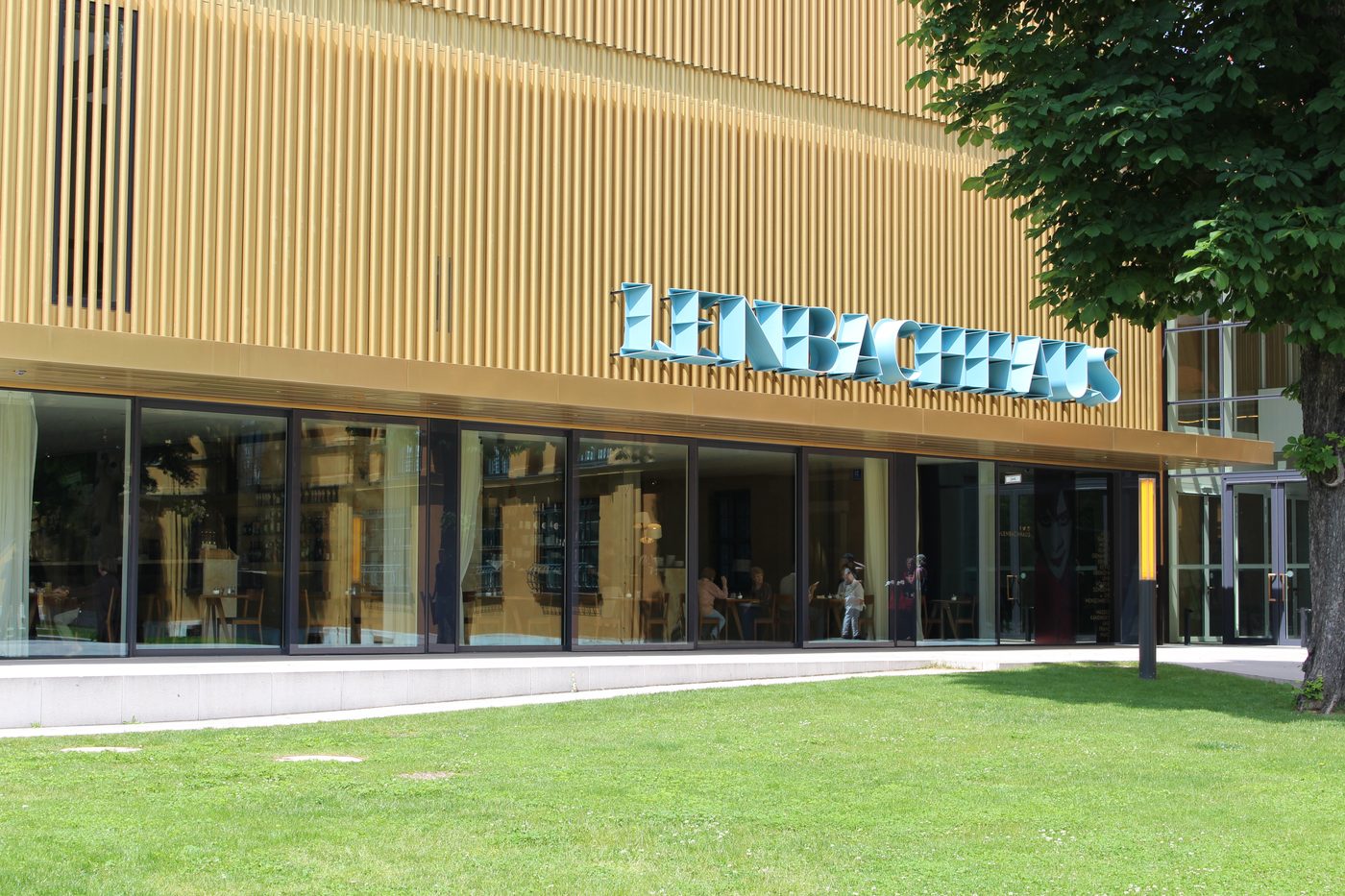
Image context: the lead image now uses the Lenbachhaus as a real-world anchor for the Blue Rider's afterlife. The article still reads Marc, Kandinsky, Munter, and the almanac closely, but the cover avoids a direct artwork reproduction and instead situates that visual language inside the Munich institution most closely associated with its public presentation today.[1][2][6]
The point was a new language, not a shared formula
The Lenbachhaus's current Blue Rider presentation says this directly. It describes the group as artists seeking "a new language" and stresses that their aim was not homogeneity of formal means, but an expression of collective ideas: subjective experience, exchange across national borders, and a visual language for spiritual or intellectual truths.[2] That formulation is the right starting point because it rescues the movement from a common misunderstanding. Blue Rider art is not best defined by one surface effect. It is best defined by the kinds of meaning its artists thought form could hold.
The movement's roots already explain that openness. Lenbachhaus traces them not only to Art Nouveau and Impressionism, but also to folk art, children's art, Japanese woodcuts, Bavarian reverse-glass painting, and the international avant-gardes.[2] This is an unusually mixed inheritance. It means the artists were not trying to purify painting into one doctrine. They were building a selective, experimental syntax out of very different visual traditions.
That helps explain why a Blue Rider room can move so quickly from Kandinsky's increasingly abstract signs to Munter's compressed village views or Marc's animals without feeling incoherent.[1][2] The continuity lies not in style sameness, but in the conviction that visible form can be translated away from mere description and toward inner force.
The group was a network before it was a canon
The Lenbachhaus overview on the movement emphasizes exchange: Kandinsky, Marc, Munter, Jawlensky, Werefkin, August Macke, Maria Franck-Marc, and others formed a productive circle rather than a rigid membership machine.[1][2] That matters because the Blue Rider is often remembered through just two names, Kandinsky and Marc, as though the movement were a dual authorship with assistants orbiting around it. The historical shape was looser and more social than that.
Smarthistory's discussion of the 1912 almanac helps sharpen the point.[4] The publication was meant as a yearly book, but it also functioned as a declaration of method. Its pages placed modern paintings alongside African sculpture, Chinese ink painting, German folk art, medieval sculpture, Renaissance woodcuts, and musical or theoretical texts.[4] The almanac therefore behaved like more than a catalogue. It was an argument that the most important divisions in art were not old versus new or European versus non-European, but dead outer imitation versus living inner necessity.
This is also why the movement feels larger than its short lifespan. A network can move quickly across mediums. A network can absorb influence without treating influence as impurity. The Blue Rider's reach into theater, music, print, and book design belongs to the same logic.[3][4]
Color stopped describing the world and started valuing it
MoMA's overview of Der Blaue Reiter is especially clear here. It describes the group as a loose association formed in Munich in 1911 around abstracted forms and prismatic colors that were understood to have spiritual value.[3] That phrase is the key. Color in Blue Rider painting is not only emotional intensity turned up. It is evaluative. It tells the viewer how a form matters.
Franz Marc makes this easiest to see because animals let him strip away urban anecdote and human social clutter. In a painting such as Blue Horse I, the horse is not rendered as a stable natural specimen with locally correct color. Instead the body becomes a field where tenderness, calm, and force are fused into one chromatic decision.[1][2][5] The landscape around it is equally liberated from straightforward realism. Green, red, and yellow do not build a believable hillside so much as a rhythmic world adequate to the animal's presence.
Kandinsky pushes the same principle toward a different outcome. MoMA notes that flattened perspective and reductive woodcut-like form helped put the artists, especially Kandinsky, on the path toward abstraction.[3] In his case, color and line become increasingly independent from named things altogether. But the underlying wager is shared with Marc: visible form should carry inner life directly, more like music than like inventory.[3][4]
The almanac matters because it shows the movement thinking in public
Many movements leave paintings behind. The Blue Rider left a book that explains how it wanted to see. Smarthistory's account of the almanac stresses both its eclecticism and its ambition.[4] Kandinsky wrote that the goal was to show "how the inner wishes of the artist are embodied," and the selection of images makes that claim concrete.[4] Folk carving, avant-garde painting, medieval imagery, masks, music, and experimental writing are not treated as separate cultural shelves. They are arranged as evidence that art's deepest problem is expression, not genre ranking.
That public self-explanation is part of the movement's durability. The Blue Rider did not merely produce striking images; it theorized why those images needed another standard of judgment. Once the question becomes inner necessity rather than outward accuracy, stylistic diversity stops looking like weakness. It becomes proof that no one syntax owns the spiritual field.[2][3][4]
Why the Blue Rider still reads as modern
The movement lasted only from its first exhibitions in 1911 until war shattered the circle in 1914.[1][3] Kandinsky returned to Russia. Marc and Macke died because of the war's violence.[3] The historical arc is brutally short. Yet the movement's afterlife has been long because it solved a problem that modern art keeps facing: how to become freer without hardening into another official manner.
The Blue Rider's answer was not to reject structure. It was to relocate structure inside acts of translation. Nature could be translated into color relations. Folk art could be translated into compressed form. Music could be translated into rhythm on the page. A group could become modern not by flattening difference, but by giving difference a shared horizon.[1][2][3][4]
That is why the Blue Rider should not be remembered as one more early modern style. It is better understood as a short, brilliant attempt to make modern art speak many dialects at once, while still believing that art could say something inward, serious, and necessary about the world.[1][2][3][4]
Sources
- Lenbachhaus, "The Blue Rider" - museum overview on the circle's major artists, the first 1911 exhibition, the second 1912 exhibition, and the Lenbachhaus's central Blue Rider collection.
- Lenbachhaus, "The Blue Rider: A New Language" - exhibition text on the group's roots in Art Nouveau, Impressionism, folk art, children's art, Japanese woodcuts, reverse-glass painting, and its search for a new visual language rather than stylistic uniformity.
- The Museum of Modern Art, "German Expressionism Styles: Der Blaue Reiter" - overview of the 1911 Munich formation, spiritual value of prismatic color, the horse-and-rider motif, and the move toward abstraction.
- Smarthistory, "Der Blaue Reiter" - essay on the 1912 almanac, the group's artist-run alternative to conservative art structures, and its wide visual and cultural range.
- Wikimedia Commons, "File:Marc, Franz - Blue Horse I - Google Art Project.jpg" - source page for a faithful photographic reproduction useful for checking the Blue Horse I visual details discussed in the article.
- Wikimedia Commons, "File:Lenbachhaus muenchen.jpg" - source page for the real-world Lenbachhaus view used as this article's immersive cover image.