Edward Hopper's Automat is often approached as a simple loneliness picture: one woman, one late-night table, one dark window, and a city that has gone cold around her.[2][5] The mood is real, but that label ends the painting too quickly. Hopper has built something more exact. The force of Automat lies in suspension. Nearly every element in the picture holds the scene in a state that feels complete enough to be legible yet unfinished enough to resist a final story. The woman has arrived somewhere, but the painting refuses to tell us whether she is resting, waiting, or getting ready to leave.[1][2][3]
That refusal begins with structure rather than psychology. Hopper's mature paintings repeatedly use windows to merge the public city outside with the private life inside, turning glass into a threshold through which modern urban experience can be watched and felt at once.[3][4] In Automat, that threshold stays active, but it stops behaving like a clear opening. The woman sits by a window, yet the city does not come into view. What returns instead is a second image made of reflected ceiling lights. The outside world has receded into a black field, while the interior keeps projecting itself back onto the glass.[2][3]
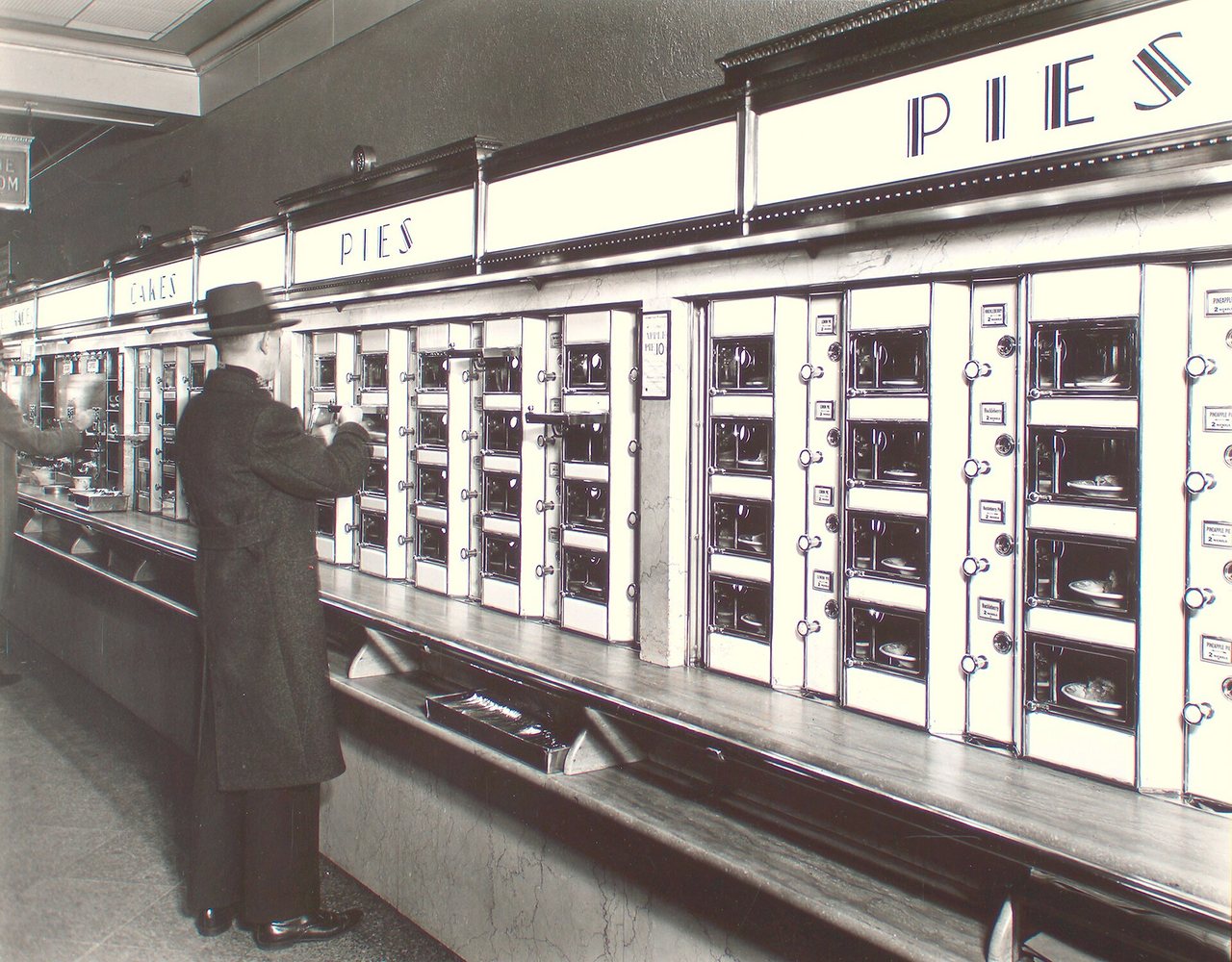
Image context: the lead image uses a historical New York Automat photograph to hold the article inside the real dining culture behind Hopper's scene. The painting itself remains the object of the reading, but the cover avoids turning the card into a direct artwork reproduction and instead gives the reader Hopper's underlying urban machinery: self-service compartments, public eating, and solitary pause arranged inside a commercial room.[1][2][7]
The window gives her no outside world to lean on
The Whitney's artist page is useful here because it identifies the window as one of Hopper's enduring symbols and notes that he used it to merge urban facades with glimpses into private lives.[3] Automat makes that device unusually severe. The window occupies nearly half the composition, but it offers no compensating street narrative: no pedestrians, no taxi, no storefront, no weather, no passing train of attention. Instead Hopper turns the glass into a dark, reflective plane broken by a row of pale lights that seem to hover over the woman's head and shoulder.[2][3]
Those reflections matter because they keep the painting from becoming ordinary genre realism. If the viewer could simply look through the glass into Manhattan, the room would sit inside a larger city scene. Hopper denies that outlet. The exterior withdraws, and the diner becomes its own chamber. The light no longer helps us move outward; it presses inward. The Whitney audio guide puts this clearly by noting that the reflected lights point straight at the woman, focusing the composition around her, while Kambui Olujimi describes the light as a character in its own right, something that animates the room and both reveals and conceals it.[2]
That is why the painting feels so contained even though it depicts a public place. An automat is built for circulation, quick purchase, and urban transit. Hopper turns it into a still container. The black window does not open the scene up; it deepens its enclosure.
The coffee cup makes the scene a pause rather than a conclusion
The second anchoring device is the cup itself. Hopper gives the woman one cup, one table, and very little surrounding clutter.[1][6] That spareness is crucial. The painting is not crowded with food, crockery, shopping bags, or social detail that would explain what part of the evening we have entered. The cup carries the smallest possible action. She has ordered something, but the order does not expand into an event. The cup is enough to justify her presence and not enough to settle her purpose.
The Des Moines Art Center's teaching guide for Automat unexpectedly helps here because it asks viewers to think of Hopper's figures like characters in a movie paused mid-scene and to wonder whether the image belongs to the beginning, middle, or end of a story.[1] That is more than a classroom prompt. It names the painting's real mechanism. Hopper withholds the narrative markers that would tell us how to time the moment. The woman remains fully present, but her situation stays grammatically open.
Even her clothing contributes to that openness. She is still dressed for the street in hat and coat, so the scene carries the pressure of an arrival that has not fully softened into comfort.[6] At the same time, the table and cup hold her in place long enough for the room to feel momentarily inhabited. Hopper catches the thin interval in which a public stop has become intimate without becoming secure.
Public space turns inward without becoming private
This is where Automat differs from a simple illustration of urban sadness. The Whitney audio points out that Hopper leaves the mood unresolved between contemplative solitude and alienation.[2] That uncertainty matters because the painting never collapses into one verdict. The room is impersonal, but it is not empty. The woman is alone, but she is not theatrical. The light isolates her, yet it also gives the scene its peculiar warmth. Hopper does not push the viewer toward pity so much as toward concentrated attention.
That concentration belongs to the larger urban logic of his work. Kim Conaty's Whitney essay describes Hopper as an artist who captured modern city life in forms where change and changelessness could coexist and where specific New York observation could be transformed into broader sensations of urban experience.[4] The same essay and the Whitney artist page both stress that many Hopper paintings synthesize disparate locations into imagined wholes rather than recording one exact address.[3][4] Automat gains power from that method. The room feels recognizable, but it does not lock into documentary fact. It behaves like a distilled urban condition: lit, public, proximate, and strangely sealed.
This is also why the painting's silence feels durable. Hopper was deeply interested in the psychological pressure created when exterior architecture and interior life meet at a pane of glass.[3][4] In Automat, that pane no longer mediates between two visible realms. It becomes a dark screen carrying the room's own light back toward the sitter. The city remains present as pressure, not as view.
Why the painting still holds
Automat lasts because it never forces the woman into a single emotional script. The painting is specific enough to make us feel the hour, the warmth of the room, the hardness of the table edge, and the isolated brightness of the lights, yet open enough that the scene never settles into anecdote.[1][2][3][4] Hopper gives us a public interior that has briefly folded in on itself. The black window keeps the city outside from becoming explanatory background. The reflections turn that window into a second surface. The single cup keeps the action small and unfinished.
That is the deeper achievement of the painting. Hopper does not merely show a solitary woman in a cafe. He arranges a moment whose emotional truth comes from remaining suspended. The scene holds together because nothing in it quite closes: not the story, not the room, not the question of whether this is a refuge, a habit, or a quiet form of estrangement.[1][2][3][4][5]
Sources
- Des Moines Art Center, Mood + Hopper lesson-plan PDF for Automat (artist, title, date, collection credit, and the museum's story-pause framing for the painting).
- Whitney Museum of American Art, "Automat, 1927" audio transcript from Edward Hopper's New York (reflected lights, radiator shadow, and the unresolved mood between solitude and alienation).
- Whitney Museum of American Art, "Edward Hopper" artist page (Hopper's use of windows as a recurring symbol and his synthesis of observed city elements into imagined scenes).
- Kim Conaty, Whitney Museum of American Art, "Approaching a City: Hopper and New York" (Hopper's transformation of New York observation into broader urban experience).
- Encyclopaedia Britannica, "Edward Hopper" (biographical overview of Hopper's emphasis on solitude, light, shadow, and modern American life).
- Wikimedia Commons, "File:Automat-edward-hopper-1927.jpg" - source page for a faithful photographic reproduction of the painting, useful for checking the visual details discussed in the reading.
- Wikimedia Commons, "File:Automat, 977 Eighth Avenue, Manhattan (NYPL b13668355-482752).jpg" - source page for the real historical New York Automat photograph used as this article's immersive cover image.