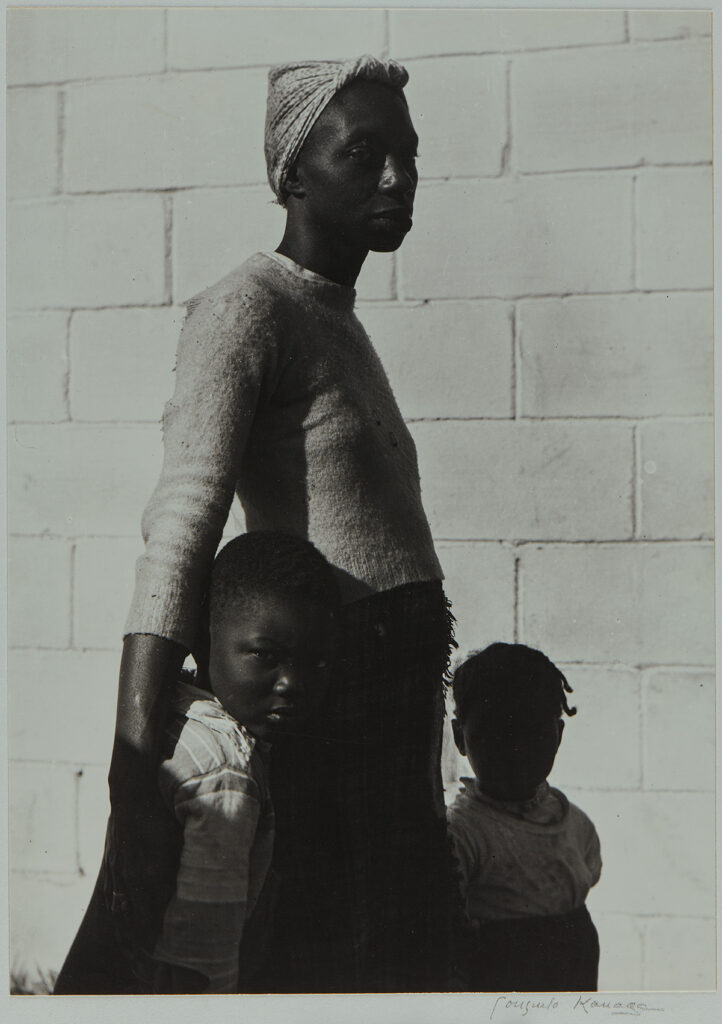
The wall is bright enough to make the shadows feel inhabited. A woman stands with two children close to her body; the pale sweater catches the light, while the smaller figures take longer to separate from the darkness. In Consuelo Kanaga's She is a Tree of Life (1950), looking begins with a strong shape and becomes an encounter with three people.[1]
The title offers an immediate reading: shelter, sustenance, motherhood. The faces make that reading less comfortable to finish. The woman's sideways attention and the children's different positions leave room for something beyond an emblem. A photograph can invite recognition without giving us access to its subjects' thoughts.
Kanaga's career makes that tension unusually productive. She worked across news photography, commissioned portraits, still life, and political documentary. Her strongest pictures bring the discipline of composing an image into contact with the difficulty of explaining a life.
A newspaper job, a room for portraits
Born in 1894, Kanaga began writing for the San Francisco Chronicle in 1915 and became a staff photographer in 1918. In 1922 she moved to New York to work for the New York American. There she formed a friendship with Alfred Stieglitz, whose commitment to photography as an art helped shape her practice.[2]
These beginnings matter because the usual division between useful photographs and artistic ones fits her poorly. A newspaper assignment gives a picture a job: show a person, describe a situation, make an event legible. The same frame can also organize attention through the weight of a shadow or the distance between a hand and a face. Kanaga kept both possibilities available.
Portraiture also paid. From the early 1920s, she supplemented newspaper work with a studio, photographing wealthy clients and artist friends to support herself and her partners.[3] The portrait was a livelihood as well as a field of experiment. That combination makes artistic development look less like a clean succession of breakthroughs than a practice sustained between obligations.
In 1932 she showed four photographs in the inaugural Group f.64 exhibition at San Francisco's de Young, without formally joining the group.[2] An exhibition can locate an artist historically without explaining her entire practice.
The face was made in the darkroom, too
Kanaga worked on the expressive character of a portrait after exposure. Curator Drew Sawyer describes her use of burning and dodging to change local light and dark, metal toning, and pencil or graphite additions to emphasize features. Posing, cropping, and printing all belonged to the process.[3]
These are consequential choices. Deepening a shadow can slow recognition; a crop can make a hand feel like a second center of attention. Such decisions mean that intimacy is partly constructed. The apparent immediacy of a face on paper can depend on repeated, deliberate work.
That does not tell us that a sitter's expression is false. It tells us to keep two kinds of presence in view: the person before the camera and the photographer shaping what another person will see. Sympathy alone cannot explain a finished print's force.
Eluard Luchell McDaniel, her handyman and close friend, became a recurring subject. SFMOMA curator Delphine Sims distinguishes these formally attentive portraits from Kanaga's later, more documentary Southern work.[2] Friendship gives the pictures a history beyond a single encounter, only partly recoverable from a face.
Political company, individual faces
Kanaga's social commitments had institutional outlets. After returning to New York in 1935, she contributed photographs to leftist publications including Labor Defender, New Masses, and Sunday Worker. Her portraits of Black cultural figures included Langston Hughes, Sargent Johnson, and Kenneth Spencer. Sawyer places this work alongside the New Negro Movement while also acknowledging the complications of Kanaga's position as a white photographer.[3]
There is no reason to dissolve those complications into a reassuring story about empathy. An artist's convictions do not grant complete knowledge of another person's experience. The interesting question is what the picture asks us to attend to—and how much it leaves unresolved.
Reviewing the Brooklyn Museum's 2025 retrospective, Loring Knoblauch draws attention to the variants within Kanaga's Southern portraits: heads turn, crops change, and different exposures register different expressions. He treats the celebrated mother-and-children photograph as part of a sustained practice of attention.[6] Seen in that company, a famous image acquires neighbors. Its authority becomes easier to examine because we can imagine other decisions, other frames.
When a portrait becomes everybody's story
Kanaga made the Florida picture while photographing Black agricultural workers around reclaimed swampland.[2] LACMA holds a gelatin silver print under the longer title She is a Tree of Life to Them and records its inclusion in Edward Steichen's 1955 exhibition The Family of Man.[4]
MoMA describes that exhibition as a photographic account of shared human experience, organized around a vision of global solidarity.[5] Within such an arrangement, a particular family could become an image of motherhood recognizable across national boundaries. The appeal is powerful. So is the possibility of losing the conditions under which the photograph was made.
My reading is that Kanaga's picture holds both scales uneasily together. We can respond to closeness and care while remembering the specific world of Black agricultural labor from which this encounter came. Neither response gives us the family's full story. Treating the image as universally legible should not make its people interchangeable.
Look again at the children. One is more readily visible; the other asks for a longer look. Their unequal visibility interrupts the quick recognition promised by the title. Kanaga's composition gives us an image we can grasp almost at once, then leaves people inside it whom we have barely begun to see.
Sources
- San Francisco Museum of Modern Art, “Consuelo Kanaga: Catch the Spirit,” September 28, 2024–February 9, 2025 — exhibition overview and Brooklyn Museum photograph of She is a Tree of Life, 1950.
- Cristina Chan, “Way Ahead of Her Time,” SFMOMA, September 2024 — newspaper career, Group f.64 participation, McDaniel portraits, and the Florida photograph's context.
- Drew Sawyer, Consuelo Kanaga: Catch the Spirit, Fundación MAPFRE exhibition texts — portrait work, darkroom methods, political publications, and representations of Blackness.
- Los Angeles County Museum of Art, “Consuelo Kanaga, She is a Tree of Life to Them, 1950,” accession M.2006.93 — print metadata and inclusion in The Family of Man.
- Museum of Modern Art, “The Family of Man,” January 24–May 8, 1955 — Steichen's exhibition and its framing of shared human experience.
- Loring Knoblauch, “Consuelo Kanaga: Catch the Spirit @Brooklyn Museum,” Collector Daily, April 24, 2025 — review discussing portrait variants and the famous photograph's place within her wider practice.