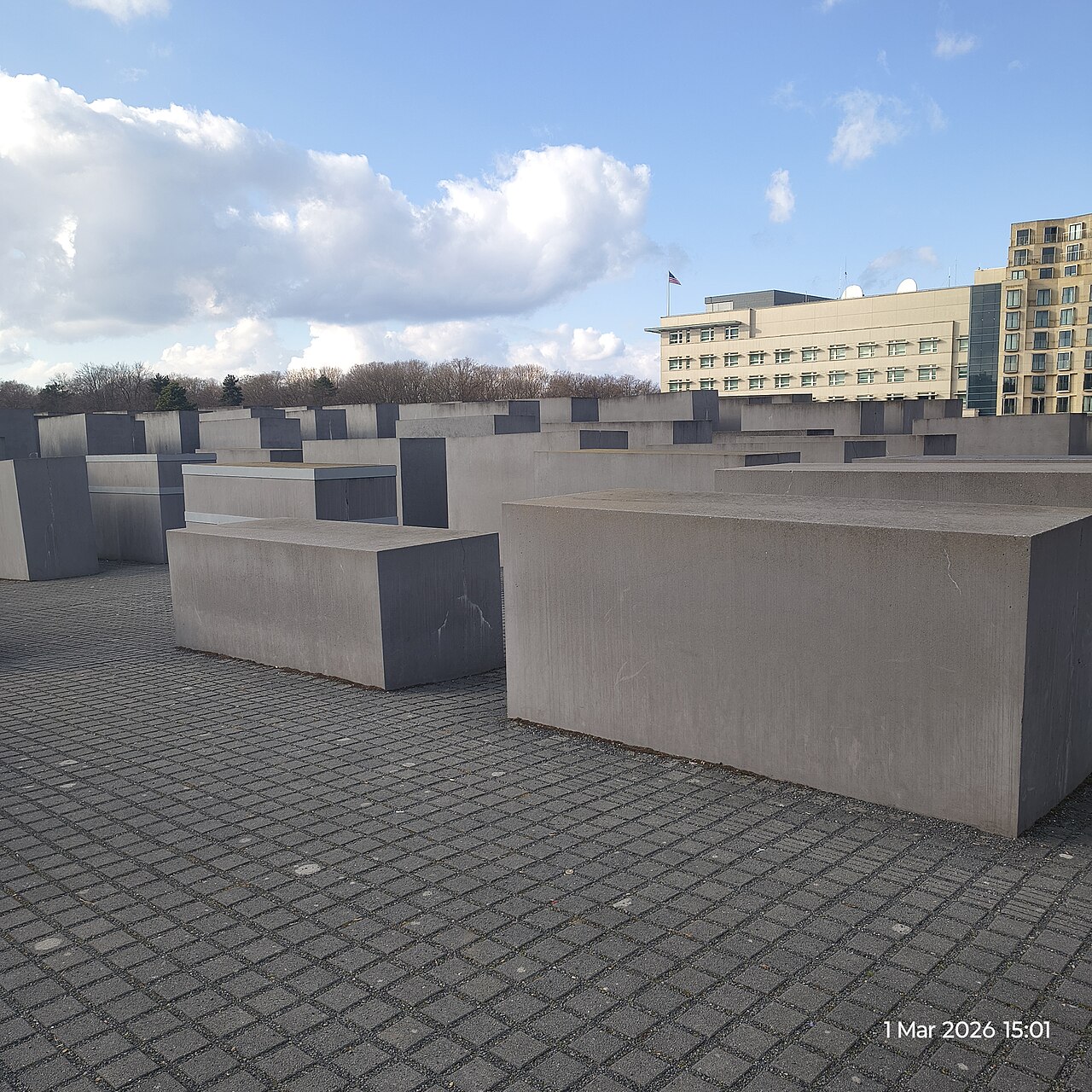
Berlin's Memorial to the Murdered Jews of Europe is one of those works that many people think they already know before they reach it. Photographs teach a quick version first: a field of grey blocks, severe but legible, a piece that can be grasped from the edge as a pattern.[1][5] The stronger experience begins when that photographic confidence starts to fail. Once you walk into the field, the memorial stops behaving like an overhead image and starts behaving like a bodily sequence. Ground falls away, stelae rise, sightlines close, and a space that looked diagrammatic from the street turns into an instrument for uncertainty.[1][2][3]
That shift is the real achievement of the work. Officially opened on 10 May 2005, the memorial combines Peter Eisenman's Field of Stelae with an underground Information Centre.[1][4] The Foundation's facts page gives the hard structure: 2,710 concrete stelae across 19,073 square meters, each stele 0.95 meters wide and 2.38 meters long, with heights running from ground level up to 4.7 meters and slight inclinations between 0.5 degrees and 2 degrees.[1] Those numbers matter because they explain how the memorial exerts pressure without resorting to figurative drama. Its argument lives in spacing, grade, repetition, and bodily navigation.[1][2]
Image context: this article uses a documentary photograph taken from within the memorial rather than a distant overview because the work's meaning is inseparable from movement through it. A real in-situ photograph preserves the narrow passages, rising walls, and open strip of sky that make the field feel both public and withdrawn.[1][5]
The memorial refuses a single privileged view
Many monuments teach visitors where to stand. They present a front, a pedestal, or a focal figure that organizes attention from the start. This memorial takes another route. VisitBerlin notes that the site is open from all four sides and that the field can be fully traversed.[2] That openness matters because it withholds the usual ceremonial script. There is no single entry sequence that instructs the visitor how to feel. You arrive laterally, almost casually, and the memorial lets its force accumulate through continuation rather than proclamation.[2][3]
That is why the edge can initially seem less imposing than the subject might suggest. Along the outer areas, many of the stelae remain low enough to keep the city in view.[1] The memorial does not seize the visitor with immediate vertical grandeur. It begins at a civic scale, still porous to Berlin's sidewalks, traffic, and air. Only after a few steps does the piece reveal that this accessibility is part of the design's deeper logic. It invites entry without granting overview.
This refusal of a single commanding viewpoint also changes the memorial's relation to commemoration. Instead of presenting a symbolic object to be read from one correct position, the work distributes meaning across a field. The visitor has to move, reorient, and keep moving again. The result is less like receiving a message than entering a controlled condition.[2][3]
The slope does the deepest part of the work
If the memorial unsettles, the ground does much of the unsettling. VisitBerlin describes the field as sitting on a slight slope whose wave-like form changes wherever you stand.[2] Posen Library's overview says the ground slopes, the pillars tower over visitors at some points, and Eisenman intended a confusing atmosphere, a feeling of being trapped, and the sense of an ordered system run amok.[3] The important point is that the memorial does not rely on height alone. It relies on a coupled system: the ground sinks as the stelae rise. What felt chest-high at the edge can become architectural, even enclosing, deeper inside.[1][2][3]
This change in scale is crucial because it happens without theatrical gesture. There are no gates closing behind you, no sudden darkness, no literal maze tricks. The memorial stays materially simple. Concrete blocks repeat. Paths remain narrow and straight. The sky is still visible above. Yet the body registers a different reality with each step. The horizon line drops out. Peripheral sight gets reduced to parallel walls. Sound changes. The field begins to feel deeper than its surface plan first promised.[2][3]
That balance matters. If the stelae were monumental in the old heroic sense, the memorial would become legible too quickly as a spectacle of size. By keeping each block relatively plain and repeating the same basic module, the work lets disorientation arrive through accumulation. Anxiety enters gradually, almost soberly, which is why it lasts.[1][2][3]
The grid offers order and then quietly withdraws it
The field is often described as a grid, and that is true, but the word can make the work sound more stable than it feels in person. Grids usually promise control, measure, and legibility. Here those promises are only partly kept. The Foundation's technical data confirms the slight inclinations, while Posen's summary stresses the close spacing and the atmosphere of confusion and entrapment.[1][3] This means the memorial does not produce chaos through irregularity; it produces it through near-regularity.
That distinction is central to the work's emotional intelligence. A fully chaotic field would announce its intention too loudly. Eisenman's field stays close to order, close enough that the visitor keeps trying to stabilize it. Straight paths suggest continuity. Repeated forms suggest predictability. Then the body discovers small deviations: a floor that keeps shifting, heights that distort the expected horizon, planes that feel subtly askew.[1][2][3] The memorial creates pressure by letting orientation remain imaginable but never fully secure.
This is also why photographs from above can mislead. From a distance, the field reads as a crisp abstract pattern, almost elegant in its repetition.[5] Inside it, elegance gives way to duration. The same repeated unit that looked visually satisfying from afar becomes physically insistent at walking speed. The memorial's real medium is not the aerial image. It is the passage from recognizability into uncertainty.
Abstraction only works here because names return below
The Field of Stelae carries the body's uncertainty, but the memorial would be thinner if that abstraction stood alone. The Foundation's site makes clear that the memorial includes an underground Information Centre added by Bundestag decision in 1999 and opened with the site in 2005.[1] VisitBerlin describes the rooms below as spaces that bring visitors into contact with individual fates, family histories, letters, names, and places.[2] This relationship between the upper field and the lower archive is what keeps the work from dissolving into pure mood.[1][2]
That pairing deserves emphasis because the memorial's abstraction has often been both praised and criticized. The field above does not represent victims through likeness or narrative scene. It gives visitors a spatial condition: repetition without relief, openness that becomes enclosure, direction that keeps fraying. The Information Centre answers by restoring historical specificity. It returns biography, chronology, and the irreducible fact that the memorial addresses murdered people rather than an abstract tragedy.[1][2]
Seen this way, the memorial's power comes from division of labor. The field does not try to say everything. It takes charge of scale, interval, bodily tension, and the stripping away of conventional monumental comfort. The rooms below take charge of names, documents, and the return of singular human lives. Together they produce a work that neither illustration nor pure formalism could achieve alone.[1][2][3]
This is why the memorial remains so strong in person. It does not ask the visitor to decode a symbol and move on. It stages a change in bodily confidence, then places that change in contact with historical memory. The piece begins in public openness and ends in a more private register of orientation, pressure, and recollection. Its seriousness comes from how quietly it carries that transition. The memorial does not overwhelm through spectacle. It lets the body discover that certainty has thinned out, one measured step at a time.[1][2][3]
Sources
- Foundation Memorial to the Murdered Jews of Europe, "Memorial to the Murdered Jews of Europe" - official memorial page with opening date, facts and figures, Field of Stelae dimensions, architect timeline, and Information Centre context.
- visitBerlin, "Memorial to the Murdered Jews of Europe" - visitor-facing description of the four-sided access, sloped field, wave-like form, and underground rooms of names, families, and sites.
- Posen Library, "Memorial to the Murdered Jews of Europe, Berlin, Germany" - overview of the close spacing, sloping ground, towering pillars, and Eisenman's intended atmosphere of confusion and entrapment.
- Eisenman Architects, "Berlin Memorial to the Murdered Jews of Europe 2005" - project page listing the competition, design, and construction years.
- Wikimedia Commons, "File:Memorial to the Murdered Jews of Europe (33778).jpg" - source page for the documentary photograph used as the article image.