
Berenice Abbott is often split into three careers that can be filed away too neatly: the sharp portraitist of Paris in the 1920s, the great recorder of New York in the 1930s, and the unlikely maker of scientific photographs in the decades that followed.[1][3][4] The 1992 documentary Berenice Abbott: A View of the 20th Century, republished by The Met from its moving-image archive, is valuable because it refuses that compartmentalization.[1][2] The film keeps showing that Abbott's work across all three phases was driven by the same demand: the camera had to clarify structure. Whether she was photographing James Joyce, lower Manhattan storefronts, or wave patterns and pendulums, the point was not atmosphere for its own sake. The point was to make the world more legible.[1][2][3][4]
That argument matters because Abbott is still easy to misread. Her New York pictures are so canonical that they can start to look like pure urban style, all hard edges, black windows, and heroic skyscraper angles.[2][3] Her Paris portraits can get reduced to proximity with famous names. Her scientific images are often treated as a curious late detour.[1][3][4] The documentary makes those reductions harder to sustain. In the Met description, the film is already framed as a grand tour through Abbott's whole life, from Ohio to Paris to MIT to Maine.[1] In the companion Met interview with filmmakers Martha Wheelock and Kay Weaver, the deeper logic becomes clearer: Abbott wanted to be "transparent" in making an image, to get out of the way of the camera's function, and to let the work explain the era she had lived through.[2]
That is why the archival format suits her so well. Abbott was born in 1898 and, as the filmmakers recall, treated the twentieth century as "her century," something she wanted to see through.[2] The documentary catches her in her early nineties at her home in Maine, speaking with the authority of someone who had watched photography move from studio portraiture to modern urban record to scientific visualization without ever surrendering its descriptive power.[1][2] What survives in the archive is not only information about Abbott. It is Abbott's own cadence of judgment: dry, exact, suspicious of prettification, and unwilling to let photography drift into misty self-expression.
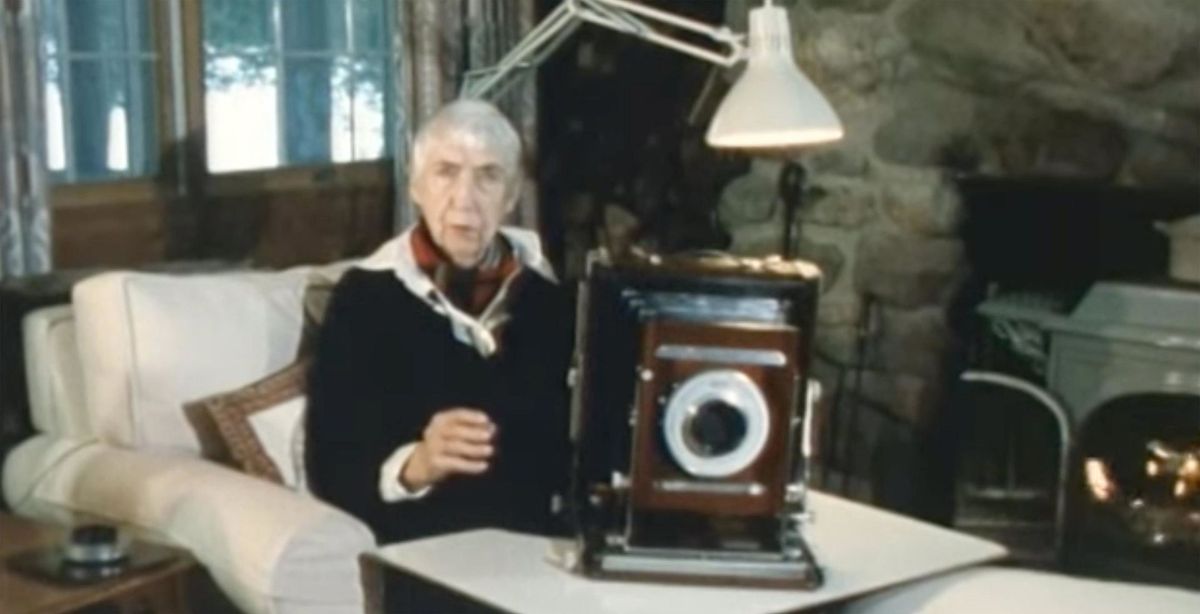
Image context: the cover uses The Met's still from the documentary's living-room sequence, with Abbott seated by the fire and a camera set before her. That choice fits the article because the archival film's strongest gift is presence. You are not only looking at finished photographs; you are watching an artist, late in life, discuss what it meant to keep control of the lens and of her own representation.[2]
Historical context: one documentary ethic across portrait, city, and science
Abbott's biography helps explain why the documentary feels so coherent. The National Museum of Women in the Arts notes that she first studied sculpture, then moved into photography in Paris while assisting Man Ray, opened her own studio in 1926, and built a portrait practice around the literary and artistic intelligentsia of Paris and New York.[3] That beginning matters because it gave her technical discipline without trapping her inside studio glamour. The same profile emphasizes that her portraits were straightforward and detailed rather than flattering or painterly.[3] Even at the start, Abbott was after formal accuracy, not soft-focus prestige.
Her return to New York sharpened that ethic into a civic project. After years in Europe, she came back to a city in violent transformation and felt compelled to document what was being replaced and what was rising in its place.[3] NMWA notes that through federal support she made 305 photographs for Changing New York, a body of work dedicated to the city's dynamism and changing character.[3] The filmmakers' Met interview gives the best gloss on why those pictures still bite: Abbott believed a viewer did not need to see a single person in a New York photograph to understand the culture of the time, because architecture, signage, windows, and street fronts already carried the social evidence.[2] That idea is more radical than it first appears. It turns documentary photography into a reading of structures, not just of events.
The same logic extends into the scientific work that can otherwise seem like a break in style. NMWA describes Abbott as one of the first photographers to join art and science in a significant way, while ICP's archive essay notes that her 1950s illustrations of scientific phenomena, made with the Physical Sciences Study Committee at MIT, became textbook images because they combined factual demonstration with striking formal clarity.[3][4] The documentary and the Met interview pull those facts together. Wheelock and Weaver describe Abbott's science stills as unprecedented, and stress that she had to design and build cameras to produce the images she wanted.[2] Once that is in view, the MIT phase no longer looks like an eccentric sideline. It looks like the most rigorous expression of a long-held principle: photography should reveal underlying relations, not merely decorate surfaces.
Video provenance
The embed below uses The Met's official upload of Berenice Abbott: A View of the 20th Century, directed by Martha Wheelock and Kay Weaver and released from the museum's film archive in July 2021 as part of the From the Vaults series.[1] The companion Met article explains that the documentary itself was completed in 1992 after a series of interviews with Abbott at her Maine home, and that the filmmakers shaped it without a narrator or on-camera questions so that Abbott could speak in her own words.[2] That provenance matters. This is not a recycled clip detached from context. It is a documented late-life portrait with a clear chain of custody: filmed near the end of Abbott's life, then preserved and reintroduced by the institution that holds the archive.
Close reading: what the archive preserves that a monograph cannot
The film's strongest decision is formal before it is biographical. In the Met interview, Weaver says the filmmakers wanted to "get out of Abbott's way," which meant no narrator, no visible prompting, and a visual style shaped by Abbott's own working principles.[2] That choice gives the documentary unusual authority. Instead of a curator explaining her, Abbott's voice and pictures establish the rhythm. The archive preserves a mode of self-presentation that suits her art: exact, self-possessed, and resistant to sentimental framing.
It also preserves Abbott's relation to control. The filmmakers recall that she commented on their lighting setup, warned them that the wood-paneled room would absorb more light than they expected, and treated the shoot almost as if she herself were directing it.[2] That anecdotal detail is not trivial. It reveals continuity between the artist and the subject of the film. Abbott does not merely appear before the camera as a venerable witness to history. She remains a technician of visibility, still thinking about exposure, surfaces, and the conditions under which an image becomes truthful.[2]
This is where the documentary becomes more than a respectful career overview. Its structure, as described by The Met, moves from Paris apprenticeship to New York transformation to scientific photography at MIT and finally to the Maine years.[1][2] Seen in sequence, those phases stop looking like separate reinventions. The portraits test how much personality can be held in a clear, unsentimental frame. Changing New York scales that clarity up to a metropolis in flux. The scientific work pushes the same descriptive ambition into invisible phenomena and classroom explanation.[2][3][4] The archive does not just remind you what Abbott photographed. It shows the internal consistency of why she photographed.
The film is especially strong on the New York years because it restores the intellectual claim inside the famous images. Wheelock and Weaver describe storefronts, churches dwarfed by business towers, gun signs, hanging chickens, and Pennsylvania Station as records of culture already visible in the built environment.[2] That is a useful correction to the way Abbott is sometimes taught as a poet of urban atmosphere. She certainly had style, but the documentary insists that her style was evidentiary. She wanted the modern city to be readable.
The late-life footage from Maine gives that evidentiary impulse a different emotional temperature. Abbott is no longer racing through a transforming city or building cameras for scientific demonstration. Yet the documentary still presents her as mentally in motion, thinking about new ways to photograph even a walnut, still treating photography as an open technical question rather than a sealed legacy.[2] That late restlessness matters. It keeps the archive from turning her into a finished monument.
Why this archival portrait still matters now
The real value of the 1992 documentary is that it protects Abbott from two flattenings at once. The first is the museum flattening, where one or two masterpieces stand in for a whole career. The second is the cultural flattening, where women artists are recovered as symbols of perseverance while the formal hardness of their work gets softened.[2][3] This film resists both. It keeps Abbott difficult in the right way: serious about craft, exact about the social meaning of structures, and impatient with any version of photography that confuses mood with knowledge.[1][2]
Seen from 2026, that feels newly relevant. We live amid a flood of images that often prize speed, vibe, and frictionless recognition. Abbott's archive argues for something stricter. The camera can still be an instrument of public intelligence. It can still show how a city changes, how a face settles into attention, how a scientific principle becomes visible, and how an artist shapes her own representation without surrendering to self-mythology.[1][2][3][4] The documentary matters because it lets Abbott make that case herself.
Sources
- The Met, "Berenice Abbott: A View of the 20th Century, 1992 | From the Vaults," YouTube video, published July 30, 2021.
- The Metropolitan Museum of Art, "Filming Berenice Abbott" - interview with filmmakers Martha Wheelock and Kay Weaver about the 1992 documentary, Abbott's Maine interviews, and the film's method.
- National Museum of Women in the Arts, "Berenice Abbott" - artist profile covering Paris portraits, Changing New York, patents, and the turn toward art-and-science photography.
- International Center of Photography, "Berenice Abbott" - archive essay covering Paris, Atget, Changing New York, and the MIT-linked scientific photographs later used in physics textbooks.