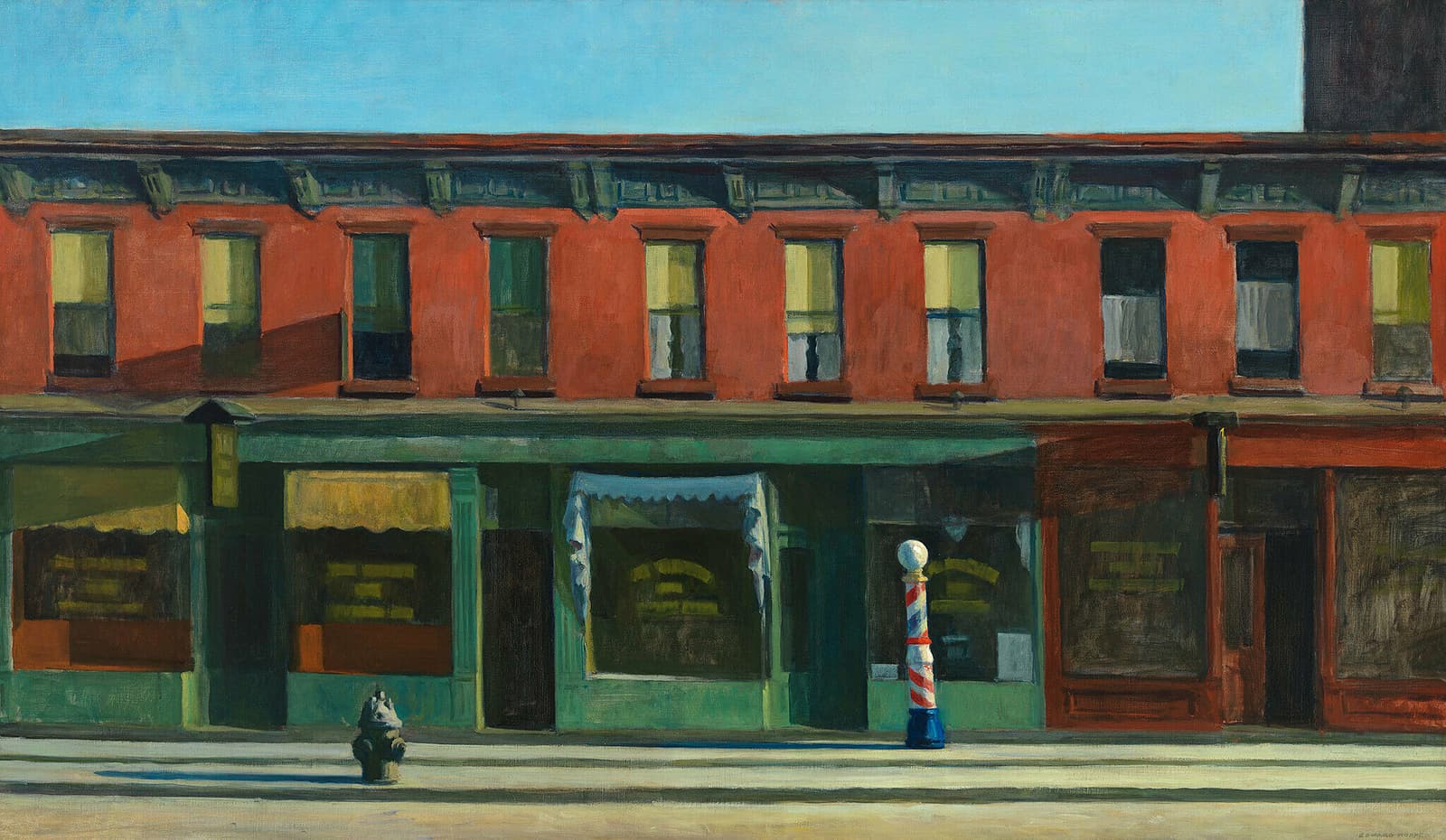
Edward Hopper's Early Sunday Morning is often approached through its emptiness first. The street is vacant, the shopfronts are shut, the signs do not fully resolve, and the row of windows above the awnings suggests lives that have not yet stepped outside. That reading is correct as far as it goes, but it stops too soon.[1] The real force of the painting comes from the way Hopper makes emptiness do structural work. He does not give us a documentary record of Seventh Avenue. He takes a real New York block and compresses it until it becomes a chamber for several kinds of time at once: the hour before commerce begins, the memory of an older street scale, and the pressure of a taller city already arriving from the edge.[1][2][3]
That compression matters because Hopper's New York was never only topographical. The Whitney's artist page describes him as an observer of the everyday who transformed what he saw through imagination into tense, enigmatic atmospheres, and its exhibition material on Edward Hopper's New York emphasizes that his city scenes stay human-scale even as twentieth-century New York races upward around them.[3][5] Early Sunday Morning is one of the clearest demonstrations of that choice. The picture is specific enough to feel walked, remembered, and owned; it is also generalized enough to feel like a whole argument about city life.
Image context: the cover uses the Whitney's collection image of the painting itself because this article turns on the work's exact visual mechanics. The point is not merely that Hopper painted storefronts. It is that he arranged this particular row of brick, glass, blinds, awnings, and light so precisely that the block begins to behave like a suspended stage set.[1]
1) Hopper strips the block down until time becomes visible
The Whitney's collection entry is useful because it names the double move cleanly. Hopper called the work "almost a literal translation of Seventh Avenue," yet the museum notes that he reduced the street to bare essentials.[1] That reduction is the picture's first drama. The window lettering remains illegible. Architectural ornament is present but loosened. Human presence survives only as evidence: curtains, shades, and the slight differences from one upstairs window to the next.[1] Instead of filling the street with anecdote, Hopper lets minor variations carry the burden of life.
This is why the painting does not feel like a straightforward realist transcript even though every element is recognizable. The storefronts on the lower level stretch horizontally in a firm band, while the repeated windows above make the facade read like a measured sequence rather than a bustling neighborhood snapshot.[1] The block feels inhabited and withheld at the same time. Each upstairs opening hints that somebody is inside, but Hopper refuses the satisfying sight of a body at the window or a figure unlocking a door. What remains is interval: the instant before the street's social script begins.
That interval helps explain why the work feels broader than its Greenwich Village source. The Whitney's verbal description observes that Hopper makes the painting look like "any Main Street" even though it derives from a real street he knew.[1] In other words, specificity is not canceled; it is filtered. The painting stays anchored in New York, but it also becomes a transferable image of storefront urban America, caught before activation. That is one reason it keeps returning in the mind. Hopper has removed enough information to prevent the block from settling into one use, one business mix, one hour's chatter.
2) The shadows make the scene theatrical on purpose
The second key decision is light. Whitney's object text points out that the long early-morning shadows in the painting would not actually fall this way on a north-south street such as Seventh Avenue.[1] The teaching guide pushes the point further: Hopper combined neighborhood observation with imagined details, including the long shadows that run perfectly parallel to the buildings.[4] Once you notice that, the painting changes. It is no longer only observed; it is staged.
That staging is not a flaw in realism but one of Hopper's chief methods. The same teaching guide notes that Early Sunday Morning was documented by Hopper as "7th Ave Shops" and connects the composition to theatrical influence, including a production with a nineteenth-century building facade as a stage set and the Hoppers' deep investment in theater and cinema.[4] The impossible light therefore does more than create mood. It tells you that the street has been rewritten for visual pressure. Hopper wants the block to read the way a stage reads: frontal, compressed, legible in silhouette, and charged by a pause before action.
The effect is subtle because nothing sensational happens. Yet the painting's restraint is exactly what intensifies it. The shadows keep the lower edge of the street from becoming inert description. They create a directional force that runs against the still-closed storefronts, so the block seems poised between sleep and opening, memory and performance. In that sense, the title does not merely name a time of day. It names a condition of anticipation.
3) Small signs of life keep the block from going dead
One of Hopper's strongest gifts is that he can remove people without emptying a picture of human tension. In Early Sunday Morning, the barber pole and fire hydrant do more than fill space. They stand upright against the long band of windows and brick, giving the lower register a pair of vertical accents that feel oddly animate.[1] The object-page transcript with Carter Foster goes so far as to read the barber pole as a stand-in for a human presence, even perhaps for Hopper himself, set against the compressed architecture and the hard clarity of morning light.[1]
That reading is persuasive because the painting keeps nudging you toward anthropomorphism without ever becoming playful. The barber pole is one of the only unmistakable business identifiers on the block. Everything else is blurred or suppressed. So the pole acquires a disproportionate charge: it marks trade, routine, grooming, habit, neighborhood repetition. It belongs to the street's coming day, even though the day has not properly started. Likewise the upper windows, with their uneven blinds and curtains, refuse the total vacancy that pure architectural study would produce.[1] The people are absent, but their timing is everywhere.
This is close to what the Whitney means when it describes Hopper as focused on psychological realities rather than mere arrangement.[5] He does not need to show faces to establish inwardness. He can do it through withheld arrival. The block becomes almost uncomfortably intimate because it is full of signs that private life exists just behind the surface and has not yet crossed into public time.
4) The little dark rectangle changes the whole city
The most important detail is easy to miss: the dark rectangular form rising in the upper right. Whitney's interpretive materials repeatedly stress its importance. The teaching guide links it to the urban development Hopper witnessed in Greenwich Village; the object-page transcripts describe it as the silhouette of a larger building going up while he worked, suggesting rapid modernization overtaking the older street.[1][4] Once you see it, the painting's balance shifts.
Without that shape, Early Sunday Morning might remain a superb exercise in storefront stillness. With it, the picture becomes historical. The old row is no longer simply quiet; it is vulnerable. Kim Conaty's essay on Hopper and New York argues that the city in Hopper's work often holds change and changelessness together, and that his New York pictures are drawn to collisions between new and old, civic and residential, public and private.[2] The exhibition page makes the same case at a broader scale, describing a city that boomed upward while Hopper kept returning to unsung utilitarian structures and out-of-the-way corners.[3] The black rectangle turns those general claims into one sharp visual event.
It also helps explain the sadness in the picture. This is not the loneliness of an abandoned block. It is the sadness of a block still standing inside its replacement. The row of stores remains solid, frontal, even stubborn. Yet the future is already visible above it. Hopper later remarked that those houses were gone.[4] The painting therefore holds two facts in a single image: the street exists, and the street is passing away.
That is why Early Sunday Morning still feels so modern. It does not oppose nostalgia and development in simple terms. It understands that a city is always being rewritten, and that the emotional life of streets often lies in these half-visible transitions.[2][3] Hopper gives that process an unusually clear form. He paints a block that seems to be waiting for business to begin, but also waiting to learn whether its scale, tempo, and way of life can survive the city forming behind it.
In that sense, the storefront light is not merely descriptive. It is diagnostic. It reveals how carefully Hopper built this image out of suppression, distortion, and measured repetition.[1][4] The painting looks calm because the tensions have been locked into structure: impossible shadows, blanked-out signage, curtains without bodies, a barber pole without customers, a rising building without a full skyline. The result is not empty atmosphere. It is suspended time, held long enough for memory and pressure to occupy the same block.[1][2][3][5]
Sources
- Whitney Museum of American Art, Early Sunday Morning - collection entry with object text, verbal description, and audio transcripts.
- Kim Conaty, "Approaching a City: Hopper and New York." Whitney Museum of American Art.
- Whitney Museum of American Art, Edward Hopper's New York - exhibition page.
- Whitney Museum of American Art, "Inside/Outside" - teaching guide page for Edward Hopper's New York.
- Whitney Museum of American Art, "Edward Hopper" - artist page.