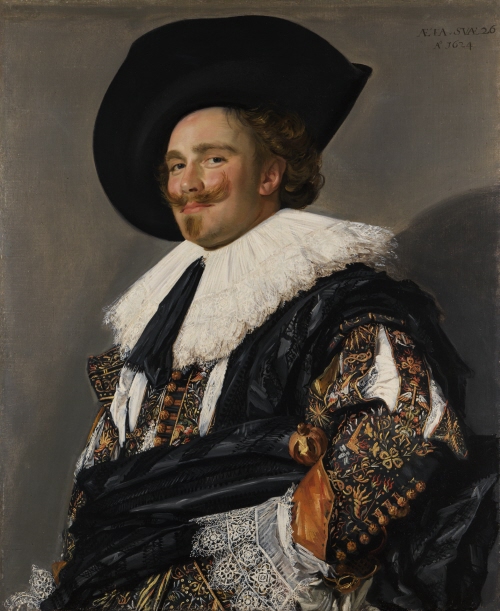
The title pushes viewers in the wrong direction before the painting has even had a chance to work. The Laughing Cavalier sounds like a swaggering anecdote, as if Frans Hals had caught a man in a burst of theatrical amusement. The Wallace Collection's own record corrects that myth directly: the title arrived late, around 1888, and the sitter is neither truly laughing nor actually a "cavalier."[2] Once that correction is in place, the portrait gets sharper. Its real subject is not laughter. It is controlled ease.
That distinction matters because Hals is doing something more technical and more durable than making a face look lively. The Wallace pages identify a twenty-six-year-old sitter in the latest French fashion, posed with his left hand on his hip, wrapped in embroidery keyed to fortune, strength, love, and virtue.[1][2] The portrait's force comes from how all that coded display is made to feel offhand. Hals turns status into something that looks almost improvised. The man does not simply possess rank, taste, and self-assurance. He appears to wear them lightly.
Image context: the lead image uses the Wallace Collection's photograph of the painting rather than a poster or crop because this argument turns on the whole orchestration of the upper body. The hat, ruff, sash, sleeve, and facial expression do not operate independently; they build one performance of poised, social ease.[1][2]
The smile is too small to be the point
The first thing to notice is that the sitter does not laugh in any ordinary sense.[2] His mouth lifts, but only slightly. The moustache sharpens the effect by making the expression legible from a distance while withholding full disclosure up close. The result is more interesting than overt merriment would be. A broad grin would spend the picture's energy immediately. Hals instead gives the face a narrow margin of animation, enough to produce vitality without sacrificing dignity.[1][2]
That is why the title has survived despite being inaccurate.[2] People keep wanting the portrait to laugh because the whole image behaves as though it is on the edge of speech or amusement. The upturned moustache, the bright eyes, and the slight pressure at the corners of the mouth all suggest a social encounter already in progress.[1] Yet the expression never collapses into anecdote. It remains formal enough to keep the painting inside elite portraiture and mobile enough to keep it from stiffening there.
The Wallace Collection's 2021 exhibition text is useful on this exact point. It argues that Hals made male portraits unusually vivid, full of vitality and presence, and that he transformed portraiture through pose, fashion, and painting technique.[3] The Laughing Cavalier condenses that achievement into one of its cleanest forms. The sitter feels near, but not familiar. He feels socially available, but not intimate. Hals lets the portrait flirt with informality without surrendering the structure of formality.
The embroidery does the social talking
If the face tempts viewers into reading character, the costume keeps pulling the painting back toward social construction. The Wallace's detailed collection entry describes the embroidered doublet as a field of emblems linked to fortune, strength, love, and virtue, and stresses that the latest French fashions shown here were accessible only to the Dutch elite.[2] This is not ornamental excess added after the fact. The clothing is part of the portrait's argument.
That argument becomes clearer once the sitter stops being treated as a generic dandy. The image is built from signs of eligibility, self-command, and cultivated display. Wallace's collection record even notes that the man is likely a bachelor, partly because of his dashing attire and his left-facing orientation, which differs from the rightward turn often used for husbands in paired portraits.[2] Read that way, the painting becomes a public statement about availability and status, not merely a likeness of a face.
What keeps this coded surface from turning inert is Hals's refusal to paint costume as static inventory. The embroidery is dense, but it does not feel pinned down. It flickers across the torso as a field of energetic marks, so symbolic content and painterly liveliness arrive together.[2][4] The portrait never asks the viewer to choose between reading the clothing and admiring the handling. In Hals, social meaning and brush activity are locked to one another.
The hand on the hip turns hierarchy into body language
The hand-on-hip pose is just as important as the costume because it converts rank into posture.[1] The gesture creates an outward angle in the elbow and opens the torso slightly toward the viewer. It is self-assertive, but not defensive. The body claims room. At the same time, the tilt of the shoulders and head keeps the gesture from becoming rigid. Hals does not freeze the sitter into heraldic stillness. He makes command look easy.
The Frans Hals Museum's own artist page helps explain why that ease matters. It notes that Hals became famous for lively brushwork that gives portraits movement and brings subjects to life, while also pointing out that wealthy sitters of his day were usually portrayed with straight faces.[4] That combination is exactly what makes this painting so pointed. Hals keeps the dignity expected of a rich client, yet pushes the body and expression right to the edge of animation.
This is where Hals differs from portrait traditions that advertise status by sheer stiffness. He wants the viewer to register control, but he also wants the sitter to appear fully alive inside that control.[1][3][4] The left hand on the hip does not merely signify confidence. It stages confidence as a bodily habit. The portrait's social ambition is therefore inseparable from its kinetic one. It sells breeding by making poise look natural.
The blacks keep the picture from becoming costume theater
The Wallace Collection's main page points to the black sash as a crucial passage and quotes Van Gogh's delighted claim that Hals must have had "27 blacks."[1] The phrase is memorable because it names something viewers can miss if they focus only on the embroidery and expression. Much of the portrait's charge comes from tonal intelligence. Hals uses a restricted dark range to create variation, pressure, and movement across the costume.
That tonal play matters because it prevents the painting from becoming a simple parade of expensive details. The sash, sleeves, and darker passages of the doublet are not flat luxury signals. They breathe. The Frans Hals Museum's description of his method is useful here because it treats the loose brushstroke not as accident but as the engine of motion and presence.[4] That is exactly what happens here. The costume glitters, but it also turns. The blacks differentiate surface from surface and keep the body underneath the fashion legible.
This is the deeper reason the portrait still feels alive. Hals does not make liveliness depend on open action. He makes it depend on pictorial instability held in balance. The expression is not fully disclosed. The costume is overloaded with code yet remains painterly. The pose is formal yet relaxed. The tonal range is narrow yet full of internal variation.[1][2][4] Everything in the picture is slightly more mobile than convention requires.
Why the painting still holds
Once those parts are read together, The Laughing Cavalier stops looking like a famous face with a misleading nickname. It becomes a portrait about the manufacture of ease. Hals takes a man loaded with the signs of wealth, fashion, and self-presentation and paints him so that display feels continuous with temperament.[1][2][3] The painting does not deny that status is being performed. Its brilliance lies in making performance look fully inhabited.
That is why the work keeps its grip. The almost-smile is only one component. The real achievement is larger: embroidery, black tonal play, hand-on-hip stance, and facial alertness all work together to turn hierarchy into lived style.[1][2][4] Hals makes elite self-fashioning look quick, human, and dangerously close to spontaneity. The title may be wrong. The vitality is not.
Sources
- The Wallace Collection, "The Laughing Cavalier" - main collection page with the sitter's age, the hand-on-hip pose, the black sash, and the museum's note on Hals's lifelike vitality.
- The Wallace Collection Online, "The Laughing Cavalier" - detailed object record covering the late title, elite French fashion, symbolic embroidery, and the likely bachelor status of the sitter.
- The Wallace Collection, "Frans Hals and Male Portraiture" - exhibition text on how Hals used pose, fashion, and painting technique to make male portraits feel unusually vivid and alive.
- Frans Hals Museum, "About Frans Hals" - museum overview on Hals's loose brushwork, his elite portrait clientele, and the social boundary between formal straight-faced portraiture and more openly smiling tronies.
Editor’s Pick Review
This piece wins the May 10 editor-pick run because it turns a familiar museum icon into a fresh, verifiable act of looking. The argument is not a generic praise note for Hals; it works from the late title, the sitter's costume code, the hand-on-hip pose, and the tonal range of the blacks, then shows how those visible details manufacture a social feeling of ease. That gives the article both close-reading pleasure and a clear critical spine.
It also fits the stricter visual policy especially well. The cover is an immersive, topic-grounded image of the work under discussion, not an analytical support graphic, and the caption explains why the whole painting matters to the thesis. The Chinese version keeps the same structure while sounding natural in art-critical Chinese, with good rhythm around phrases such as “被严格控制过的从容,” “社会构造,” and “被稳稳控制住的轻度不稳定.” Among the 24-hour candidate pool, it has the cleanest combination of source discipline, visual relevance, English prose control, and translation quality.