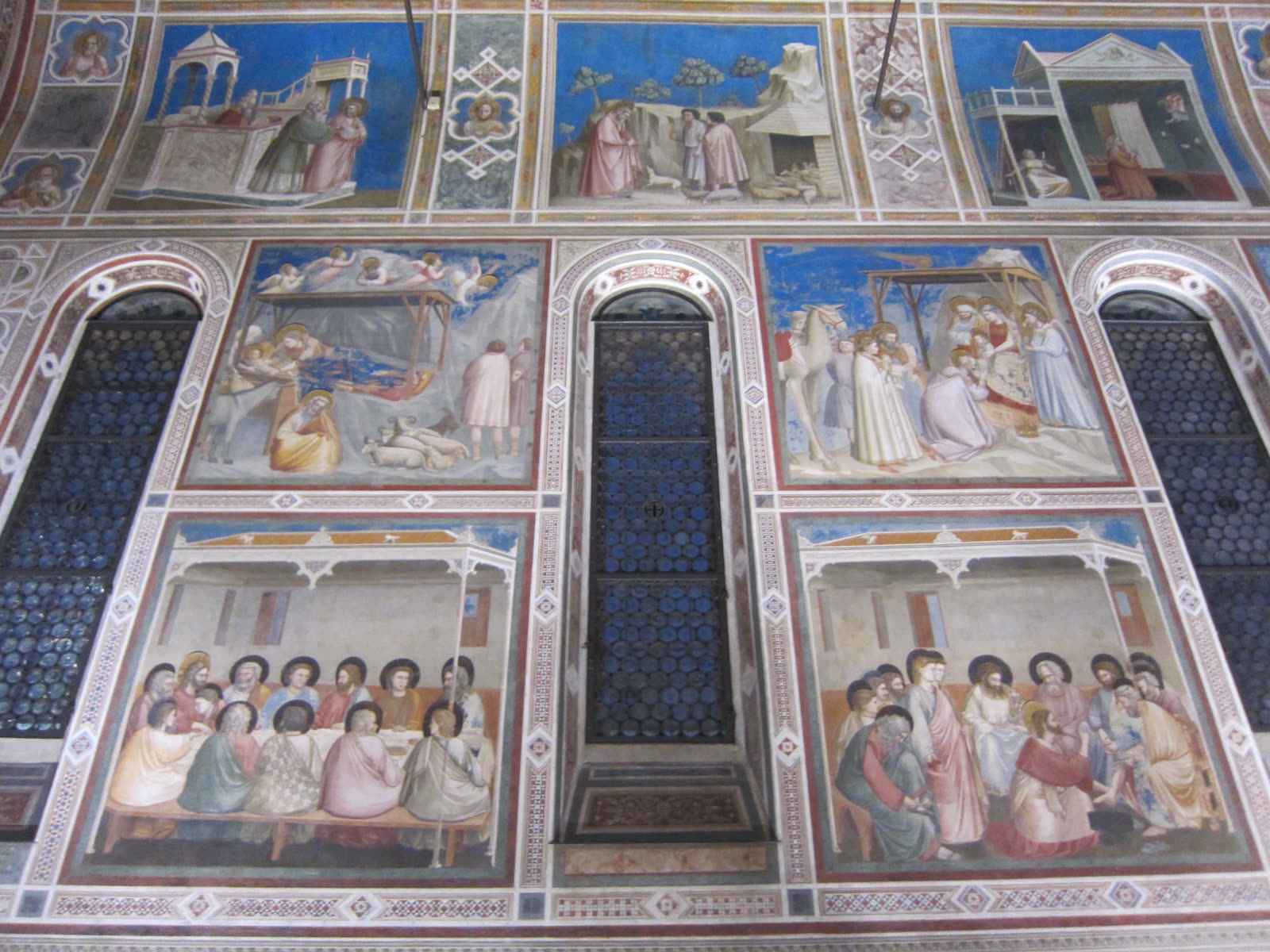
Fresco is often praised for durability, but that description catches only the aftereffect and misses the real artistic proposition.[1][2] The medium matters because it does not allow painting to behave like an easily movable surface. A fresco is made on architecture, into architecture, and finally read through architecture. Wet plaster fixes the tempo of work, the scale of each day's labor, and even the sequence of compositional decisions. By the time the painting dries, the wall is no longer a support sitting behind the image. It has become part of the image's structure.[1][2][5]
That is why Giotto's Arena Chapel in Padua is such a useful place to think about fresco as a medium rather than as a vague synonym for mural painting.[2][3][4] Inside the chapel, one does not merely face separate pictures. One enters a room in which narrative cycles, painted faux marble, vault decoration, and architectural enclosure all operate together. Fresco here is not a neutral delivery system for images. It is the reason the room can feel at once pictorial, bodily, and liturgically staged.[3]
Image context: the cover photograph is useful because it shows the point that reproduction alone can flatten away. The frescoes do not sit on isolated panels; they wrap the nave, sit under the blue barrel vault, and depend on the chapel's narrow, vertical enclosure to produce their force.[3][7]
Fresco starts by making the wall part of the image
Britannica's basic description of buon fresco is still the cleanest technical starting point: pigment is laid onto fresh plaster so that, as the plaster dries, the color becomes integral to the wall surface itself.[1] The Met's historical overview fills in the practical sequence. A rough coat of lime plaster, the arriccio, is laid down first; the design can be drawn on that surface; then a smooth layer of intonaco is applied in smaller sections, each one sized to what can be painted before the plaster loses the right degree of moisture.[2] That process makes fresco fundamentally different from easel painting. The artist is not endlessly revising a portable object. The artist is working against chemistry and setting time.[1][2]
This is also why fresco so often produces a special kind of gravity. Because the paint is literally bound into the wall, the image inherits something of the wall's authority.[1] Even when the subject is narrative and animated, the medium keeps a sense of mass underneath it. The figures may move, lament, greet, or judge, but they do so on a surface that behaves more like built space than like fabric. Fresco can look tender, but it never entirely stops feeling structural.[1][2]
Wet plaster turns composition into a clock
The technical vocabulary matters here because each term names a different pressure inside the act of painting.[1][2] Britannica notes that the final coat of intonaco is applied only to as much area as can be completed in one session, and those sections are called giornate, "a day's work."[1] The Met makes the same point historically: the overall composition is broken into these workable units, and water-diluted pigment is brushed directly onto the fresh plaster.[2] A fresco, then, is never only a picture plan. It is also a labor schedule hiding inside a picture.
Getty's conservation volume shows why this matters even after centuries have passed.[5] Conservators still trace boundaries of giornate, look for incisions in fresh intonaco, and study where work fields meet, overlap, or register later correction.[5] In other words, the wall keeps a record of decision-making. Even when seams are visually disguised, the medium preserves the history of execution beneath the image's apparent wholeness.[1][5]
That hidden clock affects style. Fresco rewards clarity of mass, legible directional movement, and compositional decisions that can survive being distributed across separate work fields.[1][2] It is not an accident that major fresco cycles often feel architectonic even in their most emotional passages. The medium pushes painters toward forms strong enough to hold together across time slices. Fresco is painting, but it is painting with deadlines physically embedded in it.[1][5]
Giotto shows what the medium can do to a room
The Arena Chapel demonstrates the medium's immersive potential with unusual clarity.[3][4] Smarthistory's walkthrough stresses the feeling of being enclosed by images and notices that even the bands between narrative scenes act like painted architecture rather than empty separators.[3] That observation matters because it reveals what fresco does best: it can turn every available surface into part of one pictorial argument. The false marble revetment, the tiered scenes from the lives of Joachim, Anne, Mary, and Christ, and the blue vault overhead do not read as detachable illustrations. They behave as one environment.[3]
The result is not just visual abundance. It is pictorial order under bodily conditions. A viewer stands inside a narrow chapel and reads the sequence by moving, lifting the head, and tracking how scenes answer one another across the side walls.[3] Fresco's scale and fixity make that bodily reading unavoidable. The medium does not merely present an image to the eye. It arranges the viewer within a programmed field of looking.[2][3]
This is where Giotto's importance and the medium's logic meet. The Met credits him with turning the flat world of earlier Italian painting toward a more measurable, convincing analogue of lived space, and the Arena Chapel is a decisive proof of that transformation.[2] Fresco gave him not only a large surface but also a total interior in which narrative, mass, and spatial coherence could be tested at once.[2][3]
Color, correction, and loss are material facts here
Fresco's reputation for permanence is deserved, but it is never absolute.[1][2] The same chemistry that binds pigment into wet plaster also imposes restrictions. Britannica notes that true fresco demands speed and does not allow ordinary overpainting; correction requires a fresh coat of plaster or later intervention in secco.[1] The Met makes the conservation consequence plain: embellishments painted onto dry walls are far less durable and tend to flake over time.[2]
Smarthistory's discussion of the Arena Chapel turns that technical distinction into a vivid case study.[4] In Giotto's Entry into Jerusalem, the blue around Christ's waist is now largely missing because the expensive ultramarine was applied a secco rather than fully bound into wet plaster.[4] The reason was economic and optical at once: lapis lazuli was costly, and the patron wanted its brilliance preserved rather than dulled by admixture with plaster.[4] What survives, then, is not just an image but a history of compromise among cost, color, material behavior, and time.[1][4]
That detail is one of fresco's most revealing lessons. The medium does not let aesthetics float free from procedure. Color choice, sequence, and even patronal ambition end up legible in the wall's condition.[4][5] Damage is not external to the story. It often tells the story of how the image was made.
Conservation becomes part of the work's present tense
Because fresco remains tied to wall, moisture, air, and visitation, conservation cannot be treated as a backstage matter.[2][5][6] The Met notes the medium's vulnerability to damp conditions.[2] Getty's conservation literature, though focused on many sites beyond Padua, repeatedly returns to the same technical realities: intonaco can crack or detach, salts migrate, a secco areas behave differently from true fresco, and the mapping of work fields becomes part of diagnosis.[5] A wall painting lives in an environmental system, not in isolation.
The current visit protocol at the Scrovegni Chapel makes that dependency visible in practical form.[6] Visitors enter in groups of no more than twenty-five, wait in a compensation chamber for fifteen minutes so the microclimate can stabilize, and then spend fifteen minutes inside the chapel itself.[6] That routine may sound administrative, but it is really a contemporary extension of the medium's logic. Fresco still depends on the room behaving correctly. The art remains inseparable from climate control, thresholds, and the management of bodies in space.[5][6]
This is why fresco still feels different from almost every other pictorial medium. Its great subject is relation: pigment to lime, image to wall, day of labor to finished whole, and present viewer to a room that must be carefully kept alive.[1][2][5][6] To say that fresco lasts is true. To say only that is too small. Fresco matters because it makes painting answer to architecture, and architecture answer back.
Sources
- Encyclopaedia Britannica, "Fresco painting" - overview of buon fresco, intonaco, giornate, secco, and the medium's chemical binding to the wall.
- The Metropolitan Museum of Art, "Italian Painting of the Later Middle Ages" - historical and technical summary of arriccio, intonaco, giornate, secco durability, and Giotto's Arena Chapel.
- Smarthistory, "Giotto, Arena (Scrovegni) Chapel (part 1 of 4)" - walkthrough emphasizing enclosure, painted faux marble, and the chapel as an image-saturated room.
- Smarthistory, "Giotto, Arena (Scrovegni) Chapel (part 2 of 4)" - discussion of buon fresco, missing ultramarine passages, and the role of a secco application in the chapel.
- Getty Conservation Institute, The Conservation of Wall Paintings - technical discussion of intonaco, giornate/work fields, a secco areas, and diagnostic mapping in wall-painting conservation.
- Padova Musei Civici, "Svolgimento della visita" - current Scrovegni Chapel visit protocol covering visitor limits and the microclimate stabilization chamber.
- Wikimedia Commons, "File:Cappella degli Scrovegni (Padua) - Interior 04.jpg" - in-situ interior photograph of the chapel used for the article image.