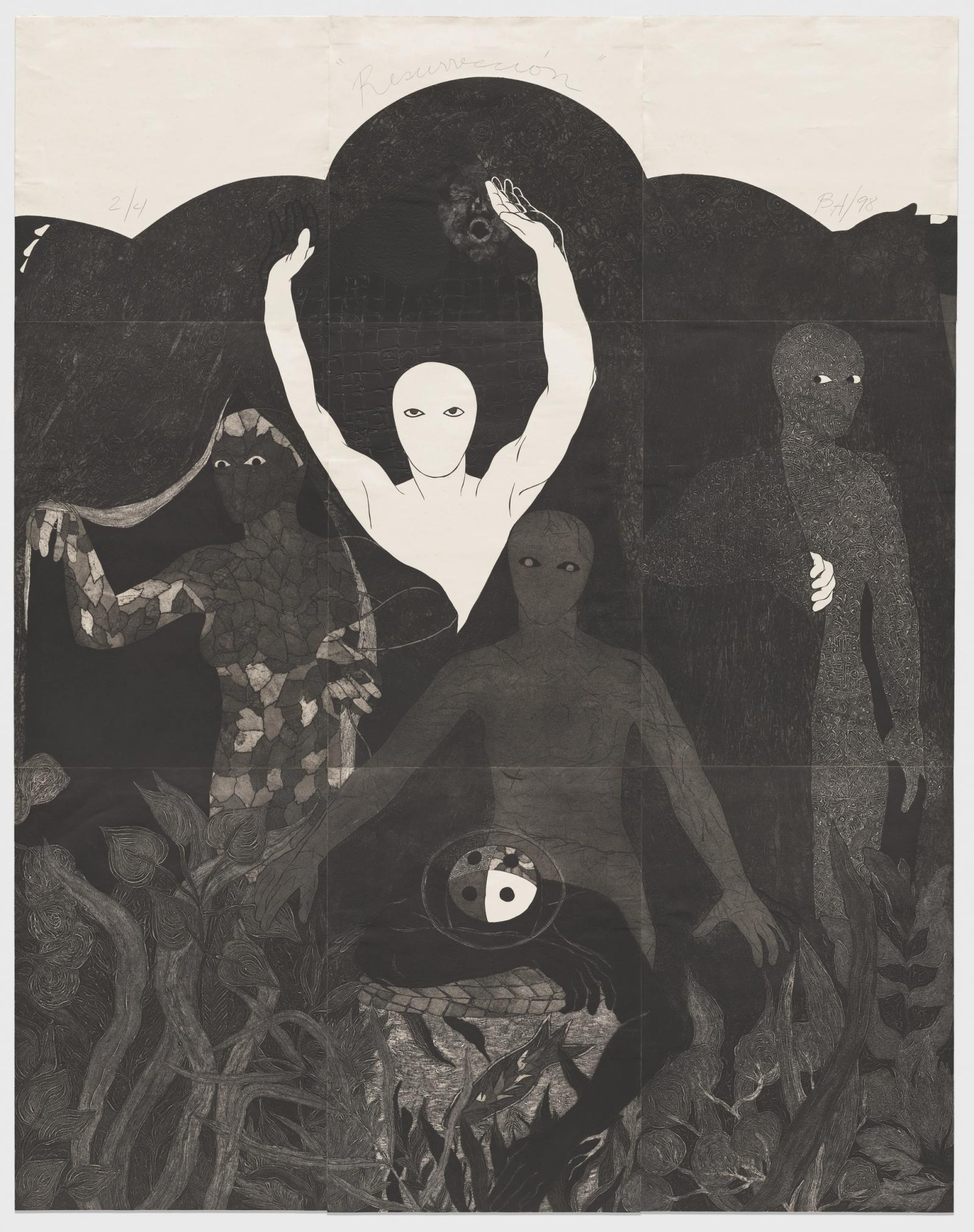
Image context: the cover is MoMA's direct museum reproduction of the exact nine-sheet print. Its seams, uneven fields of black, and densely patterned bodies are not incidental wear. They are evidence of how Ayón made monumentality from separate passes through a press.[1]
The first thing Belkis Ayón withholds is the mouth. Her figures have eyes—enormous ones, dark-rimmed and steadily directed at us—but many cannot answer, explain, or confess. Their skin carries scales, crosses, spirals, vegetation, and abrasive-looking grain. What speech cannot do, surface takes over.
That exchange is the key to Ayón's brief, concentrated career. Born in Havana in 1967, she devoted most of her mature work to stories associated with Abakuá, an Afro-Cuban fraternal society whose knowledge is guarded and whose membership is male. She did not simply illustrate a ready-made sequence of sacred scenes. Working as a woman, an atheist, and a printmaker outside the society, she built an independent visual language around material that was transmitted largely through words, music, signs, objects, and performance rather than a public figurative canon.[2][4][6]
Her solution was formally audacious. Ayón used collagraphy—a process in which a plate is constructed as a textured collage—to make black, white, and grey feel almost tactile. Then she joined individually printed sheets until her figures approached human scale. Secrecy stopped being a small, sealed subject. It became an environment that could surround a viewer without surrendering all that it knew.
A closed tradition became an open visual problem
Abakuá was established in nineteenth-century Cuba by Africans carried from the Cross River region of what is now southeastern Nigeria and southwestern Cameroon. It served protection and mutual aid as well as religious and social purposes. Its rites preserve histories through drumming, chants, dance, symbolic writing, plant and animal materials, and masked performance.[6] That complexity matters. Calling it only a “secret cult” turns a living institution into atmosphere; calling Ayón's work an exposé imagines that her prints simply unlocked it.
They do something more interesting. As a student, Ayón began sustained work with Abakuá subjects in the mid-1980s. The founding narrative gave her a charged protagonist: Sikán, the woman who encounters the sacred fish and its voice, discloses knowledge reserved by men, and is condemned to die. The surviving versions of this story belong to a ritual culture Ayón did not claim to reproduce neutrally. She rearranged its figures, crossed them with Christian compositions, and allowed Sikán to appear not merely as the cautionary betrayer of an inherited account but as witness, double, sacrifice, and resistant presence.[2][3][7]
This was neither ethnographic transcription nor arbitrary borrowing. Ayón researched the tradition closely while making the limits of her position productive. She could not offer an initiate's view, so she did not pretend to. Instead, she invented a theater of partial access: symbols repeat without becoming a glossary; ceremonies appear without resolving into instructions; faces look directly out while their mouths remain absent.
The result keeps the viewer in a useful state of uncertainty. We can recognize power moving through a scene without possessing the secret that organizes it. Ayón makes looking possible but mastery impossible.
The plate remembered every abrasion
Collagraphy begins with construction. Paper, cardboard, sandpaper, varnish, chalk, acrylic, and other materials can be fixed to a support so that one area drinks ink, another resists it, and a third embosses the paper under pressure. The plate is less like a smooth copper surface than a shallow relief. When it passes through the press, texture becomes tone.[2][7]
Ayón exploited that translation with extraordinary control. A piece of abrasive material could become a dense skin of dots. Cut paper could produce a sharp pale contour. Scored lines might emerge as hair, water, flame, or a ritual sign. Black was never just one black: it could be velvety, scraped, smoky, scaled, or nearly reflective. White was not empty paper left behind. It often arrived bearing the pressed memory of the matrix.
That is visible in I Always Return, made in 1993 and printed in 1994. A large pale figure floats above three smaller bodies, its torso filled with botanical detail and its head sealed by marks. Below, raised hands and crossed arms form three different responses—appeal, protection, submission, or ritual attention remain possible. The Cleveland Museum identifies the central figure as presumably Sikán and records Ayón's own identification with her: “Sikán is a transgressor … as I also see myself.”[5]
The statement clarifies an affinity, not a one-to-one autobiography. Ayón did not turn Sikán into a conventional self-portrait. She made her recur across bodies whose identities remain fluid. Pattern carries personality where portrait features would ordinarily settle it. A fish scale, a leaf, a palm, or a patch of rough grey can distinguish one presence from another while keeping each inside a shared symbolic world.
Joined sheets changed the social distance
A print is often imagined as intimate: paper held in the hands, an image approached at reading distance. Ayón broke that expectation without abandoning the press. Beginning in 1988, she assembled large works from manageable sections, commonly around 100 by 70 centimetres each. Later compositions could require nine or twelve sheets. The practical limit of the press became a modular unit rather than a ceiling.[7]
Scale changed the relationship between image and body. In a small print, a viewer can survey the whole scene and then choose a detail. In Ayón's monumental works, the figures meet the viewer first. Seams divide them, dark zones extend beyond peripheral vision, and near-life-size eyes hold their ground. The image behaves less like a window than a set.
The 1991 black-and-white version of The Supper makes that theatrical logic explicit. Ayón fused an Abakuá initiation banquet with the compositional memory of the Christian Last Supper, placed women in the gathering, and moved Sikán into the symbolic center. This is syncretism used as an argument: a familiar structure is made strange enough to expose who normally gets to occupy its positions of authority.[2][7]
In Resurrection from 1998, the work shown above, nine sheets form an expanse roughly 2.77 metres high and 2.16 metres wide. A sacred fish anchors the lower center; ghostly bodies accumulate around it; several possible manifestations of Sikán emerge across a field that feels at once like crowd, grotto, and altar. MoMA's record notes a crucial difference within that assembly: one upper figure has a mouth while many surrounding figures do not.[1] Voice is not absent from the work. It is scarce, unevenly distributed, and therefore political.
The eyes refuse the easy meaning of silence
Mouthlessness can look like pure victimhood, especially in a body of work organized around a woman punished for disclosing knowledge. Ayón complicates that reading through the eyes. Her figures do not avert their gaze. They watch one another, monitor the ritual, and frequently meet the spectator so directly that looking begins to feel reciprocal.
This is why “giving Sikán a voice,” though useful as shorthand, does not quite describe the achievement. Ayón did not simply add speech to a silenced heroine. She gave silence a visual agency. A mouth might explain itself and close the interpretive gap. An eye can accuse, invite, or withhold without deciding which response the viewer deserves.
Texture deepens that refusal. The surfaces seem to carry messages, but they never become fully legible text. Bodies are patterned like archives whose cataloguing system is missing. The viewer can tell that differences matter—the scale around one torso, the white hand inside a dark crowd, the cross or fish lodged in a field of marks—yet the prints do not reward a hunt for one master key.
That boundary protects the work from two reductions. One would treat Abakuá as an exotic storehouse of signs. The other would turn every sign into a transparent feminist slogan. Ayón certainly brought a woman's position to a men-only narrative and identified with its punished female transgressor. But her scenes also contain loyalty, grief, initiation, spiritual longing, community, and fear. Their power structures are contested without being flattened into a single verdict.[3][7]
Monochrome was a decision, not a shortage effect
Ayón reached artistic maturity during Cuba's severe economic crisis after the collapse of the Soviet bloc. Materials and travel became difficult, and the pressure of the 1990s inevitably entered the conditions under which she worked. When invited to the 1993 Venice Biennale, she set out for Havana's airport by bicycle while her father followed on another bicycle carrying her print. He did not arrive in time; with the help of a traveler, the work reached Italy days later.[4]
It is a memorable story because it makes the physical life of a print impossible to ignore: sheets have weight, planes have deadlines, and an international career can depend on improvised transport. But scarcity should not be allowed to explain away Ayón's formal intelligence. Her engagement with Abakuá began before the worst crisis. She enlarged her prints by 1988, and in 1991 she committed to black and white because she considered it better suited to the existential drama of the material.[3][7]
Monochrome gave her more, not less. Removing hue concentrated attention on absorbency, pressure, edge, and the moral contrast between a pale body and the darkness that holds it. Joined paper let her make scale without one impossible matrix. Cheap or ordinary plate materials became capable of extraordinary tonal range. Constraint mattered, but she converted it into a grammar.
The Reina Sofía retrospective places her 1990s monumentality beside censorship, intolerance, exclusion, inequality, and mechanisms of control.[3] That is a curator's historical frame rather than a decoder ring for each scene. It is persuasive because Ayón's formal choices already stage those pressures: who may know, who may speak, who becomes visible, and who controls the terms of belonging.
The work returns without becoming less secret
Ayón died in 1999 at thirty-two, leaving a career of little more than a decade. The afterlife has been far longer. The Fowler Museum mounted the first U.S. museum retrospective in 2016; the Reina Sofía presented the first European retrospective in 2021–22; the Venice Biennale included her in The Milk of Dreams in 2022; and Bildmuseet assembled more than thirty works and sketches for Mythologies in 2025.[2][3][4][7]
Those exhibitions have made the work more visible without making it easier. In fact, the museum wall intensifies Ayón's central paradox. A print made from cardboard scraps and abrasive surfaces can command an architectural space. A story associated with restricted knowledge can confront a broad public. A figure without a mouth can dominate a room.
That is why I Always Return feels like more than a title. Ayón's figures return across sheets, impressions, collections, and new encounters, but repetition never exhausts them. The press transfers an image while preserving the evidence of pressure. The myth is retold while withholding the fantasy of complete access.
Belkis Ayón did not solve secrecy by turning it into spectacle. She gave it scale, texture, and a gaze. Then she made the viewer stand inside the distance between seeing and knowing.
Sources
- Museum of Modern Art, “Belkis Ayón, Resurrection (Resurrección), 1998” — exact work record, nine-sheet format, dimensions, iconography, and the museum photograph used as the cover.
- UCLA Newsroom and Fowler Museum, “Fowler Museum presents first solo U.S. museum exhibition of Cuban artist Belkis Ayón” (August 30, 2016) — retrospective chronology, Abakuá narrative, matrix materials, monochrome palette, scale, and artist statements.
- Museo Nacional Centro de Arte Reina Sofía, “Belkis Ayón” — official retrospective essay on her training, 1990s Cuban context, monumentality, syncretism, and late work.
- La Biennale di Venezia, “Belkis Ayón,” The Milk of Dreams (2022) — institutional profile covering her 1993 Venice participation, collagraph process, atheism, and recurring treatment of Sikán.
- Cleveland Museum of Art, “Belkis Ayón, I Always Return, 1993, printed 1994” — object record, dimensions, process description, provenance, and Ayón's statement identifying with Sikán as a transgressor.
- University Press of Mississippi, Lydia Cabrera, The Sacred Language of the Abakuá, translated and annotated edition — historical grounding on Cross River origins, mutual aid, ritual performance, oral transmission, and Cuban cultural influence.
- Bildmuseet, Umeå University, “Belkis Ayón / Mythologies” (2025) — detailed institutional account of her materials, modular printing, move to black and white, major compositions, and reinterpretation of Sikán.