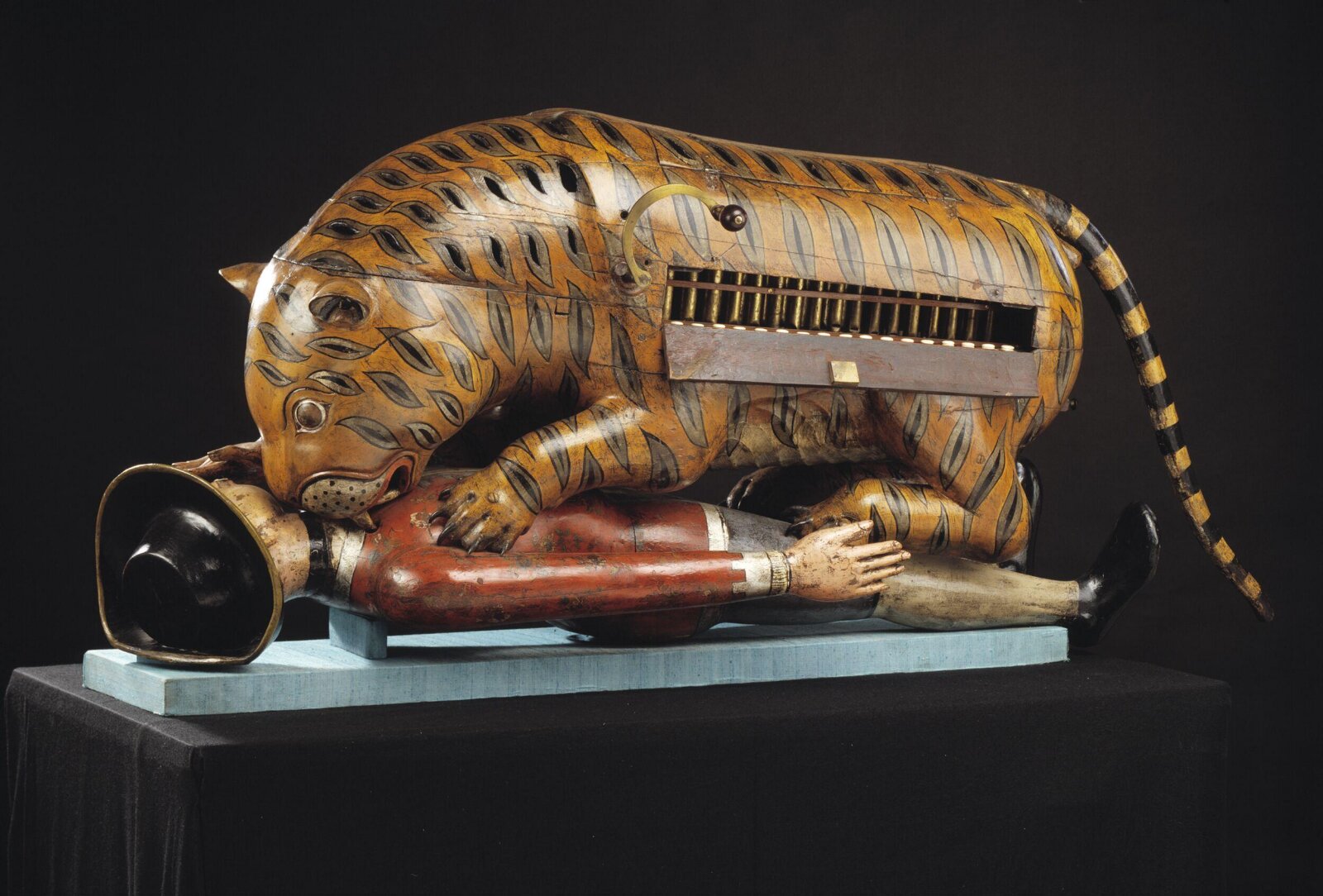
Image context: the cover is the Victoria and Albert Museum's documentary studio photograph of the exact work. The open panel is essential: it lets the carved tiger remain an animal while revealing that its body is also an instrument case.[1]
At first glance, nothing in Tipu's Tiger needs to move. The tiger has landed. One paw pins the European man's chest, another bears down near his hip, and the jaws have found his neck. His body runs beneath the animal like a base made for the sculpture. The outcome seems carved in advance.
Then the tiger's flank opens, and a row of pipes and button keys appears.
This interruption is the work's great formal surprise. Made in Mysore around 1790 for Tipu Sultan, the nearly life-size painted wooden group is at once a violent image, a semi-automaton, and a small organ. Turn its handle and bellows produce sounds assigned to predator and victim while the man's forearm rises and falls. Open the hinged side and the same striped body becomes a cabinet for a keyboard.[1][2]
The mechanism does not make the scene more realistic. It makes the viewer responsible for completing it. The tiger holds still; the victim moves; an operator supplies the breath. That distribution of agency is why the object remains more unsettling than a clever mechanical toy. It stages mastery as something that must be performed—and then shows how completely a performance can change when a conquered object acquires a new operator.
The picture has already decided who wins
At 178 centimetres long, the object is approximately the height of a tall person turned sideways. Its scale prevents the victim from becoming a miniature joke. He occupies the full horizontal span beneath the tiger, dressed in a red coat, pale breeches and stockings, black shoes, and a broad dark hat. Yet his body is compositionally demoted. The straight line of his legs becomes a shelf for the tiger's bent mass; his face is pushed toward the far end, almost beyond the animal's muzzle.[1]
The tiger is not naturalistically striped. Black, leaf-shaped marks repeat across orange and cream bands, changing direction as they cross shoulder, ribs, haunch, and tail. The pattern makes the surface restless even while the body stays fixed. Its huge painted eyes are frontal enough to address the viewer, but its mouth points down. It can supervise the room and consume its victim at once.
The man is both specific and generic. His coat, waistcoat, breeches, stockings, and hat mark him as European, but the V&A's record notes that the costume mixes features associated with several earlier decades rather than presenting an exact 1790s uniform. No name is attached to him. Early British descriptions promoted him to a European “officer,” but the carving itself offers a type: the Company's world compressed into one available body.[1][3]
That generic quality matters. A portrait would memorialize one death. A type makes the attack repeatable. Every activation can defeat the European again.
The victim moves; the tiger holds still
Automata often impress by imitating life throughout a figure: eyes roll, jaws open, wings beat, or feet advance. Tipu's Tiger uses motion much more sparingly. The tiger's bite does not deepen. Its paws do not rake. Instead, the jointed left forearm of the man travels between his mouth and the tiger's ear while the internal bellows generate a growl and a plaintive human sound.[1]
The economy is brutal. Movement belongs to the losing body. The tiger needs no animation because the carved pose has already made its power absolute; only suffering has to recur in time. The rising arm can look like resistance, an appeal, or a reflex. None of those gestures changes the arrangement. Repetition turns the possibility of escape into a loop.
Sound makes that loop less stable than the carving. A painted open mouth only asks the eye to imagine a cry. Bellows push the cry into the room, where it competes with the tiger's mechanical growl and with whatever music is played on the concealed organ. These are not recordings of animal and human voices. They are crafted substitutions: air, pipes, valves, and moving parts agreeing to stand for pain.
The person at the handle therefore occupies an uncomfortable position. The operator is neither simply watching the attack nor represented inside it. By supplying force, that person helps the tiger growl, helps the victim protest, and resets the arm for another cycle. The scene's violence is not self-running. Its audience becomes its engine.
A keyboard interrupts the animal
The open flank in the cover photograph destroys any illusion that the tiger is a seamless body. A long rectangular hatch cuts across the stripes; dark pipes form a disciplined row; pale button keys sit immediately below them. The curve of the back says animal, while the aperture says furniture, workshop, and instrument.[1]
That collision of visual languages is more revealing than a hidden mechanism would be. A clockwork concealed forever could support the fantasy of a magically living beast. A playable keyboard advertises construction. It permits tunes that have no necessary relation to the attack, allowing melody to run alongside growls and cries. The machine can narrate one fixed political victory while the instrument remains open to different sequences of notes.
The makers are unrecorded, and the exact circumstances of the commission are unknown. The V&A dates the work to about 1790, within a range of roughly 1785–94, and notes that it was certainly known by 1792 through a now-lost drawing attributed to the military artist James Hunter. A museum label describes the painted casing as South Indian workmanship and the mechanism as European in origin. That is evidence of joined technical traditions, not a license to invent a named French or Indian maker where the record supplies none.[1]
The uncertainty is useful. It keeps close looking focused on what the object can prove: multiple crafts had to cooperate. Carvers made two interlocked bodies; painters converted wooden shells into skin and clothing; organ builders fitted breath, pitch, and noise inside the tiger; a mechanic transferred the crank's force to a human limb. The result does not hide collaboration beneath a single heroic signature. Its anonymous complexity remains visible every time the panel opens.
The stripes were a court language
The tiger was not chosen simply because it made an exciting predator. Tipu Sultan, who ruled Mysore from 1782 until his death in 1799, used tiger heads and a repeated stripe device across the material language of his court. The pattern appeared on weapons, coinage, throne fittings, military mortars, and dress. A surviving war turban taken at Srirangapatna carries quilted bubri, the stylized stripes associated with him.[2][4]
On the automaton, the motif expands from ornament into action. Elsewhere a tiger head might terminate a gun or a stripe might announce ownership; here the emblem has a whole body and a European opponent. The court sign becomes a plot.
That plot emerged during sustained resistance to East India Company expansion in southern India. Tipu and his father, Haidar Ali, built a state capable of fighting Company armies and their Indian allies; by the 1790s, tiger imagery made Tipu's sovereignty instantly legible to both supporters and enemies.[2][4] The automaton does not explain those wars, and it should not be treated as a documentary report of one battle. It works more like a victory fantasy: the political relation has been reduced to predator above, European below.
Even that reading needs a boundary. Later British writers confidently claimed that Tipu ordered the machine as proof of his hatred and watched its “miserable triumph” for amusement. Those accounts tell us a great deal about how the captured object was introduced to British audiences. They do not give us a neutral transcript of how it was used in the palace. The V&A record can establish that the tiger was found in the music room at Srirangapatna and made for Tipu; it also states plainly that the circumstances of its commission remain unknown.[1][3]
Capture changed the operator
In May 1799, East India Company forces and their allies stormed Srirangapatna. Tipu was killed, the city and palace were looted, and prize agents subsequently valued and divided the royal treasury. The tiger was shipped to London in 1800. It entered East India House, was on public display by at least 1803, and became one of the Company's best-known museum objects.[1][2][4]
The move did not neutralize the machine. It reversed the social position of the person at its handle.
In Mysore, the European figure's recurring defeat could affirm the ruler whose emblem occupied the top of the scene. In London, British visitors operated a trophy taken from that ruler's palace. The V&A's research on India Museum visitors records how guidebooks and firsthand accounts presented the machine as evidence of Tipu's hostility and invited attention to its grotesque sounds. Later museum interpretation notes that visitors also played patriotic tunes on its keyboard.[1][3]
The captured tiger could therefore deliver two satisfactions at once. Its carved scene offered the thrill of danger: look how violently this defeated enemy imagined us. Its possession offered reassurance: the enemy who commissioned the fantasy is dead, and his machine now performs for us. The East India Company did not need to erase the European's humiliation. It could display that humiliation as proof of the ferocity it claimed to have overcome.
British victory imagery made the reversal explicit. The Seringapatam medal replaced the tiger's attack with a British lion forcing Tipu's tiger down, while a banner proclaimed the “Victorious Lion of God.”[2][5] Set beside the automaton, the medal reveals a contest fought through animal grammar. Each side placed its beast above the other. Political history became a question of which predator occupied the top of the composition.
An illustrated 1800 victory volume helped establish the tiger's British afterlife almost immediately, putting its image at the threshold of an account of the war.[1][6] Before most London viewers could encounter the mechanism, print had already framed it as evidence captured from a vanquished enemy. The object arrived with an interpretation attached.
The trophy cannot settle the scene
Calling Tipu's Tiger a trophy describes its British history but not its whole form. Calling it resistance art restores the direction of its original attack but can make the commission sound more fully documented than it is. Calling it a musical toy catches the organ and misses the conquest. The work survives by refusing each single label.
The open panel offers a better model for looking. Keep the striped animal and the mechanism visible together. The tiger is a sovereign emblem, a carved predator, and an instrument case. The man is a European type, a sounding chamber, and the only moving body in a scene designed to deny him escape. The operator is participant, musician, tormentor, and—after 1799—custodian of a captured object.
That last role changes the meaning without changing the wood. Ownership determines who may turn the handle; display determines what the sound is said to prove; conservation determines whether the machine is encountered as motion, silence, or recorded memory. Yet the first composition remains stubbornly legible: tiger above, European below, keyboard inside.
The most revealing part of the ambush is therefore not the bite. It is the invitation to play. Tipu's Tiger turns spectatorship into an action and then makes every operator inherit the politics of the room. Its history is the history of who had the power to make the victim cry—and who got to call the resulting noise victory.
Sources
- Victoria and Albert Museum, “Tippoo's Tiger,” collection record O61949 — exact object metadata, dimensions, dating range, physical description, mechanism, attribution limits, object history, gallery labels, and the cover photograph.
- Victoria and Albert Museum, “Tipu's Tiger,” updated October 8, 2025 — official contextual essay on the tiger motif, Tipu Sultan's resistance to East India Company expansion, the 1799 seizure, and the British victory medal.
- Victoria and Albert Museum, “Reconstructing the India Museum experience: some early personal visitor accounts” — guidebook and visitor evidence for how the captured machine was described, heard, and interpreted in London.
- National Army Museum, “Tipu Sultan's war turban” — the Anglo-Mysore conflict, bubri stripe symbolism, the 1799 siege, and the distribution of objects seized at Srirangapatna.
- National Army Museum, “Seringapatam Medal 1799” — official object record explaining the British lion-over-tiger design, inscription, purpose, and issues of 1801 and 1808.
- James Salmond, ed., A Review of the Origin, Progress and Result of the Decisive War with the Late Tippoo Sultan in Mysore. London, 1800 — digitized primary victory narrative whose frontispiece circulated the captured tiger's image.