The Bauhaus is easy to misremember as a visual brand. White walls, sans-serif type, steel-tube chairs, clean geometry: those are real parts of the story, yet they can make the school feel like a style warehouse that happened to influence twentieth-century design.[1] The stronger way to read it is structural. The Bauhaus worked as a routing system. Students passed through a preliminary course that reset how they understood material, color, and form; then they moved into workshops where those lessons were translated into wood, metal, weaving, print, stage design, and architecture; then the whole school periodically pushed its experiments into public view.[1][2][5]
That sequence matters because it changes the movement's historical meaning. The Bauhaus was founded in 1919 and closed under Nazi pressure in 1933, but across those years it kept testing the same question: how can art leave the easel and enter the conditions of modern life without simply becoming decoration on the old terms?[1] MoMA's exhibition framing remains useful here because it describes the school as a conversation among artists, architects, and designers about art in an age of technology, and stresses the collective range of its production rather than a single master style.[1] The famous objects came out of that conversation. They were not the conversation itself.
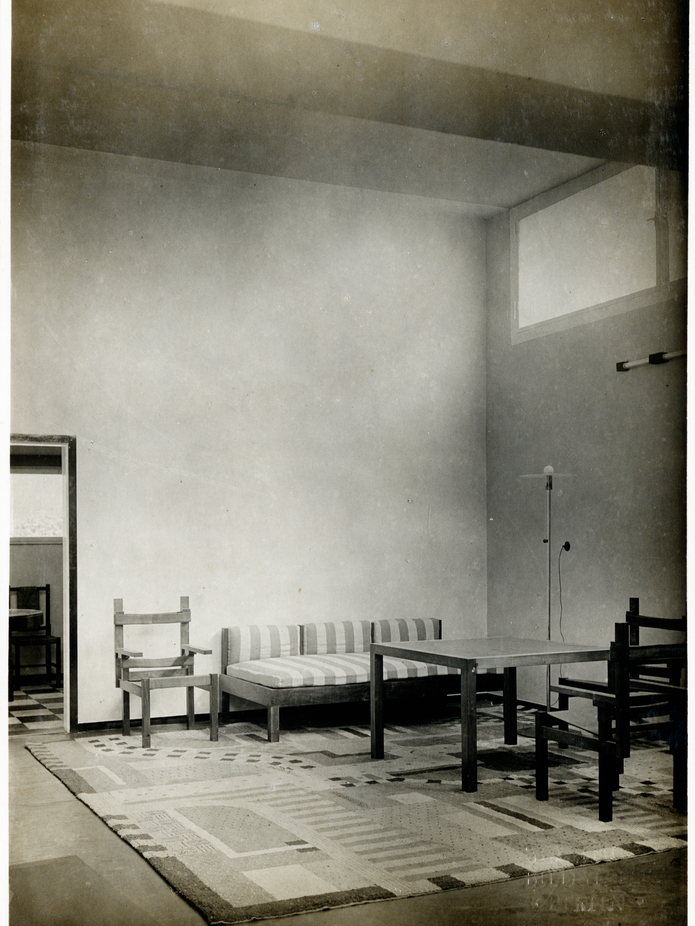
Image context: the cover uses the historical living-room photograph from Haus am Horn because the article's main claim is about convergence. In that room, the Bauhaus stops looking like a pile of separate innovations and starts looking like a coordinated interior system in which furniture, textiles, color, and architecture have already been taught to work together.[5]
The school began by undoing old habits
The preliminary course was decisive because it asked students to unlearn the idea that art education begins with imitation.[2] On the Bauhaus Cooperation page devoted to Johannes Itten's course, the emphasis falls on basic exercises in contrasts, material studies, color, and form, all meant to sharpen perceptual judgment before students specialized.[2] That sounds elementary, but it was radical in practice. Instead of treating drawing from established models as the entrance ticket to artistic seriousness, the course treated seeing, touching, combining, and testing as the first discipline.
This is one reason the Bauhaus cannot be reduced to machine aesthetics, even when its later products look industrial. The system started with bodily training and material encounter. Students were expected to understand surface, weight, texture, proportion, and rhythm as active problems.[2] A chair or a lamp that later appears inevitable in a museum gallery comes out of that prior pedagogy. The object is the residue of a method.
That method also helps explain why the school produced such heterogeneous results. Itten's preliminary course did not impose a single finished look. It created a shared grammar for experimentation.[2] Once that grammar was in place, different workshops could push it in different directions without losing contact with one another. The Bauhaus gained coherence less by enforcing one style than by building one traffic pattern.
The workshops turned experiment into transfer
The workshop system is where the school's legend usually gets flattened into a few heroic names and a few collectible objects. The richer story is about translation. Bauhaus lessons had to survive contact with actual media, labor, and use.[1][3] The weaving workshop is especially good at correcting the popular myth, because it shows that the school was never only about hard-edged architecture or masculine industrial form. The Bauhaus Cooperation account describes weaving as one of the most successful workshops, a place where color, material intelligence, and repeat structure were pushed toward fabrics and interiors rather than left as abstract exercises.[3]
That matters historically because textiles were one of the clearest routes by which Bauhaus thinking entered everyday space. Woven work touched walls, chairs, windows, and rooms. It carried the school's experiments into domestic life at a scale larger and more continuous than any one isolated object could manage.[3] If one remembers only steel-tube furniture, the movement looks cooler, harder, and narrower than it really was. The weaving workshop restores warmth, tactility, and pattern to the picture without making it any less modern.
The same translation logic appears in graphics. Joost Schmidt's poster for the 1923 Bauhaus exhibition in Weimar is useful not because it is merely famous, but because it shows the school learning to speak in public.[4] Bauhaus Cooperation notes that Schmidt built the poster as a diagonal cross of circles and squares, incorporated Oskar Schlemmer's Bauhaus signet, and produced a design that was used for advertising in 120 German railway stations.[4] This is not workshop culture hidden inside a studio. It is workshop intelligence moving outward through information design, circulation, and public address.
Put differently, the workshops did not just make objects. They made transfer systems. Weaving moved pedagogy into touch and atmosphere. Graphic design moved it into signage and public orientation. Furniture and architecture moved it into posture and use. The famous Bauhaus "look" is what remains visible after those transfers have already happened.
Haus am Horn was the public proof
Haus am Horn is the clearest demonstration that the Bauhaus should be read as an operating model rather than as a style sampler.[5] The Klassik Stiftung Weimar describes it as the only building designed and constructed by the Bauhaus in Weimar, built especially for the 1923 exhibition as the school's first public presentation of modern living and architecture.[5] That point alone would make it important. The stronger fact comes in the history section: the house allowed all Bauhaus workshops to collaborate on a single project.[5]
That line clarifies almost everything. Haus am Horn was not simply a building to be admired from the outside. It was a prototype in which architecture, furniture, textiles, and interior planning had to behave as one environment.[5] The historical living-room image used here is valuable for that exact reason. It shows the movement in its coordinated state. You can see that the Bauhaus ambition was never exhausted by making novel forms. The harder ambition was to choreograph a room.
Seen this way, the house also corrects a common misunderstanding about modernism. The Bauhaus did not aspire to blankness for its own sake. It aspired to legibility, economy, and integration under modern conditions.[1][5] A prototype house makes those priorities more visible than any isolated chair or poster can, because the success or failure of the project depends on relations: how one surface meets another, how furniture sits in space, how circulation works, how domestic life is imagined.
Why the style myth survives
The style myth survives because the school was unusually good at producing memorable forms, and museums understandably preserve forms more easily than they preserve educational process.[1] A chair, a typeface, or a poster can be collected, photographed, and repeated. A pedagogy of routing students through material study into workshop collaboration is harder to display. Yet once the process disappears, the Bauhaus can start to look like a package of clean shapes with a moral halo attached.
That is why the movement still rewards rereading. Its real achievement was not to deliver one universally correct modern style. It was to build a disciplined relay between perception, training, production, and life.[1][2][3][4][5] The Bauhaus mattered because it taught artists and designers to move across media without dropping their conceptual grip, and because it insisted that the room, the poster, the fabric, and the object all belonged to one larger problem of modern form. Once that is visible, the school feels less like an aesthetic cliché and more like a live question: what kinds of education and collaboration are required before a new visual world can actually function?
Sources
- The Museum of Modern Art, Bauhaus 1919-1933: Workshops for Modernity - exhibition overview on the school's founding, closure, collective range, and relation between art, design, and technology.
- Bauhaus Kooperation, "Johannes Itten's preliminary course" - overview of the Bauhaus entrance curriculum in form, color, contrast, and material study.
- Bauhaus Kooperation, "Weaving" - workshop history showing how Bauhaus experimentation moved into textiles, interiors, and repeat structure.
- Bauhaus Kooperation, "Poster for the 1923 Bauhaus Exhibition in Weimar" - object page on Joost Schmidt's geometric public poster and its circulation through railway stations.
- Klassik Stiftung Weimar, "Haus Am Horn" - site history describing the 1923 model house, its all-workshop collaboration, and the historical interior photograph used for this article's image.