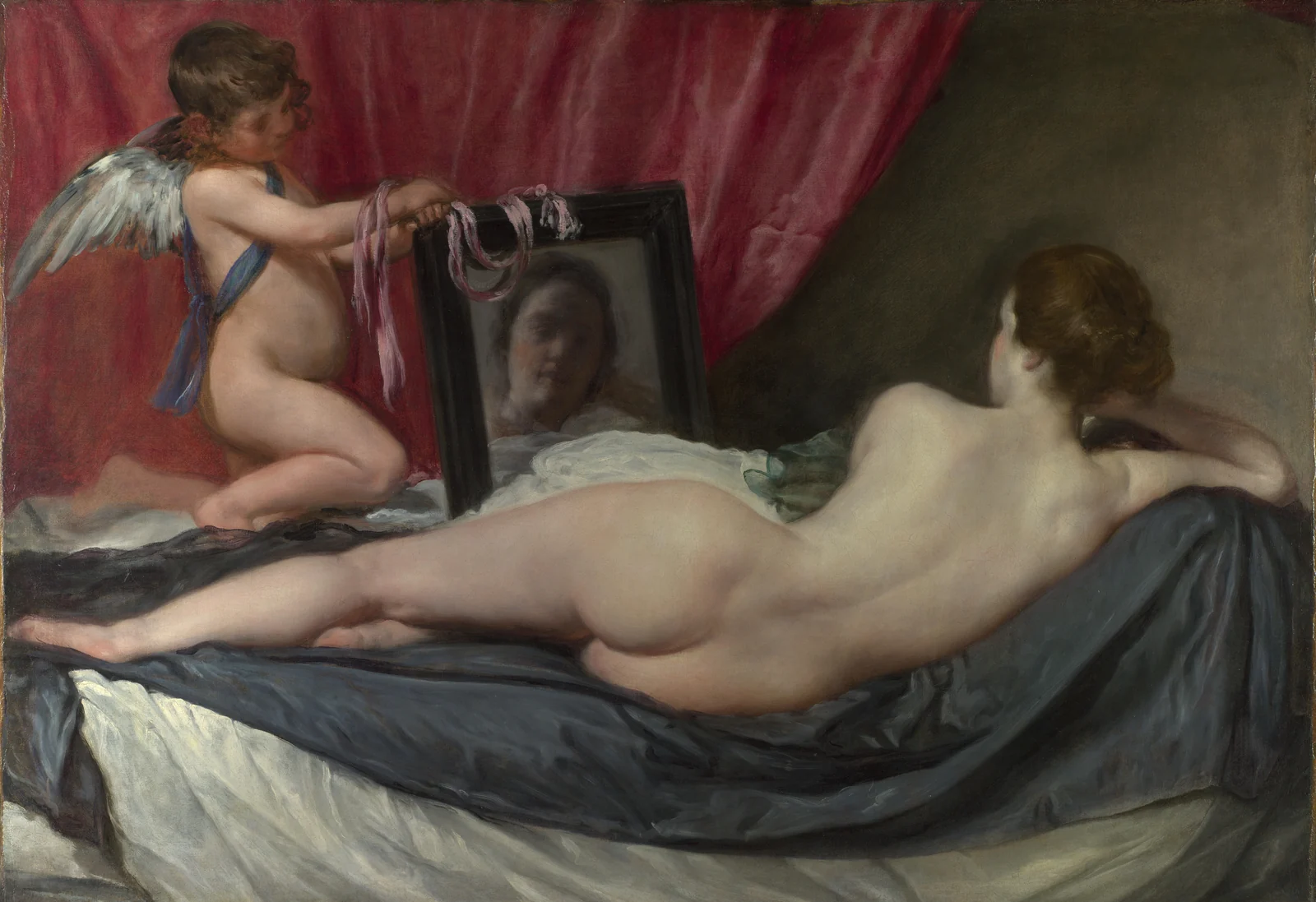
Velázquez's Rokeby Venus is one of those paintings that can look instantly legible and then become stranger the longer you stay with it. The basic subject seems familiar enough: Venus reclines on a bed, Cupid holds a mirror, and the viewer is invited into a scene of beauty and love.[1][3] But the picture does not actually reward possession. It offers the body with unusual openness, then makes the face unstable, blurred, and optically impossible to claim.[1][3]
That tension is what gives the canvas its lasting pressure. Velázquez painted the work around 1647-51, probably during or near the period of his Italian travel, and it survives as the only known female nude by him.[1][2][3] In seventeenth-century Spanish art, that fact already matters: the painting enters the world as an exception. Yet the real exception is compositional. Instead of building erotic power through frontal revelation, Velázquez turns the body away from us and places recognition where recognition should be least secure, in the mirror.[3]
Image context: the article uses the full painting because a cropped reproduction weakens the argument. The work lives in the exchange between the back we can inspect at length and the face that the mirror keeps withholding.[1][3]
The back is the painting's true front
Most paintings built around Venus promise access. Even when the goddess sleeps or turns aside, the image usually organizes itself to flatter the viewer's confidence that beauty is there to be possessed. Rokeby Venus works differently. The most available part of the body is the back, not the front; the line of the shoulder and hip does the compositional labor that a face or direct glance often does in other paintings.[1][3]
That decision matters because it changes what the painting can make us feel. A back has volume, warmth, and sensuality, but it also has reserve. It is a surface of nearness without full admission. Velázquez uses that reserve as structure. The sheet, mattress, and dark hanging fabric create a soft chamber around Venus, yet the body never fully enters our space. The curve is close, but the person remains turned away.
This is why the picture does not collapse into simple softness. The flesh is painted with extraordinary economy, but the pose is not merely languid. It is controlled. The knees tuck, the shoulders angle, the head turns only through the relay of the mirror. Each part of the composition says yes to looking and no to certainty at the same time. What the painting offers is not nakedness by itself, but a more exact arrangement: visibility without surrender.[1][3]
The mirror promises identity and gives us blur
The mirror is the painting's most famous device and also its sharpest act of misdirection. At first glance it seems to solve the problem created by the turned body. If Venus will not face us directly, then the mirror will. But the reflected face is too soft, too generalized, and too large in relation to the geometry we think we are seeing.[3] The effect is not a correction. It is a disturbance.
Writers often describe the image as Venus looking at herself, but the painting does not finally let that reading settle. The reflection is angled toward us as much as toward her. We receive the face through Cupid's handling of the mirror, and what we receive is not portrait certainty but an unstable sign of face-ness.[1][3] That difference matters. A clear reflection would have completed the body with identity. Velázquez instead gives us a face that behaves more like a rumor of identity than identity itself.
This is where the painting becomes more modern than its mythology suggests. The mirror does not deepen the illusion of presence; it exposes the limits of visual possession. We are close enough to inspect skin, fabric, and contour, but when the moment comes that should confirm the person before us, the painting relaxes into blur. Beauty arrives, then slips its legal name.
Cupid works less as a symbol of love than as a handler of access
Cupid's role in the picture is easily underestimated because he is so quiet. He is present, but he does not dominate the scene with action or narrative. He does not loose an arrow or animate the room with obvious divine theater. What he does instead is practical: he holds the instrument that manages access.[1][3]
That small shift changes the emotional logic of the work. Cupid is not here mainly to tell us that this is Venus. His real function inside the composition is to mediate what can be seen and how. Without the mirror, the painting would be a turned nude with extreme tact. With it, the picture becomes a negotiation between body, image, and viewer. Cupid therefore serves less as a mythological label than as a stagehand for the act of looking.
Seen this way, the painting's erotic intelligence lies in delay. The body is immediate, but recognition is delayed. Mythology is immediate, but intimacy is delayed. The mirror appears to shorten distance, yet it makes distance harder to measure. Velázquez turns the scene into a contract that keeps revising its own terms: here is beauty, here is the apparatus by which beauty will be shown to you, and here is the point where showing stops short.[1][3]
A private nude that kept becoming a public argument
The afterlife of Rokeby Venus clarifies something that the image already knew about itself: looking is never neutral. Wikipedia's survey of the painting notes that the canvas moved through private aristocratic collections before reaching England and finally entering the National Gallery in 1906.[3] By then it had already become an unusually exposed object, a Spanish nude in a public museum, and that exposure would keep attracting argument.
The sharpest historical instance came in March 1914, when suffragette Mary Richardson attacked the painting in the National Gallery.[4] HistoryExtra's reconstruction of the episode emphasizes that the attack was meant as a political statement rather than random destruction: Richardson chose a famous nude because she saw it as an image of female objectification at the very moment the suffrage struggle was fighting over women's civic personhood.[4] The slash marks were repaired, but the episode permanently changed the work's public meaning.
That event matters for more than biography. It reveals that the painting's unstable contract of looking was never only formal. The canvas had always organized beauty through distance, mediation, and withholding. After 1914, it also carried the memory that an image of idealized femininity could become a battleground over who gets to define womanhood in public. The viewer no longer meets only Venus. The viewer also meets the history of resistance gathered around her.
What keeps Rokeby Venus alive, then, is not simply that it is beautiful, or rare, or scandalous by Spanish standards. It is that Velázquez builds beauty through interruption. The back turns pleasure into delay. The mirror turns identity into blur. Cupid turns mythology into an access device. And the painting's later history proves that this uncertainty never stayed inside the frame.[1][3][4] The picture offers itself, but only on terms it keeps rewriting.
Sources
- National Gallery, London, "Diego Velázquez, The Toilet of Venus ('The Rokeby Venus')" - collection page with title, date, medium, and work overview.
- National Gallery, London, "Diego Velázquez (1599-1660)" - artist page covering Velázquez's Seville training, court role, and Italian travel.
- Wikipedia contributors, "Rokeby Venus" - overview of the painting's date, composition, rarity in Spanish art, provenance, and mirror effect discussion.
- Elinor Evans, "Why did a suffragette attack 'The Rokeby Venus' with a meat cleaver?" HistoryExtra - account of Mary Richardson's 1914 attack and its political symbolism.