Rachel Whiteread is still often summarized by the quickest available phrase: she casts negative space.[1] The description is accurate, but it can flatten what the work actually does. It makes her sculpture sound like a clever reversal, as though the main point were simply to turn inside into outside. Her stronger achievement is more exacting. Whiteread takes the spaces that use leaves behind, the air under a chair, the void inside a closet, the volume of a room, the interior of a rooftop tank, and turns them into things that hold memory without illustrating it.[1][2][3]
That is why her work keeps moving so forcefully between the domestic and the civic. Whitechapel Gallery's overview says her sculpture confronts history, memory, and the everyday, and that her method is predicated on translating negative space into solid form.[1] The key word there is not only "space." It is "everyday." Whiteread is not excavating grand ruins or symbolic abstractions first. She starts with furniture, rooms, utility structures, and ordinary built forms that people usually register only while using them. Once cast, those forms stop behaving like background. They become evidence.
Her career gives that evidence a public scale. Whitechapel's biographical note places the training clearly: painting at Brighton Polytechnic, sculpture at the Slade, the Turner Prize in 1993, the Venice Biennale in 1997, and a major Tate Britain retrospective decades later.[1] Those career markers matter, but they can also distract from the harder artistic continuity. From early interior casts to later public commissions, Whiteread has kept asking the same question: what happens when you give weight to the part of architecture and furniture that the body normally passes through and forgets?[1][3][4]
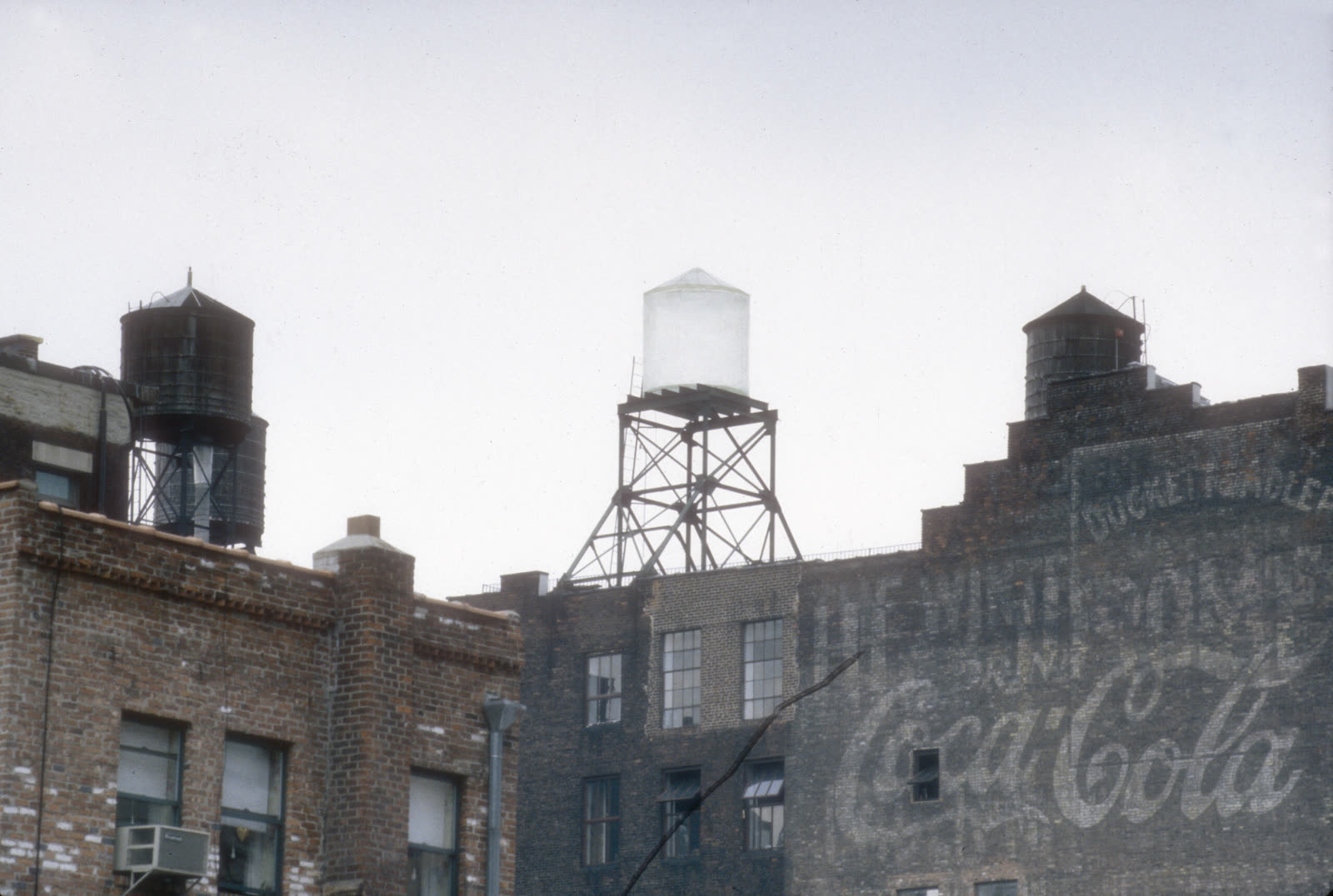
Image context: the cover uses Public Art Fund's photograph of Water Tower because the work shows Whiteread's method at full urban scale. Surrounded by dark wooden tanks and weathered brick, the translucent cast looks neither like a fantasy object nor like a replica. It looks like familiar infrastructure made newly legible by being turned into a pale, inhabitable ghost.[4][5]
1) The real subject is not emptiness; it is use after the users have gone
Whiteread's sculpture becomes clearer when you stop treating "negative space" as a technical trick and start reading it as a record of contact. The spaces inside and around objects are usually invisible because life moves through them too quickly. A chair is seen as a seat, not as the shaped pocket of air under its surface. A room is seen as a place to inhabit, not as a volume with its own contour. By casting those zones, Whiteread turns habit into afterimage.[1][3]
That is why her work carries an emotional charge without using narrative illustration. She does not carve figures, stage scenes, or tell a story in a descriptive way. Instead, she preserves the mold of where a body must once have been, or where a routine once unfolded. The result feels intimate because it begins with touch and occupation, but it never stays merely personal. Once the cast is separated from function, the viewer starts reading it as social memory: who lived here, who sat here, who stored things here, who moved through this volume every day?[1][3]
Whitechapel's description of her materials helps here too. Rubber, dental plaster, and resin are not neutral choices in her career summary; they are substances capable of catching surface nuance and transferring it into a solid record.[1] Whiteread is not interested in the rhetorical mass of sculpture alone. She wants precision. The cast has to keep the pressure of use, the edge of molding, the shallow dip of an interior boundary, the exact profile that makes a familiar object recognizable after it has become estranged.[1][3]
2) Ghost turns one ordinary room into architecture that remembers
The National Gallery of Art's description of Ghost is the cleanest demonstration of Whiteread's method at room scale. The work appears as a freestanding white plaster cube, but the object's details reveal another origin: the fireplace opening projects outward, its interior is faintly blackened, and inset bands mark where the baseboards and crown molding once were.[2][3] The NGA explains that Whiteread created the sculpture by filling an empty room with plaster.[3] That sentence matters because it shifts the work away from model-making. Ghost is not a representation of a room. It is the room's interior volume made object.
Once you grasp that, the sculpture stops reading as minimalist block and starts reading as compressed domestic time. A mantel, a fireplace, a wall edge, and a ceiling line survive, but they survive in reverse, sealed into a solid that no longer allows habitation.[2][3] The room becomes present at exactly the moment it becomes unusable. Whiteread turns shelter into residue.
This is where her work separates itself from a more theatrical kind of haunting. The effect of Ghost is eerie, but the eeriness is produced by factual specificity rather than by gothic decoration. The sculpture is powerful because the room is still so legible. The viewer can tell where the fire was, where the walls met the floor, where a person might once have stood. Whiteread lets the ordinary structure remain ordinary enough that its reversal hurts.[2][3]
3) Water Tower carries the same logic from the interior to the skyline
If Ghost is Whiteread's breakthrough in domestic scale, Water Tower shows how naturally the same thinking can move into public space. Public Art Fund describes the work as a translucent resin cast of the interior of a wooden water tank measuring roughly twelve feet high by nine feet wide.[4] MoMA's object page gives the medium more exactly as translucent resin and painted steel and notes its placement in the Sculpture Garden.[5] Those details are enough to explain why the piece feels so exact. Whiteread did not invent a new silhouette for the city. She selected one that New Yorkers already read unconsciously.
That selection is crucial. Rooftop water towers are part of the city's working grammar, practical, repetitive, and usually glanced past. Whiteread's version keeps the form but changes its state. In the Public Art Fund photograph, the tank rises pale and semi-luminous above dark neighboring towers and weathered buildings.[4] It looks familiar first and uncanny second. The work does not dramatize infrastructure by making it bigger or louder. It dramatizes it by making it visible.
The shift from plaster room to rooftop resin cast also clarifies Whiteread's public ambition. The issue is no longer one absent body or one lost domestic interior. It is the way a city is full of forms that support collective life while remaining visually unnoticed.[4][5] By casting the interior of a water tower rather than its outer skin, Whiteread turns one unnoticed support structure into a civic apparition. The sculpture keeps utility in view even after function has been suspended.
4) Why the work still matters: memory arrives as structure, not as illustration
Whitechapel's summary of Whiteread's later public commissions is useful because it keeps the historical dimension in frame. The same page notes a Dalby Forest commission that manifests the negative space of a First World War Nissen hut, making the war's impact on the British landscape visible.[1] That example belongs with Ghost and Water Tower even though the sites differ. In each case Whiteread does not memorialize by depicting an event. She memorializes by preserving a volume that history once occupied.
That is the larger reason her sculpture remains so durable. Many artists working with memory turn toward image, archive, or reenactment. Whiteread turns toward structure. She asks what it would mean for an empty room, a household object, or a rooftop tank to carry the emotional and historical burden instead.[1][3][4] The answer is not sentimental. Her objects stay blunt, often stubbornly plain. But their plainness is what allows them to hold so much. They are never allegories first. They are forms that have been used, inverted, and released back to us as evidence.
Seen this way, Rachel Whiteread's importance lies beyond the novelty of inside-out casting.[1][2][3][4][5] She made absence architectural. She gave weight to the spaces that daily life produces and discards. Then she proved that those spaces could speak publicly, whether in a single room's sealed interior or in a skyline object made strange enough to be seen again. That is why her sculpture lingers. It does not merely show that emptiness has shape. It shows that ordinary forms remember.
Sources
- Whitechapel Gallery, "Art Icon: Rachel Whiteread" - event page with a concise account of her method, biography, and public commissions.
- National Gallery of Art, "Rachel Whiteread" - artist page listing selected works in the collection, including Ghost.
- National Gallery of Art, "Ghost" - object page with the work's date, medium, and visual description of the cast room, fireplace, molding, and interior volume.
- Public Art Fund, "Water Tower" - exhibition page describing the work as a translucent resin cast of the interior of a wooden rooftop tank and documenting its New York presentation.
- The Museum of Modern Art, "Rachel Whiteread. Water Tower. 1998" - object page with material, dimensions, and current collection context.