
Short archival films about modern artists often flatten into respectful atmosphere. A famous sculptor appears beside finished work, the camera admires the studio, and the result feels like heritage rather than thought. The BBC Archive's 1961 Barbara Hepworth on Sculpture is better than that.[1] What gives the clip its lasting value is that Hepworth does not describe sculpture as monument, prestige, or abstract theory detached from making. She describes it as a lived relation among land, touch, resistance, and the changing space inside and around form.[1][2][3]
That emphasis matters because Hepworth's reputation can become too architectural in the wrong way. She is easy to summarize through major commissions, pierced forms, and her place beside Henry Moore in British modernism.[2][5] Yet the film keeps shifting attention away from career monumentality and back toward sensation. Her memory of Yorkshire roads, her attachment to St Ives, her stress on hearing tools strike material, and her insistence that the left hand thinks by feeling all point in the same direction.[1] Sculpture, for Hepworth, begins before the gallery. It begins in how a body moves through slopes, hollows, pressure, and light.[1][3]
The written record around the film confirms that this was not a late interview performance invented for television. Hepworth's official biography traces her early years in Wakefield, her training in Leeds and at the Royal College of Art, and the emergence of her first pierced form in the early 1930s.[2] Her collected writings, quoted on the Barbara Hepworth site, repeat the same core ideas across decades: carving requires accord with material, sculpture is realized through mass and space alike, and the relation between figure and landscape remains central to her thinking.[3] The Tate's St Ives museum page then gives the concrete setting the film depends on: Trewyn Studio and garden, where Hepworth lived and worked from 1949 until her death, remain the place where those ideas became daily practice.[4]
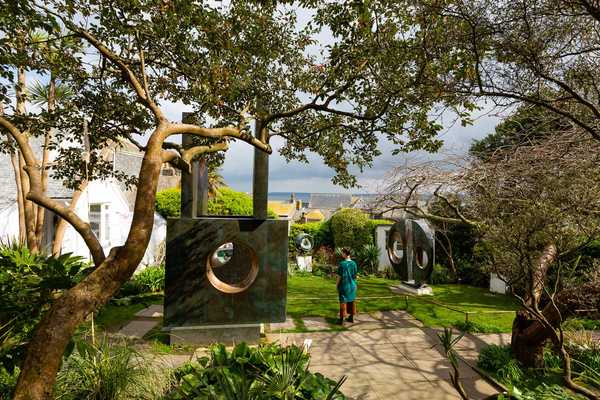
Image context: the cover uses a photographic view of the Barbara Hepworth Museum and Sculpture Garden in St Ives. It is the right image for this article because the film's deepest claim is spatial. A pierced sculpture matters here not as a sealed object but as a device that admits sky, trees, walking paths, and distance into the work's meaning.[4]
Around 0:00 to 1:30, the film opposes city display and chosen working ground
The opening minute is deceptively simple.[1] A narrator begins with a sculpture standing in the courtyard of a new London building, notes that some admire it and others are puzzled, then pivots away from metropolitan public reception toward the place Hepworth chose for work: St Ives in Cornwall.[1] That shift is the first strong editorial decision in the film. The city appears as a site of exposure and recognition, but not as the source of the work's inner logic. The source lies elsewhere, in the terrain Hepworth had already made productive for more than two decades by 1961.[1][4]
That contrast helps explain why the clip still feels sharp. Public commissions can make a sculptor look like a supplier of civic symbols. The film refuses that reduction. It frames the urban sculpture as one endpoint of a longer sensory education, then takes the viewer back to the coast, the garden, and the studio conditions that made Hepworth's forms thinkable.[1][4] The official St Ives materials deepen that reading. Trewyn was not a neutral address but the place where carving, plaster work, monumental commissions, and outdoor placement converged.[4] When the camera turns from London walls to Cornwall, it is not moving from success to retreat. It is moving from display back to origin.
Around 1:30 to 2:35, Yorkshire becomes a sculptural memory system
The heart of the film arrives when Hepworth begins speaking in her own voice about childhood.[1] She says her early memories are of forms, shapes, and textures; she remembers traveling with her father and feeling that the hills were sculptures and the roads defined their forms.[1] That is a remarkably condensed statement of method. Landscape is not scenery behind later abstraction. It is already organized as mass, contour, route, and bodily passage. One does not merely look at it. One moves through it physically and mentally.
Her biography makes that memory legible.[2] Hepworth was born in Wakefield in 1903, and the family car journeys through Yorkshire recur in official accounts of her development. The film turns those facts into a working philosophy.[1][2] Roads matter because they cut and reveal form. Hills matter because they are felt as volume before they are named as motif. This is where her pierced sculpture begins to make sense. The hole is not an avant-garde signature added to otherwise solid mass. It is a continuation of the experience of moving through hollows and slopes, of sensing that form is defined as much by passage and interval as by bulk.[1][3]
Her writings make the connection even clearer. On the official texts page, Hepworth describes an enduring interest in oval and ovoid forms, then explains that piercing them opens continuous curves in the third dimension.[3] In other words, the hole is not absence. It is a way of activating form so that inside and outside, contour and air, begin to speak to one another. The film does not need to lecture this point because the memory sequence already does the work. Yorkshire is presented as an apprenticeship in spatial intelligence.[1][2][3]
Around 2:35 to 3:35, carving becomes a dialogue between motor action and the thinking hand
The next stretch is the most useful for understanding Hepworth as a maker rather than merely a sculptural poet.[1] She says she loves the joy of carving and the rhythm of movement in sculpture, then shifts to a striking distinction: the right hand is the motor in carving, while the left hand is the thinking, feeling hand.[1] That sentence is important because it strips away the old fantasy that carving is pure will imposed on stone. Hepworth presents making as coordination. One hand drives, the other judges. One hand advances, the other reads resistance.
This tactile intelligence runs through her published writing as well.[3] She repeatedly argues that carving demands sensitivity to the specific nature of material and that the sculptor must find harmony rather than domination. The material has vitality; it resists and makes demands.[3] Put beside the film, those statements become more than admirable principles. They sound operational. When Hepworth talks about hearing tools, feeling gouge and chisel through the left hand, and treating tools as personal extensions of sight and touch, she is describing sculpture as distributed perception.[1] Thought does not sit above the block and issue commands. It moves through ear, grip, pressure, and adjustment.
That is part of why the clip still feels contemporary. Much current writing on sculpture returns to embodiment, process, and the politics of materials. Hepworth's language is older, but it is not vague.[1][3] She identifies a precise chain: body to tool, tool to surface, surface to revised judgment. The finished object keeps that chain inside it, which is why even her most austere forms feel handled rather than merely designed.
Around 3:35 to the end, the pebble and the pierced form turn continuity into structure
The closing images and words move toward a smaller object: a pebble held in the hand.[1] Hepworth says weight, form, and texture relate us to the past, and that a stone washed up by the sea can become a symbol of continuity, survival, peace, and security.[1] This might sound sentimental if it arrived as decorative nature mysticism. In the film it does something stricter. It shrinks modern sculpture back to the scale of touch. Monumentality is not denied, but it is grounded in the same tactile relation that begins with a found stone.
Her writings help explain why this closing turn matters.[3] Hepworth repeatedly stresses the relation between light, interior and exterior form, and the spaces between bodies in space. She also writes that the relation between figure and landscape is vitally important to her and cannot be felt in the city with the same force.[3] Seen through that lens, the pebble is not an anecdotal prop. It is a model of what her sculpture tries to preserve: concentrated contact with the world's weight and contour, held long enough that space itself becomes articulate.
The Tate museum garden image sharpens the point for a present-day viewer.[4] Hepworth's forms in St Ives are never only profiles against a neutral backdrop. Trees, weather, and pathways keep entering them. The pierced opening frames air; the polished curve catches light; the garden route turns viewers into moving counterparts of the road-and-hill memory she describes in the film.[1][4] The sculpture remains self-contained, but it also behaves like an instrument for measuring what lies around it.
That is why this 1961 clip is worth revisiting now.[1] It shows a major modern sculptor giving an account of abstraction that never drifts away from matter. Landscape is tactile. Carving is negotiated. Space inside form is as alive as mass. A pebble can hold civilizational feeling without ceasing to be a pebble. Hepworth's achievement, as the film presents it, is not that she escaped the physical world into purity. It is that she found a way to make purity answer to touch, memory, and the land underfoot.[1][2][3][4][5]
Sources
- BBC Archive, "1961: BARBARA HEPWORTH on SCULPTURE | Barbara Hepworth | 1960s | BBC Archive," YouTube video.
- Barbara Hepworth, "Biography" - official chronology and life overview on barbarahepworth.org.uk.
- Barbara Hepworth, "Quotations from Barbara Hepworth's Writings" - official texts page on carving, space, material, and landscape.
- Tate, "Barbara Hepworth Museum and Sculpture Garden" - museum overview for Trewyn Studio and garden in St Ives.
- The Hepworth Wakefield, "Artist Barbara Hepworth" - museum profile and collection context.