
Jacob Lawrence is often introduced through a small set of sanctioned masterpieces: The Migration Series, the Toussaint L'Ouverture panels, perhaps a few late Builders paintings. That shorthand is useful, but it can also make his achievement look tidier than it was. The Met's archival upload of Jacob Lawrence: An Intimate Portrait, 1993 matters because it returns Lawrence to a working historical problem.[1][2] The film does not present him as a solitary genius producing single iconic canvases. It presents him as a maker of sequences, a painter who kept turning Black history, Harlem memory, teaching, and ordinary labor into linked panels, linked statements, and linked acts of public address.[1]
That emphasis is historically exact. Lawrence was born in 1917, moved with his family to Harlem in 1930, and came of age in workshop spaces where art was inseparable from community formation.[3][5] The Phillips Collection's Lawrence materials describe how the 60-panel Migration Series emerged from research, written captions, and a method of painting all the boards together color by color so the whole cycle would hold as one argument rather than a pile of separate scenes.[4] The Library of Congress guide adds the broader arc: Lawrence built a career out of Black American history rendered in a sharp, simplified visual language shaped by social realism and Mexican muralism, then carried that language across war pictures, teaching, and later public commissions.[5]
The 1993 portrait catches him after all of that, which is why it is stronger than a youthful studio fragment would have been. The Met's description notes that the short feature was originally produced to accompany a 1993 Los Angeles County Museum of Art exhibition on Lawrence's earlier Frederick Douglass and Harriet Tubman series, and that the film also includes glimpses of Struggle: From the History of the American People alongside voices from Gwendolyn Knight and Barbara Thomas.[1][2] In other words, the video is already retrospective when it is made. Lawrence is looking back across decades and explaining what stayed constant.
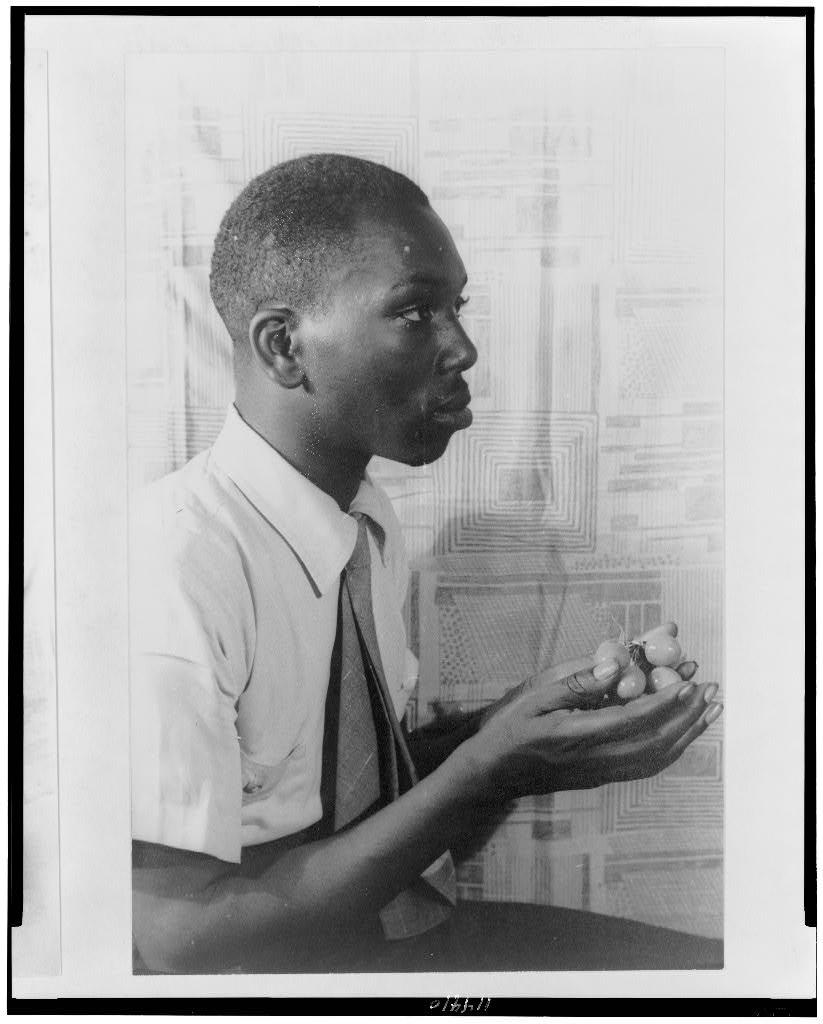
Image context: the cover uses Carl Van Vechten's 1941 portrait of Lawrence from the Library of Congress rather than a cropped panel from one series. That choice fits the article because the film's real subject is Lawrence's public voice: how a painter who rarely dramatized himself still made history audible through calm explanation, serial construction, and visual restraint.[6]
Historical context: why serial painting mattered to Lawrence
Lawrence's serial method did not begin as a clever formal preference. It grew out of a specific intellectual and social environment in Harlem. Around the 8:15-9:00 stretch of the film, Lawrence recalls going to the Schomburg Collection, reading, taking notes, and developing a series from that work.[1] That memory lines up with the Phillips Collection's account of the Migration Series: captions first, research first, structure first, then the patient labor of keeping dozens of panels in visual relation.[4] The important point is that Lawrence treated history neither as a backdrop nor as decorative subject matter. History had to be organized so viewers could move through it.
That is one reason the film feels richer than a standard artist profile. It keeps showing that Lawrence's great subjects were not detached heroes floating above the social field. By the time the narrator arrives at Toussaint L'Ouverture, Frederick Douglass, Harriet Tubman, and John Brown, the film has already situated Lawrence inside Harlem workshops, street-corner politics, newspapers, laundry jobs, and the larger pressure of a Black community trying to define itself against exclusion.[1][3][5] The heroic series therefore look less like commemorative pageants than like extensions of daily life into historical form.
The same logic clarifies Lawrence's relation to fame. By 1941, the year of the Carl Van Vechten portrait used here, Lawrence had already become a young artist of unusual visibility.[4][6] Yet the serial format kept pulling attention away from one breakthrough image and back toward accumulation, sequence, and social rhythm. Lawrence's paintings move by recurrence: trains, stairs, tools, marching bodies, windows, angled tables, bent arms. The film is valuable because it makes that recurrence sound like a philosophy of narration rather than a signature trick.[1][4]
Video provenance
The embed below uses The Met's official upload of the film. The museum describes it as a short feature made for the 1993 LACMA exhibition on Lawrence's Frederick Douglass and Harriet Tubman cycles, then republished in 2020 through the museum's From the Vaults archive program.[1][2] That provenance matters. This is not stray footage detached from context. It is a documented archival object with an institutional chain of custody and a clear reason for existing.
What the film shows that wall labels usually miss
One of the best early moments comes around 2:43-3:37, when Lawrence talks about discovering that he could put black next to red and make decisions on the picture plane.[1] The remark sounds simple, but it opens a larger political key. He says people like himself rarely had the chance to make decisions, and that painting offered a constructive zone of control.[1] This is a precise way to understand his color and shape. The hard diagonals and compressed palettes are not merely aesthetic branding. They are forms through which choice itself becomes visible.
The film becomes even stronger around 8:40-10:05, when Lawrence explains that the Tubman, Douglass, and Toussaint series were also acts of self-expression and that he may have been seeing himself in those roles.[1] That admission keeps the historical cycles from turning saintly. Lawrence does not paint heroes as marble examples. He paints them as structures through which a young artist with an interrupted family story could think about endurance, leadership, and dignity.[1] The result is why his narrative painting still feels warm even when the compositions are angular and severe. Biography passes into history without becoming confession.
Another crucial stretch arrives around 13:50-14:35, when Lawrence recalls complaints about his image of Harriet Tubman scrubbing floors and rejects the demand for prettified beauty.[1] The point is not provocation for its own sake. He insists that Tubman was not on a Sunday school outing, that conventional beauty standards can falsify the work of struggle, and that ugliness is better understood as a matter of character than of surface.[1] In a short scene, the film reveals why Lawrence's pictures remain morally tensile. They do not beautify hardship into piety, but they also do not surrender to bitterness.
Then, around 15:10-15:40, Lawrence gives perhaps the best sentence in the film: struggle does not have to be overt or overly dramatic; it can be quiet, creative, even a search.[1] That thought reorders the whole body of work. It explains why his historical panels and later Builders scenes belong together. The drama in Lawrence is rarely located in one climactic gesture. It sits in repeated acts of carrying, making, teaching, repairing, walking, and planning. Struggle is a structure of duration.
The last passage worth holding comes near 20:20-20:54, when Lawrence talks about tools as beautiful symbols of uplift, building, and achievement, then says that where others use words or other symbols, he uses paint.[1] That line is as close as the film comes to a manifesto. It suggests that Lawrence's public voice was never primarily verbal. Even when he speaks gently, as Barbara Thomas notes later in the film, the actual force of his thinking lands through visual presentation.[1] Paint becomes civic language.
Why this archival portrait still matters now
The great value of this footage is that it protects Lawrence from two bad reductions at once. The first is the textbook reduction, where he appears as the maker of one canonical migration cycle and a few useful civil-rights-era examples.[4][5] The second is the inspirational reduction, where he becomes a soft symbol of perseverance without formal difficulty. The 1993 film defeats both. It shows a painter who built serial form out of research, neighborhood memory, and historical reading, and who kept insisting that ordinary people, ordinary work, and ordinary acts of making deserved epic treatment.[1][3][4]
That is why the archival format suits him so well. A video portrait can preserve not only reproductions of panels but also cadence, hesitation, and scale of conviction. Lawrence's manner in the film is calm, almost modest, yet the argument underneath it is demanding. Learn the history. Organize it. Refuse false beauty. Let struggle remain human-sized. Treat tools and classrooms and streets as worthy of paint.[1] Those are not side notes to his art. They are the armature.
Seen from 2026, the film also feels contemporary for another reason. Lawrence's work never lets public history settle into a finished national mural. The panel remains unfinished in a productive sense: each sequence asks to be continued by another viewer, another teacher, another builder, another migrant, another child entering a workshop and discovering that putting one color beside another can already be an act of freedom.[1][4][5] The archive matters here because it keeps Lawrence's example in motion. It does not embalm him. It lets his serial, public way of thinking stay available.
Sources
- The Met, "Jacob Lawrence: An Intimate Portrait, 1993 | From the Vaults," YouTube video, published October 9, 2020.
- The Metropolitan Museum of Art, "Jacob Lawrence: An Intimate Portrait, 1993" - From the Vaults feature page.
- The Phillips Collection, "About Jacob Lawrence" - biography covering Harlem, the Rosenwald grant, teaching, and later career.
- The Phillips Collection, "The Migration Series" - project history, captions, simultaneous panel process, and Lawrence's own migration framing.
- Library of Congress, "Jacob Lawrence: A Resource Guide - Introduction" - biography and research overview.
- Library of Congress Prints and Photographs Division, Carl Van Vechten, "Portrait of Jacob Lawrence," 1941.