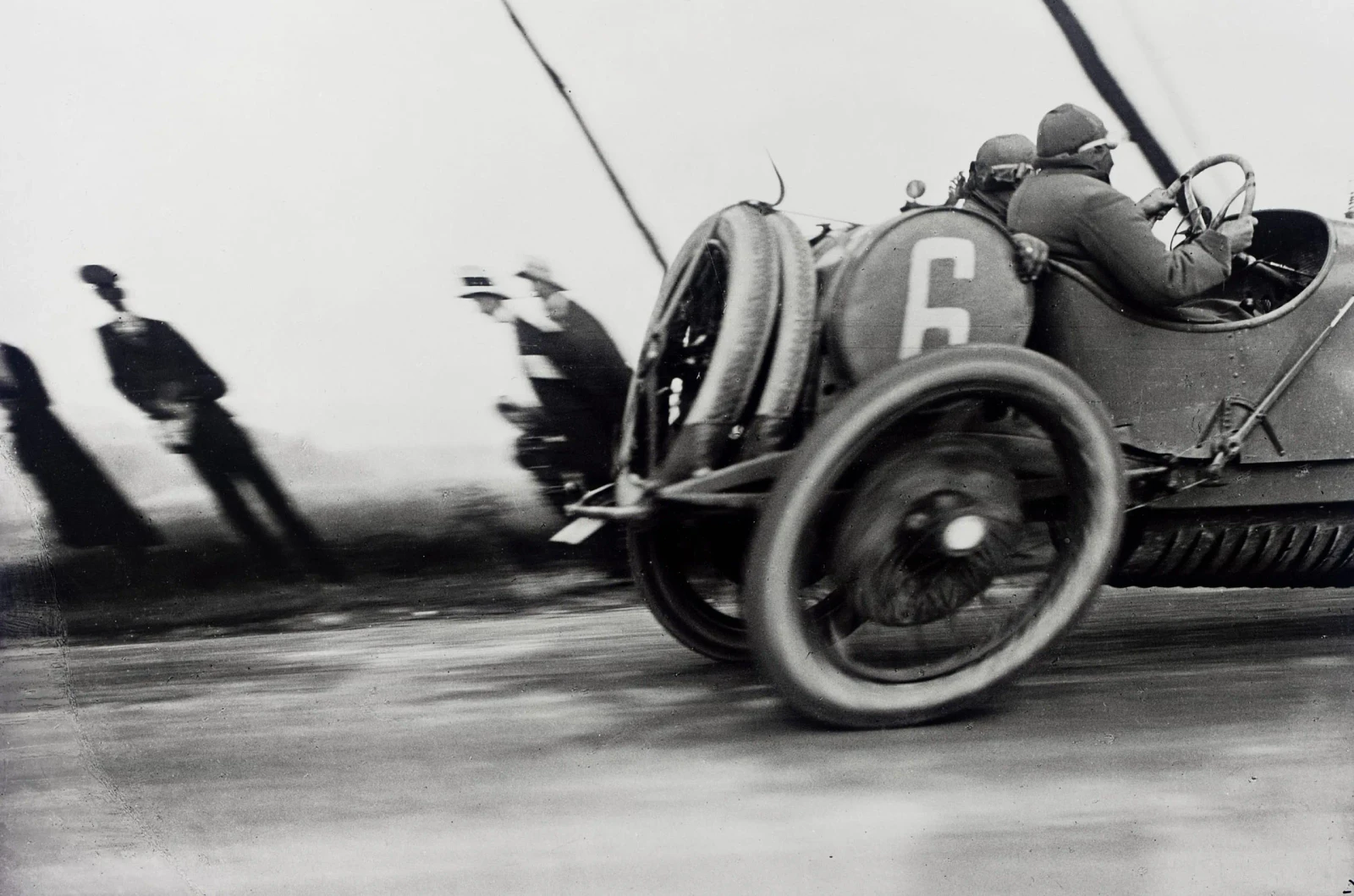
The wheel is the first thing to go wrong. It stretches into an oval, leaning eagerly toward the right. Behind it, spectators tilt the other way. The car itself has almost escaped: its front is beyond the photograph's edge, leaving a number, a wheel, and the hurried business of passing.
Jacques-Henri Lartigue's Grand Prix photograph makes speed visible by making the world look briefly unreliable. Look from the wheel to the roadside figures and back again. The two directions tug against each other. Even before we know how the camera produced them, we feel that holding this scene still has been difficult.
The reproduction here comes from LACMA's gelatin silver print, made in 1980 and catalogued under the title At the C.A.F. Grand Prix 1912.[1] The date attached to the original exposure needs a qualification, which we will come to. First, the picture deserves a little time without its caption.
The edge is part of the action
A racing photograph might give us a complete machine, neatly separated from its surroundings. Here, the frame cannot accommodate its subject. There is road to the left, while the car presses through the right boundary. Our eye wants to continue in the direction that the picture denies it.
That imbalance supplies a small narrative. Something has approached, reached the camera, and already begun to leave. We cannot inspect the car at leisure in the way we could study a parked vehicle. The missing front makes our looking feel late.
The number 6 offers a useful interruption. Among the blurred surfaces and skewed shapes, it remains legible enough to identify a competitor. For a moment, this is a record of a particular race. Then the eye slips back to the wheel, whose impossible shape gives a much more immediate account of the encounter.
The pale roadway matters, too. Its broad, relatively empty stretch gives the dark wheel room to assert itself. The photograph does not need to fill every corner with activity. The concentration of weight at the right makes the open ground feel like distance already consumed.
These are effects we can observe in the finished image. They do not establish that Lartigue planned every cut and diagonal. The distinction is part of the photograph's interest: a composition can reward deliberate looking even when its maker could not fully control the event.
A photograph takes time across its surface
The distortion has a mechanical explanation. The Snite Museum of Art's account identifies Lartigue's camera as an ICA using a glass-plate negative. He turned with the passing car, but could not keep pace. Its focal-plane shutter exposed the plate through a moving slit; the museum attributes the deformation to that shutter's travel combined with the subject's speed.[3]
The crucial point is that different parts of the image were recorded at slightly different moments. While the slit moved, the car continued along the road and the camera continued turning. Successive portions of the wheel therefore landed in shifted positions. Panning also moved the stationary background's image across the plate. The photograph brought those successive registrations together on one surface.[3]
This makes the oval more interesting than a generic sign for going fast. It records a mismatch among movements: the subject, the photographer, and the mechanism inside the camera. The camera's effort to follow the car helped give the roadside its contrary lean.
The picture invites us to experience that mismatch bodily. Following the car with our eyes, we encounter the spectators as a backward pull. Looking toward them, we lose the car again at the edge. There is no comfortable place from which everything resolves into rest.
Even the caption has trouble keeping up
LACMA dates the image to 1912; MoMA uses that year too, while identifying its own print as made in 1962.[1][4] Those printing dates describe separate physical objects. They do not resolve when Lartigue stood beside the road.
The Donation Jacques Henri Lartigue explains the problem. He placed the photograph in his 1912 album and captioned it as a Delage at Le Tréport on June 26. The estate also reports David E. Junker's identification of the vehicle as a Schneider that competed in the 1913 Grand Prix, and says the journals provide no explanation for the discrepancy.[2] The Snite Museum's account places the scene at Amiens in 1913.[3]
It is better to preserve that disagreement than to silently turn a museum's catalogue heading into certainty. The photograph contains evidence that can be checked against race history, but its expressive force does not supply its own date. Feeling the car rush past and identifying the event are different acts of attention.
Nor does the uncertainty make the image meaningless as a document. It asks us to read the photograph alongside its album placement, inscriptions, and later research. A caption is another historical object with a history of its own.
The useful failure
The estate's account of the 2017 Autophoto exhibition says Lartigue initially considered the photograph weak, even a failure, because of its blur, distortion, and cropping.[5] That judgment makes sense if the task was to catch the car cleanly. The finished picture keeps showing how difficult that task was.
Its attraction, to my eye, lies in how those difficulties cooperate. The missing front carries our attention beyond the frame. The wheel's lean sends it there faster. The spectators pull against that direction, giving the movement something to overcome. Remove any one of those disturbances and the image would have a different rhythm.
Return to the number 6. It is still doing its modest job of naming a competitor. Around it, the photograph offers something less orderly and more absorbing: the experience of trying to see an object that will not wait. A century later, we can spend as long as we like looking. The car never gives us the same courtesy.
Sources
- Los Angeles County Museum of Art, Jacques Henri Lartigue, At the C.A.F. Grand Prix 1912, M.2002.212.13 — source of the reproduced image, catalogue date, 1980 print date, medium, and image credits.
- Donation Jacques Henri Lartigue, “An icon” — album caption, panning account, and the conflicting identification of the racing car and exposure year.
- Snite Museum of Art, University of Notre Dame, Calendar of Events, January–August 2016, “Recent Acquisitions: Photographs,” pp. 14–16 — camera and shutter mechanics, the cropped composition, and the museum's identification of the race as Amiens, 1913.
- Museum of Modern Art, Jacques-Henri Lartigue, Grand Prix of the Automobile Club of France, Course at Dieppe, 28.1963 — a separate print catalogued as an image from 1912, printed in 1962.
- Donation Jacques Henri Lartigue, “Autophoto at the Cartier Foundation” — the 2017 exhibition and Lartigue's initial assessment of the photograph as unsuccessful.