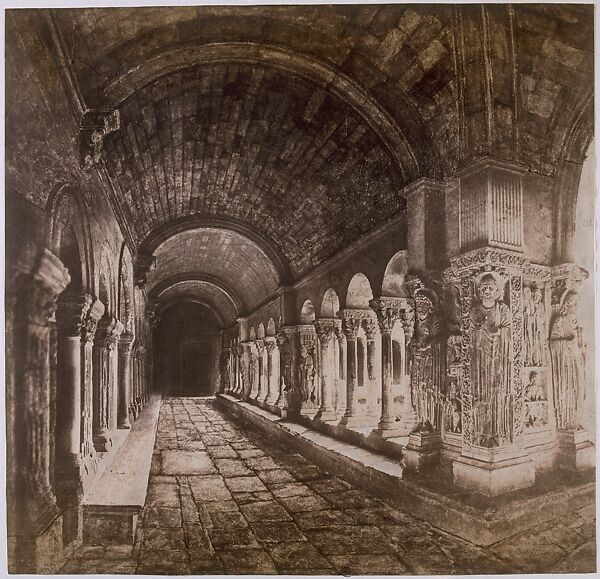
A cloister invites two kinds of looking. The passage draws the eye along its length, while the openings between columns let it slip sideways into daylight. In Édouard Baldus’s Cloister of Saint-Trophîme, Arles, both attractions remain available. We can follow the architecture into depth and pause over the carved stone that makes the journey worth taking.
The photograph dates from 1851. The Metropolitan Museum of Art identifies the large print as salted paper, made from paper negatives and finished with additional media.[1] That plural matters. The apparently continuous space was assembled from separate photographic observations. Baldus built the view on paper as carefully as he selected it through the camera.
A passage that lets the eye linger
A large carved figure on the nearest right-hand pier meets us before the passage can sweep us away. Its body occupies a vertical strip of stone beneath the capital, almost level with our imagined position. Beyond it, smaller columns repeat toward the dark doorway. The photograph gives that distant opening a strong pull, then supplies a compelling reason to remain in the foreground.
The floor and vault carry the movement differently. Irregular paving joints lead inward from the bottom edge; overhead, curved bands gather the passage beneath a heavy canopy. Between them, the bright openings on the right keep pulling attention sideways. Depth is persuasive, but it never becomes the only thing to see. The eye can turn from the dark end of the gallery to a small lit column without leaving the picture’s larger order.
The unoccupied passage also makes an unusual demand on us. No walker supplies a destination, no face offers a competing center of attention. We have to find our own pace among the supports and openings. The image is still, yet looking at it feels like a succession of small movements: forward, sideways, upward, back to a patch of carving.
My reading is that the photograph offers an unusually patient visitor’s experience. It gives us a whole space while allowing the parts to claim their own time. Knowing how it was made brings that invitation into sharper focus.
The work inside the apparent continuity
According to the Met’s object note, Baldus made about a dozen exposures, adjusting focus and exposure for the different portions of the scene. He cut and joined the negatives along architectural edges, including columns and cornices. Ink helped him disguise seams in the print; brushwork on the negatives clarified details and supplied portions of stonework.[1]
The building therefore provided both subject matter and places to join the image. A hard edge that already belonged to the architecture could also mark the boundary between separate photographic pieces. Our willingness to follow a column helps carry us across the join.
This makes the photograph more interesting than a demonstration of technical ingenuity. Separate decisions about what to bring into focus and how to expose it become one apparent invitation to look. The finished surface compresses the photographer’s repeated attention into a view we can take in at once.
There are limits to what that surface can tell us. It cannot be treated as proof that every visible passage of light was recorded simultaneously. Nor does the retouching permit us to assume that every small mark is an untouched trace of the stone. The photographed building and Baldus’s work on its representation meet in the same object.
His practice elsewhere in Arles makes the intervention concrete. A surviving amphitheater negative, also dated 1851, combines two paper negatives: one for the architecture and another for posed visitors with sketchpads. The Met identifies it as a component intended for a larger panorama that no longer survives.[4] Assembly could accommodate people as well as stone. In the cloister, its effect is to let the architecture hold our attention across a complicated field of depth and illumination.
A building made available at a distance
The commission behind this work helps explain why legibility mattered. In 1851, France’s Commission des Monuments Historiques selected five photographers to survey historic buildings. The photographs were intended to help officials in Paris assess preservation and restoration needs. Many commissioners had never visited the sites; a photographic record promised to carry useful information across that distance.[2]
That purpose changes the stakes of the lovely stone passage. An image could become a way for someone elsewhere to inspect a building. But the person receiving it also received the photographer’s decisions about what the building should look like on a sheet of paper.
Baldus had come to photography after working as a painter. Malcolm Daniel’s account places his early photographic experiments in the late 1840s and describes the technical accomplishment that quickly attracted official support. By 1855, he was recording the sculpture and ornament being made for the New Louvre, creating an extensive visual record of separate architectural parts.[3]
The cloister suggests an earlier, compact version of that problem: how can parts become a comprehensible whole? Here the answer is contained within one print. At the Louvre, it could unfold across an archive. This is a connection between the works’ methods, rather than evidence that Baldus intended the cloister as a plan for his later commissions.
Return to the columns. At first they seem to guarantee the photograph’s order: solid things standing in a convincing space. Now they also suggest the labor that makes the space available to us. The picture remains inviting after that knowledge arrives. We can still imagine moving down the passage, but we can also linger over the extraordinary work required to let our eyes travel so easily.
Sources
- The Metropolitan Museum of Art, Édouard Baldus, Cloister of Saint-Trophîme, Arles, 1851 — object record, medium, dimensions, exposure sequence, joined negatives, and ink retouching.
- Malcolm Daniel, “Mission Héliographique, 1851,” The Metropolitan Museum of Art, October 2004 — government commission, restoration purpose, itineraries, and the intended use of photographic records.
- Malcolm Daniel, “Édouard Baldus (1813–1889),” The Metropolitan Museum of Art, October 2004 — transition from painting, early photographic practice, official commissions, and the New Louvre archive.
- The Metropolitan Museum of Art, Édouard Baldus, Arles (Bouche-du-Rhône) — Interior View of the Amphitheater, 1851 — a separate surviving composite negative combining architecture and posed figures.