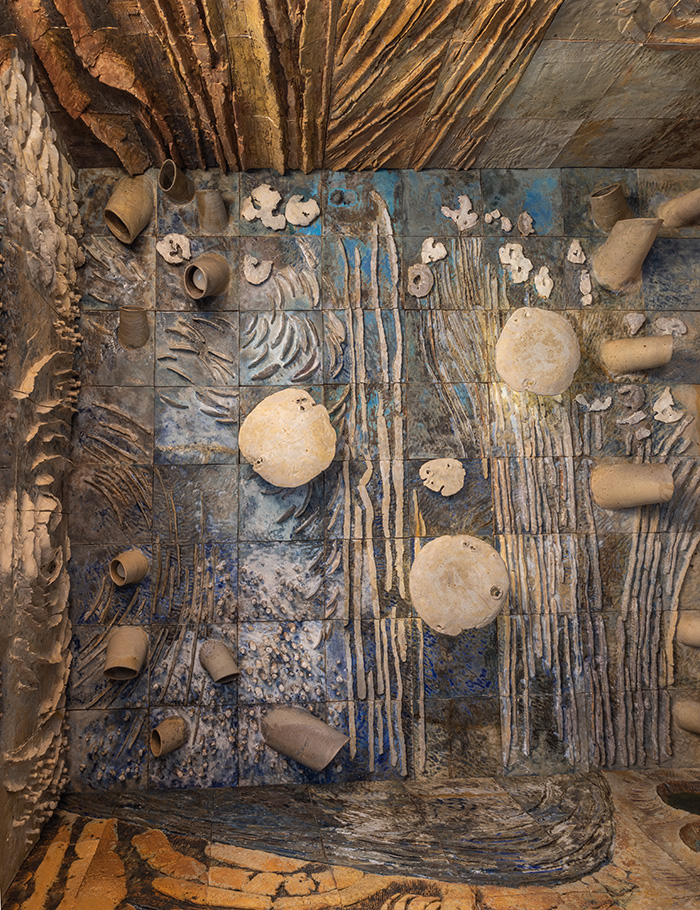
A ceramic vessel usually waits for someone to look inside. Ruth Duckworth made a work that reverses the encounter: Earth, Water, Sky spreads across four walls and the ceiling of a university entrance, putting the visitor inside a world made of clay.[1]
In the photograph, blue gathers around ridges and scored channels. Pale disks project from the tiled surface; hollow forms turn their openings toward us. The landscape has thickness. Light catches an edge and then drops into a groove.
That change in scale runs through her career. Duckworth could make porcelain seem as slight as a blade, then build a landscape large enough to surround a body. The same material offered both possibilities. Her achievement becomes clearer when we follow that movement between the hand and the room.
The Smart Museum’s 2023–24 exhibition Ruth Duckworth: Life as a Unity made a related correction. It foregrounded her Chicago sculpture and its engagement with the natural world, challenging the habit of remembering her principally as a British studio potter. Duckworth herself described her occupation as sculpture in clay.[5]
Learning to build a form
Born in Hamburg in 1919, Duckworth left Germany for England in 1936 after Nazi restrictions prevented her from pursuing art studies. At the Liverpool School of Art, she wanted to work across painting, drawing, and sculpture. The Smithsonian’s biography describes an education complicated by the expectation that a student should choose one discipline.[2]
The work that followed was materially varied: puppetry, wartime employment in a munitions factory, and carving headstones. Clay became her focus during the 1950s.[2] That sequence matters because it restores sculpture to the beginning of her story. Her later ceramic work grew from an existing interest in making forms, with several kinds of tools and materials already behind her.
Aberystwyth University’s account identifies Lucie Rie as the friend who encouraged formal ceramics training. Duckworth attended London’s Central School of Arts and Crafts from 1956 to 1958. She produced functional wares, then increasingly pursued abstract sculpture after 1960. Large stoneware vessels were built by coiling; delicate porcelain pieces could be pinched into shape.[3]
Those methods suggest different tempos of attention. Coiling lets a wall accumulate through successive additions. Pinching makes the distance between inside and outside something the fingers continually negotiate. In both, the shape can develop through local decisions. An opening, a swelling, or an uneven edge becomes part of the object's character.
The earth enters the studio
Duckworth arrived at the University of Chicago in 1964 for what was intended as a one-year teaching appointment. She stayed on the faculty for thirteen years and remained in Chicago until her death in 2009.[2] The move also brought her into contact with people whose daily work involved imagining the earth at unfamiliar scales.
Mineralogist Julian Goldsmith commissioned Earth, Water, Sky for the Henry Hinds Laboratory. Writing about the mural, geophysicist Douglas MacAyeal places it within a scientific shift toward understanding land, water, and atmosphere together. He also points to the material connection: the weathering of minerals produces the clay Duckworth shaped.[1]
This gives the installation an unusual intimacy. A viewer encounters a planetary subject through a substance that can be pressed between fingers. I read that correspondence as central to Duckworth’s art: a distant view becomes tangible without losing its breadth.
The Smart Museum traces the influence of geomorphology—the study of landforms—and the emerging environmental movement across her Chicago work. Its exhibition followed that interest from the Hinds installation through the mural Clouds Over Lake Michigan, wall reliefs, and the substantial vessels known as Mama Pots.[5] Nature was a continuing source of forms across different kinds of objects.
Two blades and the space between
The smaller works keep this story from becoming a simple ascent toward greater size. An untitled porcelain sculpture from 1989 at the Phillips Collection stands only fifteen and a half inches high. Two upright, blade-like forms share a base, one positioned slightly ahead of the other. The museum draws attention to the shadow between them as an active part of the composition.[4]
That narrow interval asks for a different kind of looking from a mural. Attention gathers around proximity: how close the forms stand, how their edges answer each other, how a strip of darkness separates two pale surfaces. A small displacement can organize the whole encounter.
The Phillips also describes Duckworth’s daily use of a “play table,” where she worked with parts of abstract forms already sanded to the translucency she wanted.[4] The phrase makes room for experiment inside an exacting practice. Smoothness did not arrive automatically with porcelain; it was something worked toward, then tested in relation to another shape.
Seen alongside the architectural work, this tabletop sculpture makes scale feel like a choice of relationship. The mural places a body within an environment. The paired forms concentrate attention on the space between objects.
A landscape with joints
The later history of Clouds Over Lake Michigan exposes the practical weight behind Duckworth’s expansive vision. The mural drew on photographs of the Chicago region taken from space. When it needed a new home, its sixty-five ceramic tiles had to be carefully removed from the wall where they were mortared in place.[6]
It was installed in the University of Chicago’s Regenstein Library in September 2023 after restoration.[1] A landscape that appears to flow across a wall could survive a change of building because it was also a constructed object, with separable parts and surfaces requiring care.
That physical fact brings Duckworth’s two scales together. Even her widest views remain made things. The planet comes within reach through clay, while the clay keeps its own demands: weight, edges, joins, and the patient decisions that let one form sit beside another.
Sources
- Laura Steward and Douglas MacAyeal, “Earthbound,” The University of Chicago Magazine, Winter 2024 — murals, scientific context, and image source.
- Smithsonian American Art Museum, “Ruth Duckworth” — biography, training, early employment, and the move to Chicago.
- Aberystwyth University School of Art Museums and Galleries, “Ruth Duckworth” — Lucie Rie, ceramics training, functional wares, coiling, and pinching.
- The Phillips Collection, “The Phillips Collects: Ruth Duckworth,” March 23, 2018 — the 1989 porcelain sculpture and her studio working method.
- Smart Museum of Art, “Ruth Duckworth: Life as a Unity,” September 21, 2023–February 4, 2024 — exhibition framing, Chicago sculpture, geomorphology, and environmental thought.
- University of Chicago News, “Ruth Duckworth’s ‘Clouds Over Lake Michigan’ will have new home at UChicago,” March 13, 2023 — aerial imagery, the mural’s tiles, and removal for conservation and relocation.