Augusta Savage is often remembered through loss. The Harp was demolished after the 1939 New York World's Fair, many of her works survive only in photographs or plaster, and even her late career is regularly told as a story of promise obstructed by racism, money, and institutional neglect.[1][3][4] Those losses matter, but they can reduce the scale of her achievement if they become the whole frame. Savage's stronger legacy lies in how she kept moving sculpture across three public registers at once: portrait busts that refused caricature and gave Black subjects formal gravity, Harlem teaching spaces that turned art into shared infrastructure, and a monument tradition aimed at placing Black life visibly into American civic space.[1][2][3][4]
That is why her work still feels structurally modern. She did not treat art as a luxury object peeled away from community need. She treated it as a way to change who could appear with dignity, who could learn, and who could occupy public memory.[1][3][4] Even when the objects disappeared, the method held.
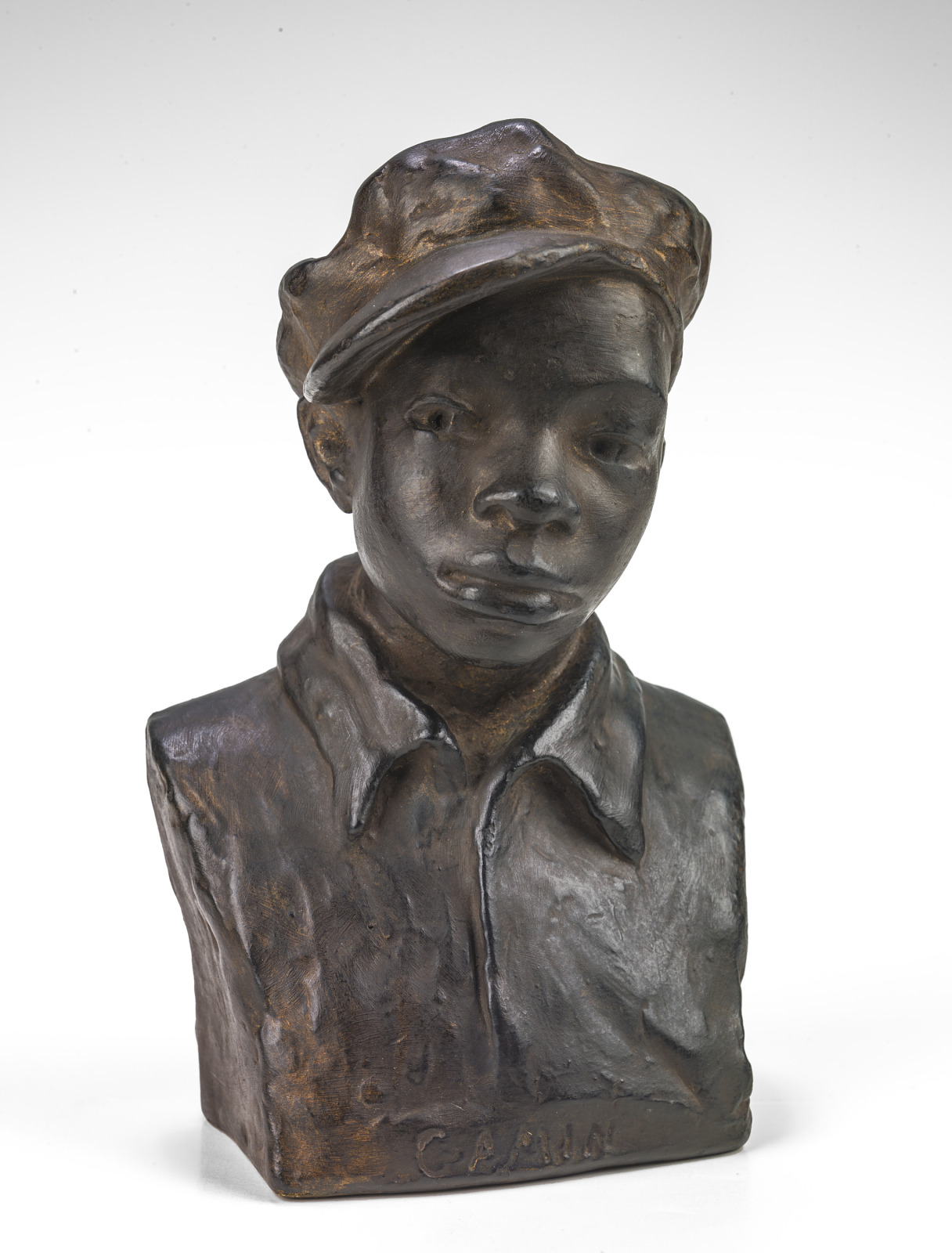
Image context: the cover uses SAAM's image of Gamin because this article's argument begins there. The bust is small, but it already contains Savage's larger program: a Black child modeled with exacting affection, a supposedly minor urban subject granted the seriousness of formal portraiture, and a sculptor testing how public regard might be built from clay.[2]
1) Gamin turns a street child into a subject of public form
Savage's career began under pressure long before the Harlem Renaissance made her visible. The Smithsonian American Art Museum artist page traces the path from Green Cove Springs, Florida, where her father opposed her early sculpting, to New York, where she arrived with almost no money, worked as an apartment caretaker, and completed Cooper Union's four-year course in three years.[1] That compressed beginning matters because it set the terms of her later sculpture. Savage did not come to portrait busts through inherited ease or salon convention. She arrived through self-invention, hustling, and the need to make talent legible inside institutions that were not built for her.
Gamin is the clearest proof. SAAM's object page identifies it as a painted plaster bust from about 1929, modeled on her nephew Ellis Ford.[2] The work matters for more than its charm. The museum's description emphasizes that formal bust portraiture had historically been reserved for the powerful and the famous, yet Savage applies that high-status form to a poor Black child associated with the working street.[2][3] She keeps the tilted cap, the wrinkled collar, and the sideways look. Nothing is idealized into false uplift. The dignity comes from the seriousness of the modeling itself.
That shift is central to understanding Savage. Gamin does not ask the viewer to admire uplift as a slogan. It asks the viewer to accept that Black childhood, especially poor Black childhood, belongs inside the formal language of sculpture.[2][3][4] The work is intimate, yet it is already public in ambition. It turns representation into advocacy without surrendering specificity. Ellis Ford remains Ellis Ford; at the same time, the bust expands outward into a claim about who deserves visibility.
2) Teaching was part of the artwork's civic scale
The standard artist-profile habit is to separate the objects from the teaching career, as though Savage made sculpture on one side and mentored younger artists on the other. Her own career resists that split. SAAM's education page and artist biography both stress that she founded the Savage Studio of Arts and Crafts in Harlem, later helped build the WPA's Harlem Community Art Center, and taught artists including Jacob Lawrence, Gwendolyn Knight, and Norman Lewis.[1][3] Those are biographical facts, but they also describe an artistic method.
Savage understood that formal access was uneven long before the language of "access" became common. A studio, a neighborhood school, and a community art center could all function like sculpture in another medium: they shaped public space, gathered bodies, and made new appearances possible.[3][4] The point was never limited to producing her own busts of W. E. B. Du Bois, Marcus Garvey, or other prominent sitters.[1][3] It was to widen the field in which Black artists and Black subjects could circulate with authority.
That is where her famous line about monumentality becomes decisive. On SAAM's artist page and in Smithsonian's Sidedoor episode, Savage says that if she could inspire young people to develop their talent, "my monument will be in their work."[1][4] Read properly, the sentence is a theory of scale. Savage wanted literal monuments, and she pursued them. She also understood that an institution, a classroom, or a generation of younger artists could carry public form farther than one object alone.
3) The Harp shows that Savage thought monumentally even when the material system failed her
That ambition reached its clearest public statement in the sculpture first titled Lift Every Voice and Sing and better known as The Harp. SAAM's sources summarize the sequence with painful clarity: after returning from Paris on Rosenwald support, Savage became a leading Harlem teacher and administrator; in 1937 she was appointed first director of the Harlem Community Art Center; then she received the 1939 World's Fair commission for a monumental sculpture based on the Black anthem Lift Every Voice and Sing.[1][3] The result was a sixteen-foot plaster work finished to resemble black basalt, with twelve Black singers forming the strings of a harp, the hand and arm of God as sounding board, and a kneeling figure as pedal.[1]
The sculpture was acclaimed, then destroyed because no money was available to cast it in bronze or store it after the fair closed.[1][3][4] That story is often told as a neat tragedy of lost masterpiece. The deeper reading is harsher and more revealing. The failure was not artistic. It was infrastructural. Savage could imagine the monument, model it, and make the public answer to it. What the system refused to provide was permanence.
Seen from that angle, The Harp clarifies the rest of her career. Savage was not merely a fine portraitist who happened to make one large symbolic work. She was testing whether Black collective life could occupy civic scale in the United States.[1][4] The monument vanished, but the question it asked did not: who gets to appear in public art as a chorus, as history, as nation?
4) Her real monument is the linkage between face, school, and public memory
A photograph preserved by the Archives of American Art shows Savage leaning against her sculpture Realization around 1938.[5] It is an instructive image because it collapses so much of her career into one scene: the artist beside her work, intimate in scale, still thinking sculpturally about presence, embodiment, and recognition. It also reminds us how much of Savage now survives through documentation, memory, and the institutions she helped shape.[4][5]
That survival can tempt us into elegy, but elegy is too passive for Savage. Her best works and best decisions keep insisting on conversion: clay into public regard, portrait into political claim, school into monument. Gamin makes this visible in miniature.[2][3] The Harlem Community Art Center made it social.[1][3] The Harp attempted it at civic scale.[1][4] Taken together, these are not scattered episodes. They are one artistic program.
That is why Augusta Savage still matters as an artist profile and not only as a recovery project. She built a form of sculpture answerable to public life. Some of the objects were lost, some remained fragile, and many institutions around her failed to hold what she made.[1][3][4] Yet her work keeps returning because it joined dignity of portrayal to dignity of access. She wanted Black Americans to be seen in museums, in schools, in plazas, and in history. Even when the plaster did not last, the artistic demand did.[1][2][3][4][5]
Sources
- Smithsonian American Art Museum, "Augusta Savage" - artist biography covering her Florida childhood, Cooper Union training, Paris fellowships, Harlem teaching, and the making and destruction of The Harp.
- Smithsonian American Art Museum, "Gamin" - object page with date, medium, model identification, and gallery text on how Savage used formal bust portraiture to dignify a Black child.
- Smithsonian American Art Museum, "Oh Freedom! Augusta Savage" - teaching resource connecting Gamin to Black childhood, the Savage Studio of Arts and Crafts, the Harlem Community Art Center, and Savage's role as mentor and activist-educator.
- Smithsonian Institution, The Monumental Imagination of Augusta Savage - official Sidedoor transcript PDF on Savage's public-monument ambition, teaching legacy, and the larger meaning of her lost works.
- Archives of American Art, Smithsonian Institution, "Augusta Savage with her sculpture Realization, circa 1938" - item page for Andrew Herman's Federal Art Project photograph of Savage beside one of her sculptures.