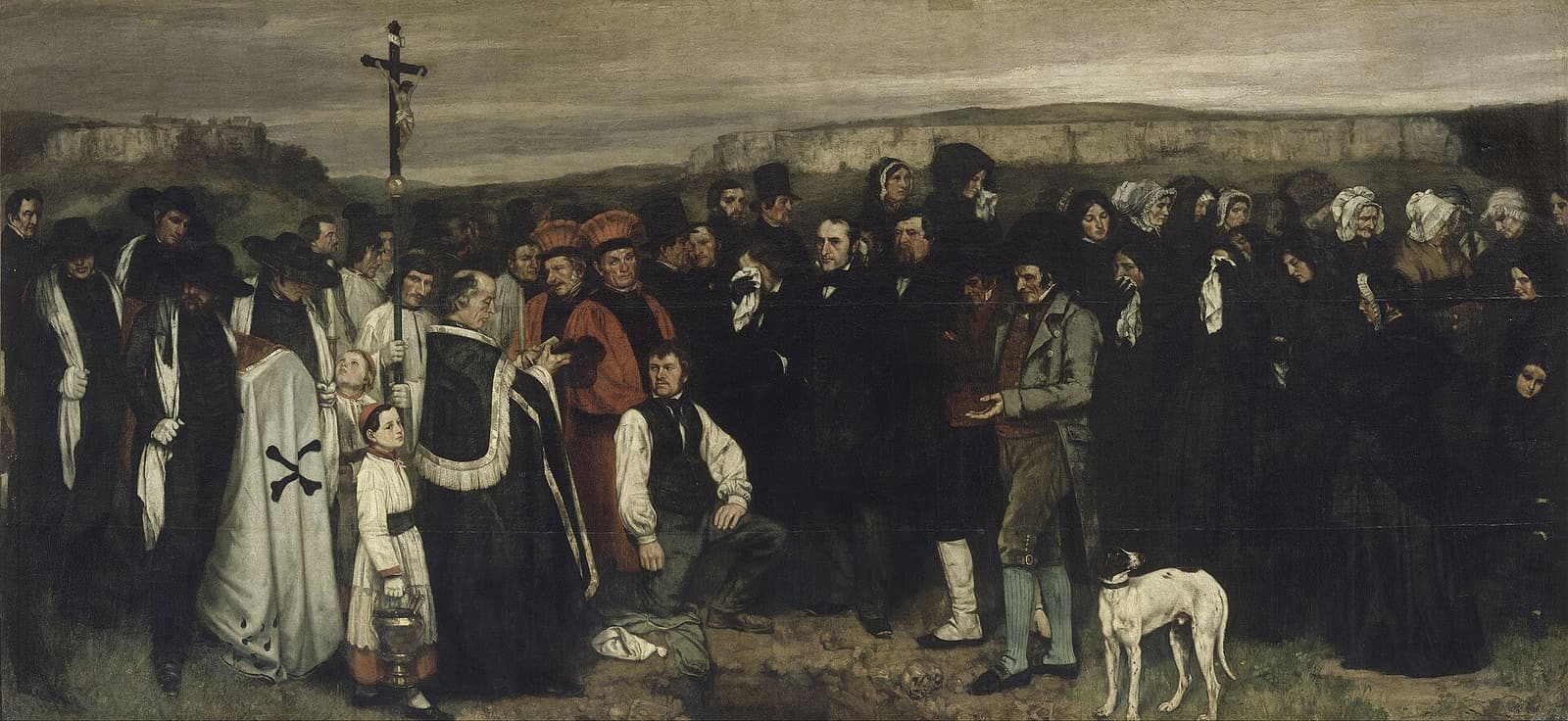
Gustave Courbet's A Burial at Ornans keeps getting summarized as the painting that made provincial reality too big.[1][3] That account is basically right, but it can still miss the picture's sharper achievement. The scandal does not come from simple bluntness. It comes from arrangement. Courbet takes the size and lateral spread once reserved for elevated public subjects and gives that scale to a funeral that refuses to sort its people into heroes, saints, or exemplary mourners. The result is less a scene of exalted grief than a dense civic fact.[1][3][4]
The numbers matter because the painting behaves physically before it behaves symbolically. The Musée d'Orsay records the canvas at 315 by 668 centimeters, wide enough that the funeral reads less like a devotional image than like a frieze that has dropped to eye level.[1] That width changes how attention moves. No single figure can monopolize the surface for long. The eye drifts from priest to veteran, from village women to gravedigger, from dog to open grave, from cliff edge to strip of sky.[1][4] A burial is taking place, but the painting's deeper subject is what a community looks like when ritual no longer guarantees hierarchy.
Image context: the cover uses the whole painting rather than a detail because the work's argument is horizontal. Courbet turns a line of local faces into the equivalent of a public procession, yet he leaves the grave open at the bottom edge and never grants the crowd a single commanding center.[1][4]
The grave sits where history painting usually puts triumph
The most destabilizing form in the picture is not the crucifix. It is the hole.[1][4] Courbet lowers the open grave into the foreground so aggressively that it interrupts any smooth ceremonial reading. Instead of allowing the eye to rise immediately toward religious authority or expressive faces, he makes us confront the dark cut in the earth first. In older monumental painting, the lower foreground often stabilizes the scene with armor, drapery, a fallen body, or some legible emblem of sacrifice. Here the ground itself is unsettled.
That placement has a hard effect on tone. The funeral cannot drift upward into edifying pathos because the grave keeps pulling the entire event back toward material fact. Priests can chant, officials can stand in their black coats, villagers can bow their heads, and the cross can punctuate the middle distance, but the burial remains anchored in soil, weight, and depth.[1][3] Courbet does not deny ritual. He simply keeps ritual from floating free of the thing it exists to manage: a body going into the ground.
Smarthistory's reading is useful here because it stresses how Courbet magnifies the ordinary without smoothing it into academic nobility.[4] The grave is part of that refusal. It gives the painting an awkward honesty. Even the dog at the lower edge contributes to the effect, not as anecdotal charm but as one more reminder that this is a local event with uneven attention, mixed motives, and no classical polish.[4]
Width is the real argument
The usual shorthand says Courbet shocked viewers by painting common people at the scale of history painting.[1][3] That is true, but the important mechanism is width. A Burial at Ornans is built as a long band of coexistence. The mourners do not compress into a pyramidal action, and they do not rise toward one decisive climax. They remain distributed across the canvas, almost stubbornly side by side.[1][4]
This is what makes the painting feel modern. Classical large-scale compositions often guide the viewer toward a moral summit: the oath, the martyrdom, the coronation, the heroic death. Courbet gives us no such peak. His figures are present with different degrees of attention, fatigue, sincerity, and social standing, but the canvas declines to rank them with much insistence. Some look inward, some outward, some downward, some distracted. Their black clothing creates a broad civic mass rather than a chain of individualized theatrical cues.[1][3]
That lateral spread is also why the work can feel almost anti-compositional at first glance. It seems to resist grace. Yet the resistance is deliberate. Courbet wants the surface to register the unevenness of a real gathering, where ceremony produces a temporary line of assembly without turning everyone in it into actors in the same drama.[4] The width makes room for social fact.
A crowd replaces the single exemplary mourner
Another way to describe the painting's break with convention is this: it swaps the exemplary figure for the collective witness.[1][3][4] No one here completely absorbs the meaning of the funeral. The priest does not. The cross-bearer does not. The gravedigger does not. Even the mourners in profile, who might have served as emotional anchors in a more selective composition, remain part of a larger chain of faces and hats and sleeves and black coats.
That matters because grief in the picture does not arrive as one purified emotion. It arrives as a social mixture. Some faces seem absorbed, some remote, some dulled by repetition, some merely dutiful. Courbet paints not the ideal form of mourning but the public administration of mourning.[4] The funeral is a communal obligation before it becomes a spiritual symbol.
Britannica's account of the work emphasizes the painting's role in establishing Realism by transferring monumental seriousness to a contemporary provincial subject.[3] The crowd is where that transfer becomes visible. These are not anonymous extras filling out a noble scene. They are the scene. Courbet's wager is that a community gathered for burial contains enough visual and moral complexity to occupy a giant canvas without borrowing prestige from mythology or antiquity.[1][3]
The cliff and the sky keep transcendence at a distance
For a burial picture, A Burial at Ornans offers remarkably little heaven.[1][3] There is sky, but not much release. The limestone ridge behind the mourners runs across the background as a dense horizontal limit, echoing the crowd's own long alignment. Instead of opening the scene toward a distant beyond, landscape behaves like another boundary. Earth answers earth.
This is one reason the crucifix feels so precise. It does not dominate the image; it punctuates it.[1][4] Courbet lets religious form stay visible, yet he does not allow it to dissolve the stubborn materiality of coats, faces, grave soil, and rock. The painting therefore keeps two orders in the same field: ceremony and geology, doctrine and weather, public rite and local ground.[1][3]
That balance helps explain why the painting still feels challenging. Courbet does not mock religion, but he does strip away the atmospheric cushions that used to make transcendence pictorially easy. What remains is a harder exchange between ritual promise and earthly circumstance. The burial proceeds in full public view, but redemption is not turned into an obvious optical effect.
Why the picture still holds
The Orsay's recent restoration framing is a reminder that A Burial at Ornans remains one of the museum's defining tests of nineteenth-century scale and surface.[2] It still matters for the same reason it initially disturbed viewers: Courbet made an ordinary communal event carry the weight once reserved for grand subjects, then refused to ennoble it with compositional shortcuts.[1][2][3]
That refusal is the source of the painting's dignity. The work does not belittle its mourners. It gives them room, gravity, and duration. What it withholds is uplift on demand. The grave stays open. The crowd stays uneven. The canvas stays wide enough that no single sentiment can close the scene.[1][4] In that sense Courbet's Realism is not just a matter of painting what he saw. It is a matter of refusing to let scale lie about what public life feels like when death passes through it.
Sources
- Musée d'Orsay, Un enterrement à Ornans - object page with date, dimensions, medium, and collection context for Courbet's monumental funeral scene.
- Musée d'Orsay, "The restoration of Courbet's painting A Burial at Ornans" - 2025 museum article on the treatment and renewed visibility of the work's surface and scale.
- Encyclopaedia Britannica, "A Burial at Ornans" - overview of the painting's Realist significance, date, and reception.
- Wikipedia, "A Burial at Ornans" - overview of the composition, figures, and exhibition history, with linked references for follow-up verification.
- Wikimedia Commons, file page for Gustave Courbet - A Burial at Ornans - Google Art Project - image record used for the lead artwork reproduction.