
Chiura Obata is easy to summarize too narrowly. He can be reduced to the California watercolor master, the Yosemite interpreter, the Japanese-born Berkeley professor who translated mountain weather into luminous wash and line. Those descriptions are true as far as they go, but the Smithsonian American Art Museum lecture Chiura Obata's America is useful because it keeps widening the frame.[1][2][3] The lecture does not treat Obata as a regional landscape specialist who happened to have a difficult wartime chapter. It presents a fuller structure in which landscape, pedagogy, immigrant adaptation, and camp-era institution building all belong to the same artistic logic.[1][2][4]
That broader framing matters because Obata's work can look serene faster than his life was. The Smithsonian artist page places him inside a long West Coast career shaped by anti-immigration politics, wartime incarceration, and a sustained refusal of simple East-versus-West labeling.[3] The exhibition page pushes the same point in curatorial terms: Obata's synthesis of traditions resists the usual split between "Japanese" and "American," while his work as a teacher and organizer becomes part of his artistic legacy rather than a side note.[2] The Archives of American Art finding aid then gives the hardest historical ground under that claim. Its summary ties Obata's papers directly to Berkeley, Tanforan, Topaz, letters from incarceration, and the art schools he established in confinement.[4]
Taken together, those sources make the lecture more than a museum talk.[1][2][3][4] They make it a strong entry point into an argument about what "America" meant for Obata. It meant mountain seeing, yes, but it also meant making culture portable. It meant training students to notice line, weather, and atmosphere. It meant insisting that art could remain communal under pressure. The lecture is strongest when read through that sequence.
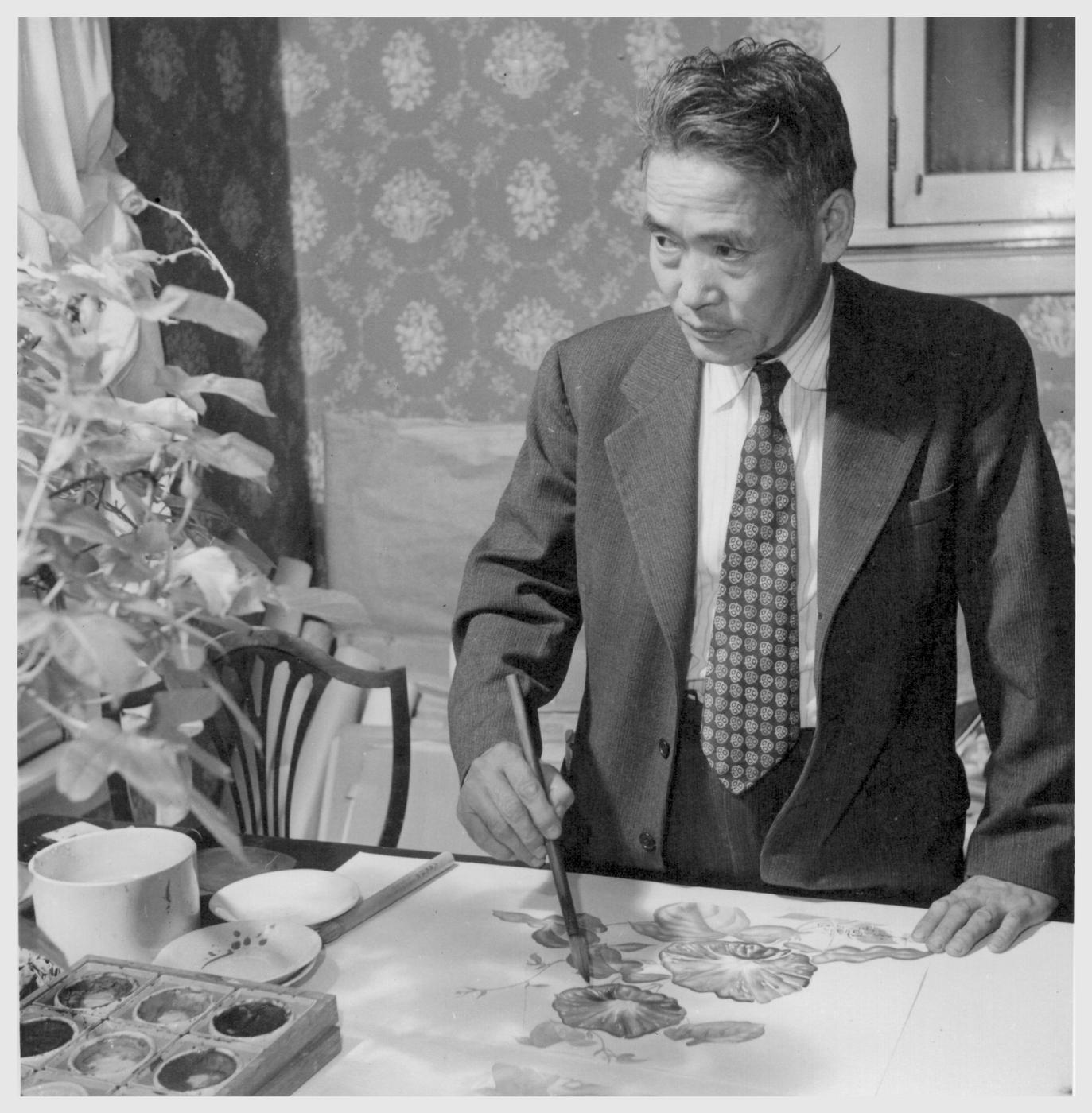
Image context: the cover uses a 1944 photograph of Obata painting, preserved on Wikimedia Commons from a wartime image record, rather than one of his finished landscapes. That choice fits the article because the lecture is really about practice: painting as repeated attention, as teachable discipline, and as something carried by the body even when ordinary civic life has broken down.[5]
Early in the lecture, "America" is defined as a field of translation rather than a destination
The first useful move in the lecture is conceptual.[1] Obata is not introduced as someone who leaves Japan, arrives in the United States, and then gradually becomes legible by adopting an American style. Instead, the talk keeps returning to mixture: modern Japanese training, American landscape experience, commercial design work, teaching, and cross-cultural institution building are all treated as simultaneous rather than sequential layers.[1][2][3] That matters because it blocks a lazy immigrant-success reading in which the artist's value lies in smooth assimilation.
The Smithsonian exhibition description supports that reading explicitly by arguing that Obata's work defies the ordinary division between East and West.[2] The artist page adds the political stakes. Obata's seven-decade career unfolded across anti-Asian exclusion and wartime incarceration, yet he still emerged as a central figure in Northern California art communities.[3] In that context, "America" in the lecture is not a passive setting where his art happened. It is an unstable field that he keeps remaking through painting, teaching, and social organization.
This is why the lecture's title is stronger than it first appears.[1] It does not simply mean "Obata in America." It means the version of America his work proposed: one built from mobility, apprenticeship, visual attention, and cultural exchange rather than from a single national school or style. The argument becomes especially persuasive because the speaker does not isolate aesthetics from biography. Formal qualities and historical pressures stay in the same frame.[1][2][3]
In the landscape passages, Yosemite and the Sierra become a method of attention
The lecture is also valuable because it refuses to treat Obata's mountain scenes as tasteful scenery.[1] The recurring emphasis on Yosemite, the Sierra, and what Obata called "Great Nature" is not merely about subject matter. It is about discipline. His landscapes are presented as records of looking hard enough that line, atmosphere, and tempo begin to reorganize perception itself.[1][2][3] Seen that way, the mountains are not an escape from history. They are where an ethic of attention is trained.
The Smithsonian artist page helps sharpen this point by describing Obata's devotion to preserving the grandeur of "Great Nature" while also stressing his technical range across painting, printmaking, and pedagogy.[3] The exhibition page goes further, linking peaks, valleys, storms, and light to broader struggles of becoming an artist and, more subtly, of becoming American as a minority subject.[2] Landscape is therefore not neutral beauty. It is a way of building internal order without denying the instability outside the frame.
That is the strongest insight to carry out of the video. Obata's landscapes are calm, but they are not passive.[1] They teach viewers how to move through complexity without flattening it. Wash, contour, and selective detail become forms of moral pacing. The lecture makes this readable by placing nature study beside teaching and camp history instead of far away from them. Once that connection is made, even the most lyrical Sierra image looks less like retreat and more like training.
The lecture's middle argument is really about teaching as an artistic medium
Obata's status as a Berkeley professor and community organizer can easily get filed away as admirable biography. The lecture is stronger because it treats teaching as part of the work itself.[1] The Smithsonian materials support that claim repeatedly. On the artist page, his importance lies not only in the objects he made but also in his role as an influential professor at UC Berkeley and a founding director of camp art schools.[3] On the exhibition page, teaching and community engagement are called his "second legacy," which is a revealing phrase.[2]
I would push that claim one step further: teaching was not a second legacy at all, but one of the media through which Obata worked. The Archives of American Art finding aid makes that inference hard to avoid.[4] It lists course material, exhibition files, letters, and records related to the art schools at Tanforan and Topaz. In other words, the archive does not separate artwork from educational labor. It preserves a practice in which drawing, correspondence, class structure, and institution building were interdependent.[4]
That interdependence changes how the lecture should be watched.[1] It is not only a curator explaining an artist's oeuvre. It is a presentation about how art becomes social form. Obata teaches people how to see; he also builds sites where such seeing can be shared, repeated, and protected. That is why the lecture's language of community feels earned rather than ceremonial.[1][2][3][4]
By the end, Tanforan and Topaz become the test of the entire argument
The final reason this video is worth embedding is that it does not leave incarceration as a tragic appendix.[1] The lecture and supporting documents make Tanforan and Topaz central to understanding Obata's American project.[2][3][4] The finding aid is especially clear: forced relocation from Berkeley, incarceration at Tanforan and Topaz, correspondence from confinement, and the art schools founded there are among the core organizing facts of the archive.[4] That means camp history is not a detour away from the art. It is where the meaning of the art is tested.
Under those conditions, the value of painting changes. Landscape no longer signifies only beauty, memory, or travel. It becomes a portable structure of attention that can be taught under coercion. The art school becomes more than enrichment. It becomes a civic repair mechanism operating in a place designed to strip civic standing away.[2][4] The lecture does not sensationalize this point, and that restraint is part of its force.[1] Obata's answer to confinement is not melodrama. It is the stubborn maintenance of line, study, and shared making.
That is why this lecture works as an annotated viewing rather than as background video.[1] Its deepest claim is not biographical completeness. It is that Obata's America should be read through a three-part sequence: nature as rigorous seeing, teaching as artistic form, and camp art school as the proof that such form could preserve dignity under state violence.[1][2][3][4] Once those pieces lock together, Obata stops looking like a painter who happened to teach and happened to endure internment. He becomes legible as an artist for whom seeing, instruction, and survival were parts of one continuous practice.
Sources
- Smithsonian American Art Museum, "Chiura Obata's America," YouTube video lecture by guest curator ShiPu Wang.
- Smithsonian American Art Museum, "Chiura Obata: American Modern" - exhibition overview describing cross-cultural synthesis, community engagement, and incarceration-era art schools.
- Smithsonian American Art Museum, "Chiura Obata" - artist page covering biography, Berkeley teaching, and the relation between Great Nature, migration, and Japanese American history.
- Archives of American Art, Smithsonian Institution, "A Finding Aid to the Chiura Obata Papers, 1891-2000" - archival PDF covering Berkeley, Tanforan, Topaz, correspondence, and teaching records.
- Wikimedia Commons, "File: During his spare time, Professor Obata likes to draw and paint for his own pleasure.jpg" - 1944 photograph of Chiura Obata painting.