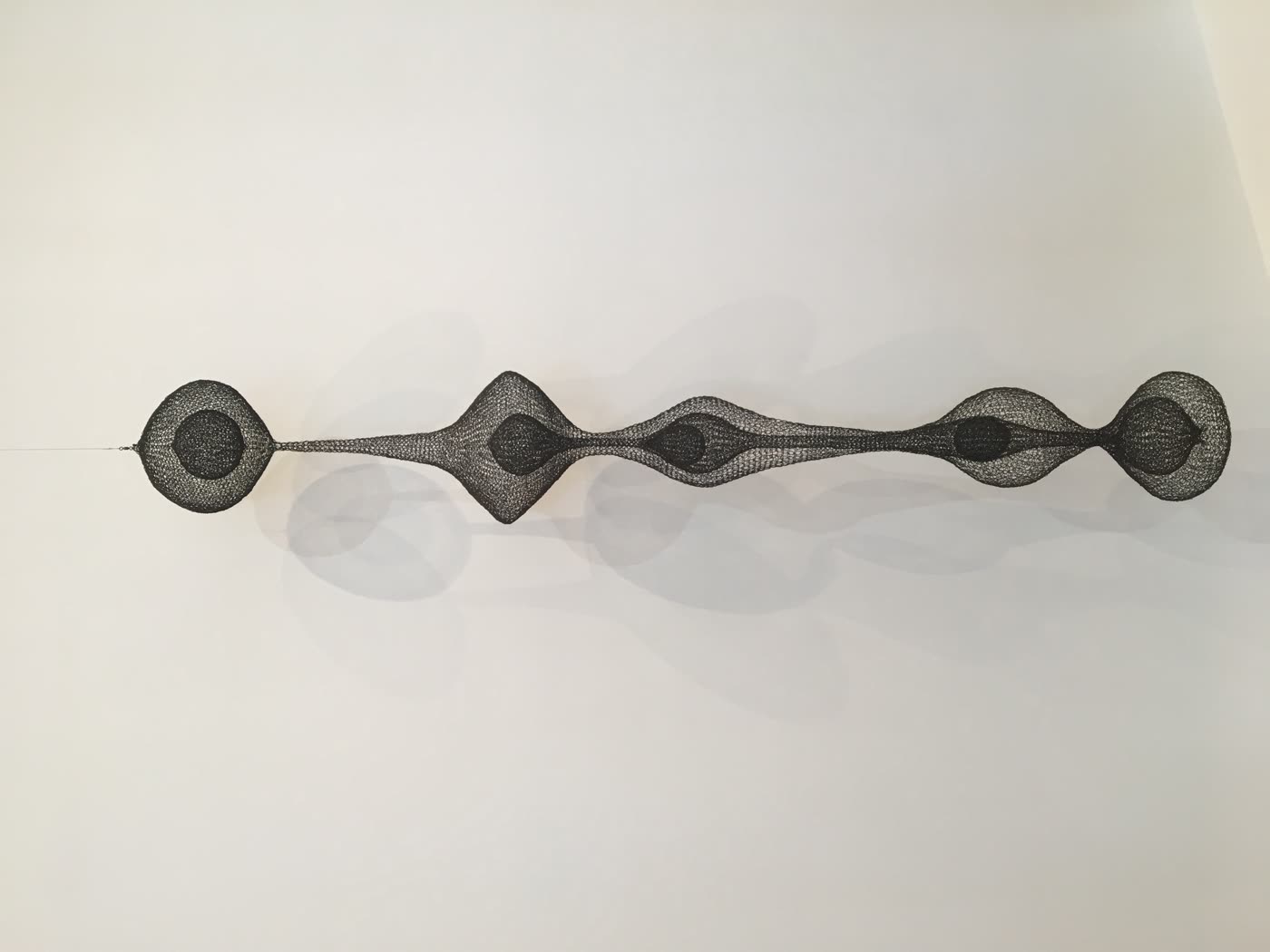
Ruth Asawa's reputation often arrives in one instant: a suspended wire form, airy enough to look weightless, exact enough to hold the eye like drawing made solid.[1][2] The risk is that the work gets reduced to elegance. Seen that way, the sculptures can look like beautiful objects whose main achievement is delicacy. That reading misses the harder thing Asawa actually did. She took line, repetition, and ordinary industrial wire and turned them into a way of thinking about relation: inside and outside, hand and material, home and city, private experiment and public form.[1][3][4]
That is why Asawa still feels unusually alive in 2026, during the centennial exhibitions that have pushed her work back into wide view.[3][4] The looped-wire sculptures remain the clearest entry point, but they are only the entry point. The larger profile is of an artist who kept refusing the clean border between artwork and life. The same mind that made hanging forms with visible interiors also built public fountains, fought for arts education, and treated domestic space as a laboratory rather than as a retreat from serious art.[3][4]
Image context: the cover image shows one of Asawa's early looped-wire sculptures, photographed in gallery installation. That exact kind of image matters here because this essay turns on transparency: you need to see the outer skin, the inner form, and the shadow-bearing mesh at the same time to understand why Asawa's sculpture never behaves like a sealed mass.[1][5][6]
The line begins with a change of route
Asawa's biography matters here, though not as a sentimental frame.[1][3][4] During World War II, she and her family were forcibly incarcerated under Executive Order 9066.[3][4] After the war, the path she had imagined for herself as a teacher narrowed under discrimination, and in 1946 she enrolled at Black Mountain College instead.[1][3] She expected painting and drawing; the school's cross-disciplinary culture moved her toward sculpture.[1]
The decisive technical turn came after a 1947 trip to Toluca, Mexico, where she learned a looped-wire basket technique from local craftworkers.[1][3] Whitney's artist page captures the procedure neatly: wire looped around a dowel into what Asawa called a "string of e's," repeated until line began to generate volume.[1] What matters is not just that she found a new technique. What matters is the kind of technique it was. It did not begin with carving out mass or welding closed structure. It began with a repeated hand motion that could stay open, adjust as it went, and let shape emerge through making.[1][2]
That procedural openness stayed central to her art. On the Ruth Asawa site, the looped-wire works are described as transparent, light, and continuously visible across inner and outer forms.[2] Asawa herself emphasized that continuity. A loop can hold form without blocking sight. That simple fact gave her sculpture its deepest premise: space is not what remains after form ends; space is part of the form.
Why the hanging sculptures changed the room around them
This is where Asawa separates herself from a lot of twentieth-century sculpture. Many sculptors made space feel activated. Asawa made space feel inhabited without being filled.[1][2][5] Her hanging works rarely behave like compact objects. They stretch downward, bifurcate, place one lobe inside another, and remain porous enough that the viewer never encounters a hard outer shell. The SFMOMA-access retrospective site describes clusters of copper and brass wire forms whose mesh makes each lobe visible while the whole group hangs lightly above the floor.[4] The Asian Art Museum installation page for Untitled (S.272) makes the same point in plainer terms: airy interior and exterior spaces flow into one another.[5]
That inside-outside continuity is not a decorative byproduct. It is the content. Whitney's collection text notes the play of interior and exterior space, as well as the constellation of shadows these works throw onto the wall.[1] The sculpture therefore does at least three things at once. It occupies the room. It lets the room remain visible through it. And it drafts a second, temporary version of itself in shadow. The viewer is never dealing with one object alone. One is dealing with object, air, and echo.
Seen that way, the supposed lightness of Asawa's work stops looking fragile and starts looking exact. The sculptures do not deny gravity; they distribute it. They do not romanticize transparency; they structure it. That is why the forms can feel organic without turning vague. Lobes, branches, nested volumes, and hanging descent all suggest plants, shells, bodies, webs, and seedpods, yet the work never settles into illustration.[1][2][5] Nature enters as structural analogy, not as motif pasted on afterward.
Experiment did not stop with wire
One reason the 2025-2026 retrospectives matter is that they restore the full range of Asawa's practice.[3][4] The SFMOMA and MoMA materials both stress that the exhibitions include far more than the iconic hanging forms: tied-wire sculptures, bronze casts, paper folds, prints, drawings, archival materials, and evidence of public commissions and arts advocacy.[3][4] That breadth changes the profile. Asawa stops looking like the maker of one miraculous invention and starts looking like an artist who kept translating the same questions across materials.
The Ruth Asawa site is especially helpful here. Its sculpture overview follows the path from looped wire into tied-wire branching forms and then into electroplated and cast works.[2] The shift is not a break. It is an expansion. In the tied-wire pieces, a central stem divides into branches, still pursuing interdependence between exterior and interior.[2] In the electroplated works, wire becomes the scaffold for crusted surfaces that grow almost like coral.[2] In the cast commissions, looped wire becomes the armature for bronze.[2] The point is consistency of thinking, not sameness of look. Asawa kept asking how form grows, how material teaches, and how openness can survive transformation.
This is also why her home and garden matter so much in the exhibition record.[3][4] The SFMOMA press release describes her San Francisco house as the epicenter of a creative universe, and the access-text version of the show emphasizes an integrated life in which artist, educator, and arts advocate were not separate identities.[3][4] That integration should not be mistaken for coziness. It names a discipline. Asawa made the home into a place where family life, drawing, looking at plants, teaching children, and hanging sculpture from the rafters could all belong to one continuous practice.
Civic patience is part of the art
This is the part of Asawa's profile that feels most instructive now. Many artists make public commissions; fewer make public life itself seem continuous with studio ethics. Asawa did.[3][4] The retrospective materials track her fountains across San Francisco, her projects tied to Japanese American memory, and her long work for arts education.[3][4] Whitney's artist page notes that by the early 1960s she had become an advocate of "art for everyone" and later helped drive the creation of the school that now bears her name.[1]
The phrase can sound generic until it is placed next to the sculpture. Then it sharpens. Asawa's art does not hoard interiority. It lets the inside remain visible. It lets structure be legible. It lets shadows travel. Put differently, her sculptural logic is already civic. It assumes that form gains force by entering relation rather than by sealing itself off. The move from hanging wire to fountain, classroom, neighborhood, and memorial is large, but it is not arbitrary. It is the same ethic scaled outward.
SFMOMA's access site includes one Asawa line that helps define the whole career: "I invested in the city of San Francisco."[4] That sentence is valuable because it is neither grand theory nor branding slogan. It names a slow choice. Asawa did not treat visibility as escape from ordinary life. She kept binding art to place, institution building, children, and shared urban memory.[1][3][4]
Why the work keeps its force
Asawa's sculptures still look contemporary because they solve a problem that has only become more urgent: how to make form strong without making it closed.[1][2][5] In an era that rewards spectacle, her work keeps offering a different kind of conviction. The forms are intricate, but they do not posture as difficulty. They are transparent, but they do not collapse into decor. They are handmade, yet never sentimental about touch. They show that patience, repetition, and permeability can produce something structurally decisive.
That is the real achievement behind the famous silhouette. Ruth Asawa made sculpture that holds air, teaches the eye to follow relation, and carries the same formal intelligence from the gallery to the civic square.[1][3][4] Once you see that, the work no longer feels merely delicate. It feels durable in a harder way: durable because it keeps space open without giving up shape.
60-second viewing drill
Try this sequence with the cover image or any suspended Asawa sculpture:
- Trace the outer contour first without looking at the center.
- Then look through the mesh and find where a second form sits inside the first.
- Shift your attention to the empty air around the work and notice how the sculpture edits that air rather than blocking it.
- If a shadow is visible, compare the shadow's outline with the wire body's outline.
- End by asking what the sculpture gains by hanging rather than standing on a pedestal.[1][2][5]
Sources
- Whitney Museum of American Art, "Ruth Asawa" (artist page with biography, Black Mountain context, and discussion of looped-wire sculpture).
- Ruth Asawa Lanier, Inc., "Sculpture" (overview of looped-wire, tied-wire, electroplated, and cast sculptural methods).
- SFMOMA Press Office, "SFMOMA Announces Global Debut of Major Ruth Asawa Retrospective in April 2025" (retrospective scope, chronology, and public-art context).
- SFMOMA Asawa Access Site, "Ruth Asawa: Retrospective" wall text (artist, educator, arts advocate, San Francisco context).
- Ruth Asawa Lanier, Inc., "Installation: Ruth Asawa: Untitled (S.272)" (installation note on airy interior/exterior space in a hanging looped-wire sculpture).
- Wikimedia Commons, file page for Untitled by Ruth Asawa.jpg (source page for the article image).