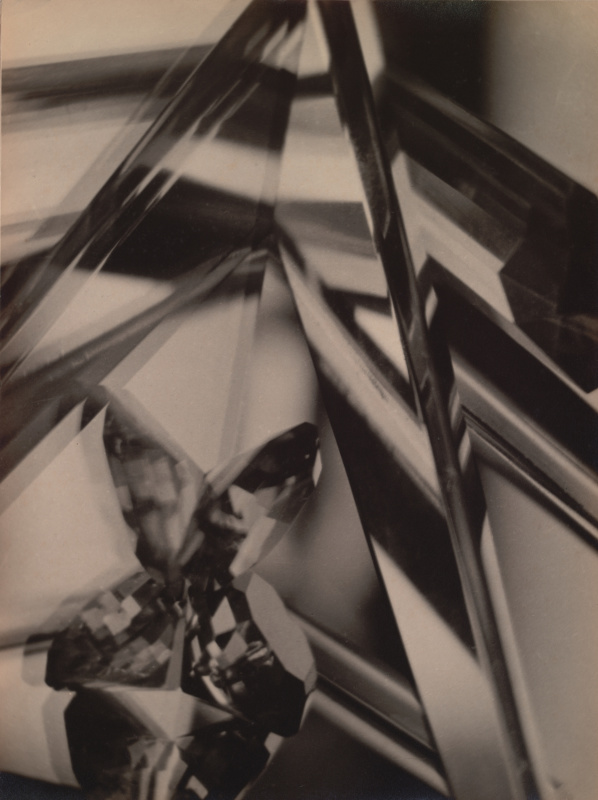
A dark diagonal offers a route into Alvin Langdon Coburn's Vortograph, then another cuts across it. Broad bands rise toward the top edge. Smaller, glittering fragments gather at the lower left. There is enough suggestion of depth to pull the eye inward, but no dependable floor, wall, or horizon to tell us where we have arrived.
The photograph reproduced here belongs to the Museum of Modern Art, which dates it to 1916–17. Its angular world came from a camera fitted with three mirrors arranged in a triangle. Ezra Pound supplied the name “vortographs” for Coburn's experiments, connecting them to the London movement Vorticism.[1] The apparatus helps explain how the picture happened. It does not exhaust what happens when we look.
My reading is that this photograph makes orientation itself the subject. We keep trying to assemble a coherent space from its lights and edges. Coburn gives us enough visual evidence to begin that task, then keeps its completion out of reach.
Follow a line until it stops explaining
Begin near the top, where several dark bands appear to converge. For a moment, they resemble the structure of a pitched roof seen from below. Follow them downward, however, and that provisional building comes apart. Pale wedges interrupt the dark framework. A diagonal at the right seems to pass behind one plane and then assert itself across another.
“Roof” is a resemblance, not an identification. The image encourages such guesses because it preserves the cues through which photographs usually make objects legible: highlights, shadows, gradients, and edges. What it withholds is a stable agreement among those cues. Each small area can suggest a solid thing; the whole refuses to become a room containing those things.
The lower-left cluster changes the pace of looking. Here, large bands give way to a knot of tiny alternating lights and darks. The eye slows down to sort them. Above, a few long directions dominate; below, fragments crowd together. That difference makes the picture more than an evenly repeated kaleidoscope pattern. Its parts ask for different kinds of attention.
Nor is its geometry perfectly crisp. Some edges are decisive, while others blur into a neighboring tone. The uncertainty matters. If every boundary were equally sharp, the picture might settle into an arrangement of flat shapes. Instead, softness keeps suggesting distance, reflection, or something momentarily beyond focus.
The camera still had something before it
Abstraction here does not mean that light stopped arriving from a physical world. The mirrors redirected what the camera could see, breaking its image into segments. Coburn changed the optical encounter before the photograph became a print.[1][2]
A related work at the Metropolitan Museum of Art makes this distinction particularly clear. The museum identifies the subject of its [Refracted Window: Vortograph] as a studio skylight seen through the mirrors.[3] That identification belongs to the Met's photograph; it does not establish what Coburn placed before the camera for the MoMA image shown here. It does establish that an ordinary architectural feature could become difficult to recognize through this apparatus.
This is the productive tension in the experiment. A photograph can remain a record of light while ceasing to function as an easily readable inventory of objects. Looking at the MoMA print, we can follow changes in brightness with confidence even when we cannot name their sources. The recording remains specific; recognition becomes uncertain.
Knowing the mechanism therefore changes the question. Instead of treating the picture as a puzzle whose solution must be a hidden object, we can ask how its fragments direct us. Which edge carries the eye farthest? Where does a bright patch seem to open a space, and where does the next dark band close it?
Sharp geometry on a soft surface
The physical print complicates any idea that this is simply a celebration of hard, modern lines. MoMA conservator Hanako Murata describes a matte paper with a slightly soft image and warm highlights. Examination found no baryta layer; gelatin emulsion covers rough paper fibers, and the paper itself supplies the warmth of the light areas.[2]
Those material findings belong to this particular object. MoMA's research distinguishes the negative's date, 1916–17, from the print's date, 1916–20.[2] The image and the sheet carrying it have related but separate histories.
On screen, we cannot experience the paper directly. Even so, the reproduction offers a useful hint: its pale areas have a muted warmth rather than the brilliant white of a diagram. The dark forms seem absorbed into a surface. Their edges can suggest blades or beams, yet the picture's overall presence is subdued.
That is an important part of its attraction. The composition offers fracture; the material gives the fracture continuity. All those apparently incompatible spaces inhabit one quiet sheet. The viewer can move between the restless scene implied by the reflections and the stillness of the photograph as an object.
A name could not settle the argument
The Vorticist connection gave these experiments a public context. The Nelson-Atkins Museum of Art places Coburn's mirror photographs within the movement's pursuit of abstract, crystalline forms and notes that contemporary critics found them baffling.[4] MoMA records a more pointed disagreement: Pound, who named the pictures, later judged them inferior to Vorticist paintings.[1]
That response reminds us that sharing a name did not guarantee agreement about artistic success. A photograph could borrow the angular vocabulary of an avant-garde and still raise questions peculiar to its own medium. How much recognizable subject matter did a photograph need? What remained of photographic description when a device disrupted the camera's familiar view?
Coburn's picture keeps those questions visible. Return to the long dark bands and the little cluster below them. They have not become easier to reconcile merely because we know about the mirrors. The pleasure lies in watching our efforts to locate ourselves repeatedly turn into attention to the photograph itself: an edge, a gleam, a softened interval, another direction to follow.
Sources
- Museum of Modern Art, Alvin Langdon Coburn, Vortograph, 1916–17, accession 1656.2001 — collection record, image credit, mirror apparatus, Pound's naming, and his later criticism.
- Hanako Murata, “Vortograph,” MoMA's Object:Photo — source of the reproduced photograph; negative and print dates, matte surface, paper fibers, and conservation findings.
- The Metropolitan Museum of Art, Alvin Langdon Coburn, [Refracted Window: Vortograph], 1916–17, accession 1986.1008.3 — a separate photograph whose subject the museum identifies as a studio skylight.
- The Nelson-Atkins Museum of Art, Alvin Langdon Coburn, Vortograph, 1917, accession 2005.27.3920 — Vorticist context, photographic abstraction, and contemporary critical reception.