Anna Atkins is still too often filed under the language of firsts.[1][2][6] She made Photographs of British Algae in the 1840s, and those pages now carry an irresistible set of claims: first book illustrated with photographs, first substantial application of photography to science, one of the earliest sustained bodies of work by a woman using the new medium.[1][6] All of that is true. It is also incomplete. The stronger reason Atkins matters is formal. She changed what a photographic page could do.
Instead of treating photography as a camera view that looked out at the world, Atkins used cyanotype as a contact method that let the world lie down on the page.[1][2][3][5] Seaweed, fern, or feather met sensitized paper directly. Sunlight did the transfer. The result was not a sketch translated by hand or a specimen described after the fact, but a print whose structure was produced by touch, pressure, translucency, and exposure.[2][3][5] That shift is why Atkins still reads as more than an early scientific illustrator. She made an art of exactness.
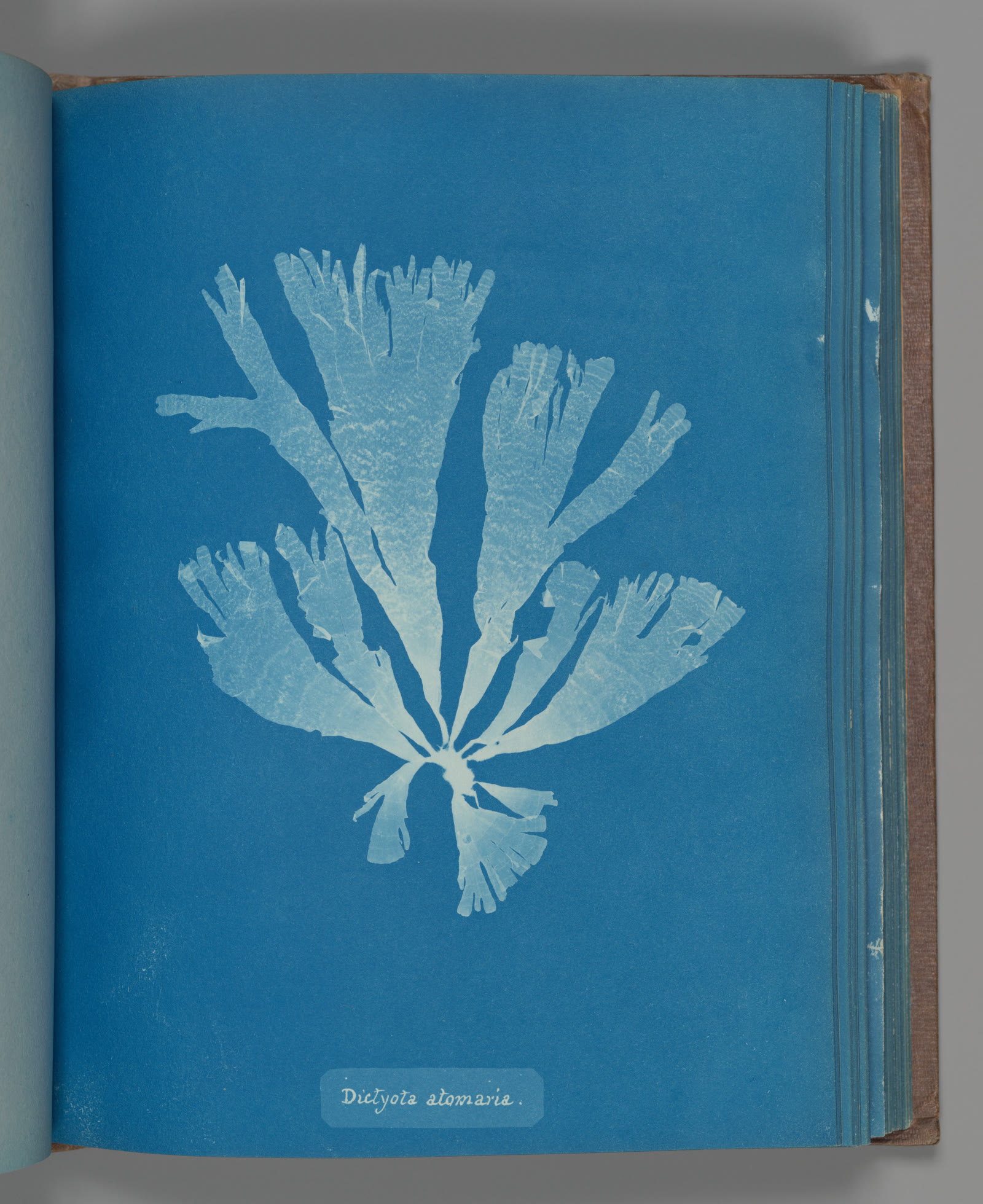
Image context: the cover uses The Met's Dictyota atomaria (ca. 1853), a cyanotype from the last phase of Photographs of British Algae. It belongs here because the image shows Atkins's method in one glance: the specimen is both object and matrix, and the blue ground is not background decoration but the chemical field where looking happens.[4]
She turned photography into a specimen discipline
The New York Public Library's 2018 Blue Prints exhibition gives the cleanest short account of Atkins's breakthrough.[1] In 1843, just a year after John Herschel invented the cyanotype process, Atkins began making blue prints of seaweeds in order to visualize and distribute information about her growing collection.[1][2] That sentence matters because it keeps art and science in the same frame. She was not decorating botany after the real work had been done. The photograph itself became part of the scientific act of ordering, comparing, and circulating knowledge.[1][2]
The NYPL's Visual World gallery note sharpens the point.[2] Atkins's most important legacy, it argues, was not simply that she was among the earliest women to experiment with photography. It was that she recognized what Herschel's process could solve: how to make multiple prints that conveyed precise information about British seaweed specimens.[2] That wording helps rescue her from the softer myth of Victorian delicacy. Atkins was methodical. She saw a new medium and understood its technical usefulness immediately.
Yet technical usefulness alone does not explain why the pages stay beautiful. The blue is part of the argument.[1][2][3][5] NYPL notes that cyanotype suited marine algae unusually well, while Getty's cyanotype explainer stresses how direct the process was: paper exposed to light turned bright blue, while the areas protected by the specimen remained white.[3][5] In other words, Atkins's pages are not blue because blue happened to be charming. They are blue because the chemistry itself became the ground of description. Sea plants, with their fronds, threads, and varying translucency, found a perfect partner in a process that could register delicacy without forcing it through drawn outline.[1][3][5]
The cyanotype page was exact, but never mechanical
One trap in writing about Atkins is to make her sound like the inventor of a frictionless reproductive system. The record says otherwise.[1][3] NYPL's botanical-illustration essay is useful precisely because it refuses easy triumphalism: each sheet still had to be treated, dried, exposed, washed, dried again, and then assembled by hand into parts and volumes.[3] The cyanotype was not a magical shortcut that eliminated labor. It was a new kind of labor, one that joined chemistry, collecting, sequencing, and publishing.
That is why Atkins's work belongs in an artist profile rather than in a footnote about process. The page order, the rhythm of silhouettes, and the relation between one specimen and the next matter as much as the individual images do.[1][3] Photographs of British Algae was issued across a decade, from 1843 to 1853, and the books survive as objects of astonishing patience rather than as one-off demonstrations.[1][3][6] The Library's exhibition summary also notes that Atkins and her friend Anne Dixon later extended the inquiry to flowering plants, feathers, and other subjects.[1] What expands is not only subject matter but confidence: the cyanotype stops being a clever answer to one botanical problem and becomes a broader visual language.
Why Dictyota atomaria still feels so modern
The Met's page for Dictyota atomaria gives us the most useful single work for seeing Atkins clearly.[4] The sheet is dated ca. 1853, late enough to belong to a mature phase of the algae project, and it shows the qualities that make her work feel almost contemporary.[4] The specimen does not sit on the page like a dead label. It branches, frays, and tapers. The white silhouette is so exact that you feel the touch of the plant, yet the image also behaves like abstraction: pale lines suspended inside a saturated field, pressure turned into interval, detail turned into rhythm.[4][5]
That doubleness explains why Atkins keeps returning in modern and contemporary art contexts.[1][2] She did not merely prefigure later photographic botany. She proposed that photographic truth and aesthetic arrangement could be the same event. The Getty description of her achievement emphasizes seaweed and sunlight; the NYPL exhibition emphasizes her daring and technical skill.[1][6] Put together, those accounts suggest a better description. Atkins made pages in which evidence arrives as atmosphere without ceasing to be evidence.
This is also why her work should not be reduced to origin mythology. Saying that she came early is historically important, but it misses the pressure of the objects themselves.[2][4][6] They are calm, yet they are not passive. Each plate holds a negotiation between specimen and field, accident and placement, natural irregularity and editorial order. The books slow photography down into a practice of careful contact.
Why Anna Atkins still matters
Atkins lasts because she found a way to let scientific handling become visual form.[1][2][3][5][6] Before photography became synonymous with instant capture, she used it as a patient printing method. Before botanical illustration was displaced by newer technologies, she pushed a chemical process into service without pretending it removed judgment or handiwork.[1][3] And before the art world had a stable language for artists who move between disciplines, she was already working in the seam between archive, herbarium, photograph, and book.
That is the real scale of her achievement. Anna Atkins did not simply prove that women belonged in the early history of photography, though she did that too.[2][6] She showed that contact itself could be a way of seeing: specimen against paper, light against chemistry, knowledge against the page until a new image rose out of the blue.[1][4][5]
Sources
- The New York Public Library, "Blue Prints: The Pioneering Photographs of Anna Atkins" - exhibition page on Atkins's 1843 start in cyanotype, Photographs of British Algae, and the later collaboration with Anne Dixon.
- The New York Public Library, "Anna Atkins's Photographs of British Algae: Cyanotype Impressions" - Visual World gallery note on Atkins's use of Herschel's cyanotype to make precise multiple prints of seaweed specimens.
- The New York Public Library, "In the Weeds: The History of Botanical Illustration and the Work of Anna Atkins" - essay on photograms, the labor of hand-printing each cyanotype sheet, and the book's place in photographic and bibliographic history.
- The Metropolitan Museum of Art, Dictyota atomaria - collection page for Anna Atkins's ca. 1853 cyanotype used here as the article image.
- Getty, "Capturing the Feeling of the Ocean on Paper" - explainer on how cyanotypes work and why Atkins's algae prints could register even delicate tendrils with direct contact accuracy.
- Getty, "The Woman Who Captured Nature in Blue: Anna Atkins and the Birth of Photographic Art" - overview of Atkins as the maker of the world's first photographically illustrated book and a figure joining art with science.