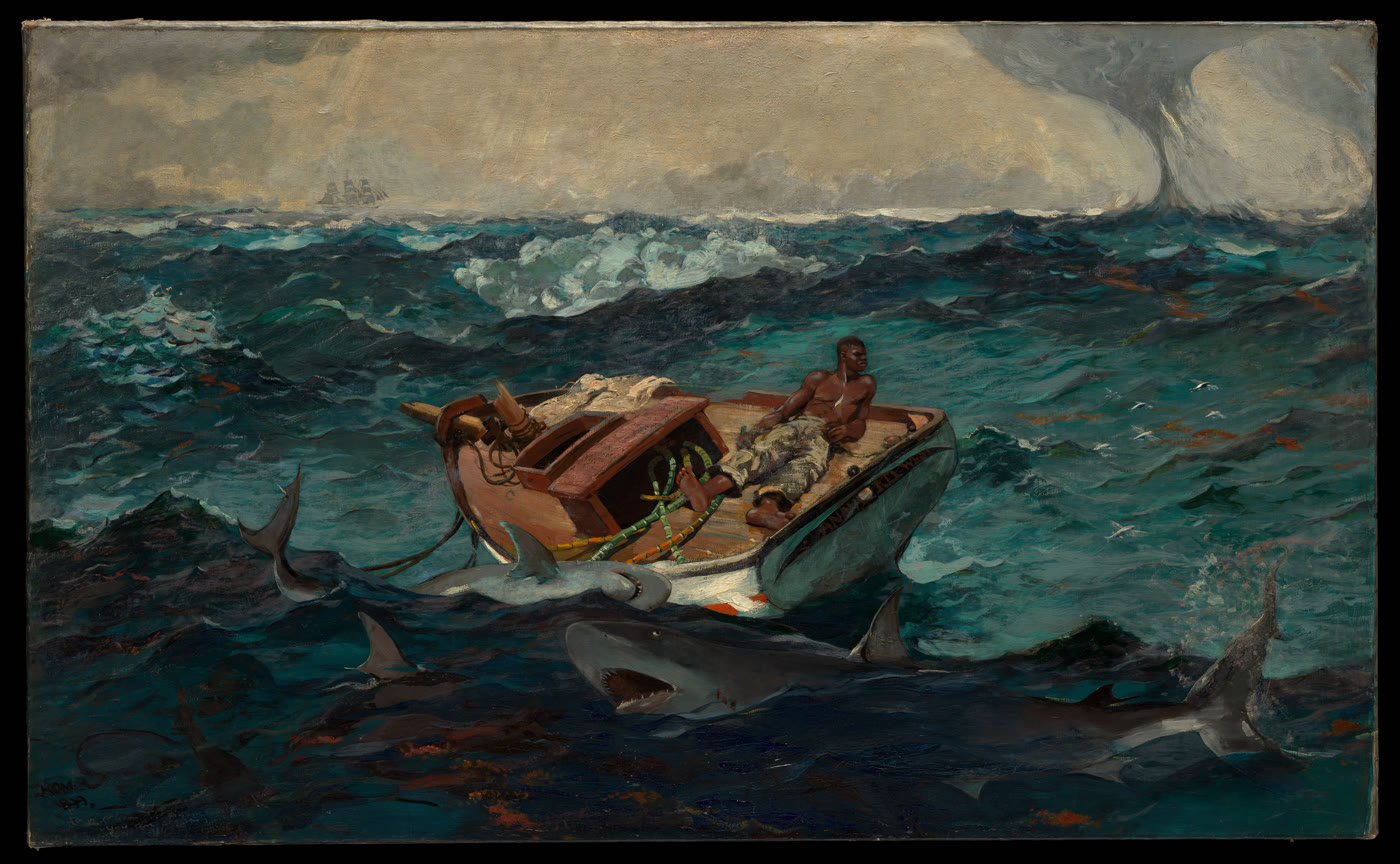
Winslow Homer's The Gulf Stream is often remembered as a scene of extremity first: sharks, storm, broken boat, a man stranded in violent water.[1][2] That description is accurate, but it does not yet explain why the painting stays so unnerving. Plenty of pictures of danger concentrate tension by bringing threat close to the body. Homer does something more exacting. He gives us catastrophe, then stretches it into duration. The sharks are near, the waterspout is rising, the boat is damaged, and yet the picture's deepest subject is not the instant of attack. It is delay.[1][2]
That delay is built everywhere into the image. The lone figure does not thrash. The boat has not fully sunk. The rescue ship exists, but only as a small shape on the far horizon.[2] Even the title shifts attention away from anecdote and toward a force larger than the man: the Gulf Stream itself, the current linking the Caribbean, the eastern United States, and the Atlantic world beyond.[1][2][4] The painting therefore works on two levels at once. It is a survival image, and it is a picture about what it means to be caught inside a system bigger than individual will.
Image context: the cover uses the Met's reproduction of the painting itself because this essay depends on the full composition. Crop away the right edge and you lose the waterspout. Crop the left and the rescue ship disappears. Crop the bottom and the sharks stop pressing upward into the boat. Homer's argument lives in the whole field.[1][2]
1) Homer makes the boat look barely usable, but not yet lost
The first thing to notice is the boat's unstable dignity. It is not a wreck in the theatrical sense. It still floats, still has shape, still gives its passenger a platform. But it is already compromised from several directions at once.[1][2] The mast is gone, the sail droops uselessly across the deck, the gunwale is damaged, and the vessel tilts just enough to make every object on board feel provisional.[2] Homer does not need to show the moment of disaster, because the boat itself preserves the event as aftermath.
That matters because the painting refuses melodramatic gesture. The figure lies propped on one elbow, facing outward rather than turning toward the nearest shark.[1][2] He is not painted as panic. He is painted as endurance so prolonged that action has become interior. The Met's collection text calls him a stoic survivor, and that description is exact.[1] Homer keeps the body legible but withholding. The man's posture asks whether he is exhausted, resigned, watchful, or simply conserving the last of his strength. The picture never resolves the question. That ambiguity is one reason the scene feels longer than a snapshot.
The horizontal shape of the painting intensifies the effect. At nearly fifty inches wide and only a little over twenty-eight inches tall, the canvas gives the sea more lateral authority than vertical drama.[1] We do not look up into sublime weather. We scan across a dangerous surface with nowhere stable to land. The painting becomes less a climax than a sustained exposure.
2) The painting was built out of remembered distress, then sharpened years later
Homer's composition did not arrive all at once. The Met's 1885 graphite sketch Distressed Boat (Sketch for "The Gulf Stream") suggests that he recorded an actual scene of a boat in peril while traveling between the Bahamas and Cuba.[3] In that early drawing, the essential structure is already present: a dismasted vessel, rough water, a heading toward storm.[3] What Homer later achieved in the oil was not raw transcription but concentration.
That long development matters for how the final work feels. Winslow Homer: Crosscurrents traces the way Homer returned to Bahamian and Caribbean studies, reworked earlier material, and gradually built the relation between the listing boat, the sharks, and the solitary figure.[2][3] The painting's power comes partly from this delay in making. Homer had fifteen years between the sketch and the finished oil to strip away accident and keep only the pressure points.
He then sharpened the picture again between its first showing in 1899 and its reworking by 1906.[1][2] According to the Met's catalogue, he increased the waterspout, added the damaged gunwale and the fallen sail, and painted in the ship on the left horizon as a possible source of rescue.[2] That revision history changes the emotional logic of the painting. The distant ship is not an original reassurance. It is a late complication. Homer did not decide merely to make the scene survivable. He decided to make survival visible and uncertain at the same time.
3) Sugarcane and the current enlarge the painting beyond one man's struggle
The cut sugarcane on the deck is the painting's quietest and most consequential detail.[1][2] On one level it is practical, the small food supply left to the survivor. On another it opens the whole historical field around him. Daniel Immerwahr's essay in Crosscurrents reads sugar as the archetypal Caribbean commodity and treats its presence as a rare glimpse, within Homer's work, of the extractive economy underpinning empire.[2] The object page makes the same move in shorter form, linking sugarcane, the Gulf Stream current, and the history of transatlantic slavery.[1]
That means the picture does not isolate "man versus nature" from politics. Nature is there in full force: sharks, wave, storm, current. But Homer's title and details insist that this sea is also historical water.[1][2] The Gulf Stream carries commerce as well as weather. It joins plantation economies, Atlantic routes, imperial movement, and the Caribbean locations Homer knew.[1][2][4] The Black figure in the boat therefore occupies more than a universal drama of human fragility. He stands inside a specific geography of race, labor, and circulation.
This is why the rescue ship matters so much less than viewers first expect. It is present, but the current named in the title feels more powerful than the vessel that may or may not arrive.[1][2] Homer even told a dealer that the boat and sharks were "outside matters of very little consequence" beside the great subject of the Gulf Stream, and that emphasis helps explain the painting's unusual calm.[2] The scene is packed with peril, yet the true protagonist remains impersonal.
4) The horizon does not promise rescue; it measures distance
Most narrative paintings use the horizon to release tension, opening depth as an escape route. Homer uses it differently. The ship is so small that it enters the painting almost as an afterthought.[1][2] You can look first at the body, then at the sharks, then at the waterspout, and only afterward register that another vessel is even there. By then the rescue it implies already feels late.
That lateness is the painting's strongest invention. The ship does not cancel danger. It converts danger into uncertainty distributed over time. Will the figure be seen? Can the other vessel turn? Is it close enough to matter? Homer gives no answer.[2] The title again becomes decisive. What governs this picture is not the heroic intervention of one boat but the movement of the current itself.
That is also why the image continues to feel modern. Its emotional structure is not built on certainty, either tragic or hopeful. It is built on suspended outcomes.[1][2] The man is alive, but survival has not become safety. Rescue is imaginable, but still abstract. Nature is overwhelming, but history is in the water too. Homer's late seascapes are often praised for force and virtuoso handling, and they deserve that praise.[4] The Gulf Stream goes further. It turns physical danger into a study of distance, scale, and historical pressure.
Seen that way, the painting's famous drama becomes more exact. This is not only a man surrounded by sharks. It is a composition in which every surrounding element works to postpone resolution: the broken rigging, the useless sugarcane, the blood-dark water, the storm at right, the ship at left, and the current running through the title like an invisible frame.[1][2][3] Homer does not simply ask whether the man will live. He asks what it means to picture a human life inside forces that are natural, imperial, and slow enough to outlast any single act of will.
60-second viewing drill
- Start with the man's body and notice that Homer paints endurance without obvious panic.
- Move to the deck and count the signs that the boat still floats but can no longer fully function.
- Look down at the sharks and then up at the waterspout so the painting's pressure closes from below and above.
- Find the sugarcane and ask why Homer wanted a Caribbean commodity visible in a picture of survival.
- End on the tiny ship at the left horizon and decide whether it feels like rescue or just distance made visible.[1][2]
Sources
- The Metropolitan Museum of Art, The Gulf Stream - collection entry with object data, curatorial overview, audio transcript, and public-domain image.
- Stephanie L. Herdrich and Sylvia Yount, Winslow Homer: Crosscurrents - The Met publication page for the 2022 catalogue on Atlantic-world themes, the sugarcane detail, and Homer's 1899-1906 revisions to The Gulf Stream.
- The Metropolitan Museum of Art, Distressed Boat (Sketch for "The Gulf Stream") - object page on the 1885 graphite sketch that records an early version of the distressed-vessel motif.
- H. Barbara Weinberg, "Winslow Homer (1836-1910)," The Metropolitan Museum of Art Heilbrunn Timeline of Art History - overview of Homer's late seascapes and his shift toward the struggle of human life against the sea.