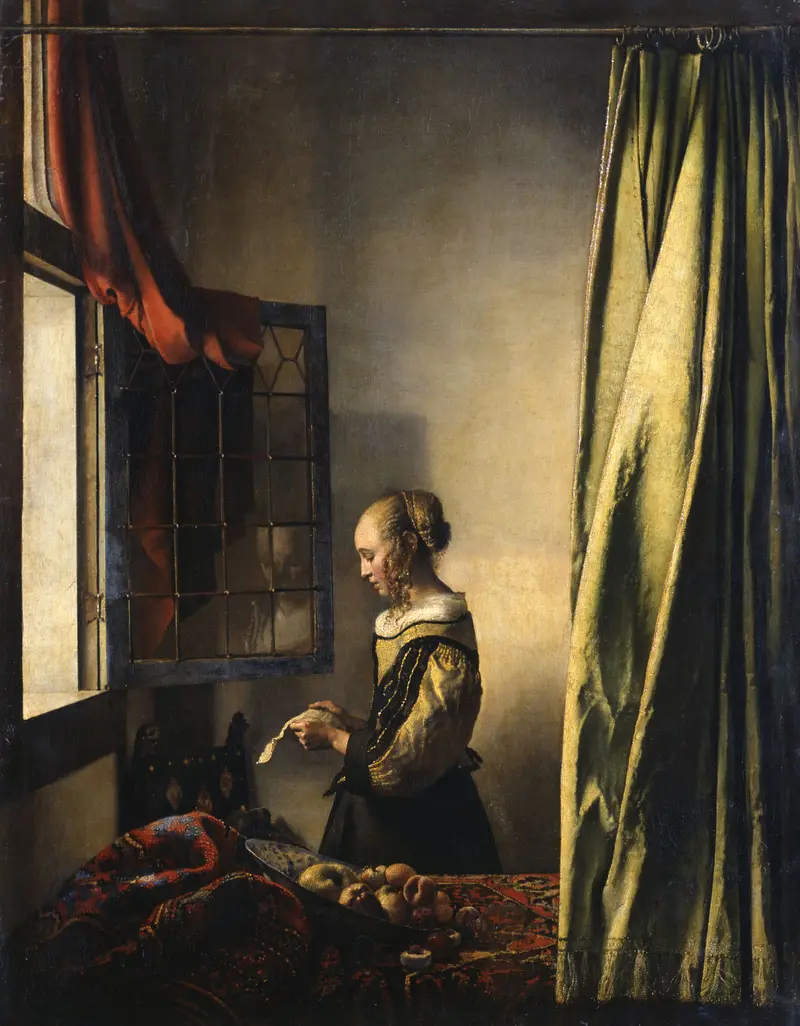
Johannes Vermeer's Girl Reading a Letter at an Open Window is often described as a quiet interior, and at first glance that seems fair enough. A woman stands alone. She reads. Light enters from the left. The room appears still.[1][5] But the painting does not actually behave like a sealed chamber of inwardness. It behaves like a staged threshold picture in which almost every important object sits on a border: the curtain between picture and viewer, the fruit bowl between table and fall, the window between interior and exterior, and the restored Cupid between private feeling and declared subject.[1][4][5]
That last element matters more than it once did. For generations, viewers knew the canvas as a scene of solitary absorption set against a pale rear wall. Dresden's research pages make clear how deep that habit ran: for more than two and a half centuries, the painting was admired in a state that no longer matched what left Vermeer's studio.[1][4] Once laboratory work established that the overpainted wall image was not by Vermeer himself, the restoration returned the painting to its earlier condition and, with it, returned a different logic of looking.[1][4] The picture did not become noisier. It became more legible.
Image context: the cover uses the complete painting rather than a cropped detail because the argument depends on the traffic between foreground and background. If the curtain, fruit bowl, reader, window, and Cupid are separated, the work starts looking more private than Vermeer actually lets it be.[1][5]
The curtain belongs to our side first
The green curtain is the clearest sign that the room is being shown rather than merely observed. Essential Vermeer describes it as a trompe-l'oeil device that does not belong to the implied three-dimensional room at all, but instead hovers slightly over the painted surface itself.[5] That is the crucial point. The curtain does not deepen the illusion. It advertises the fact that we are looking at a made image.
Once you notice that, the painting stops being only a report of one woman reading. It becomes a small theater of revelation. Curtains can conceal, protect, and ceremonially unveil. Essential Vermeer notes that in Dutch households such curtains could protect precious paintings from dust or cover nudes.[5] Vermeer therefore uses a domestic object with double force. It marks the room as intimate, but it also suggests that intimacy is being managed for display.
This is why the composition feels both near and withheld. The curtain seems close enough to touch, but that closeness does not give access. It creates a formal first barrier. Before we arrive at the woman, we first meet the picture's self-conscious front edge. Vermeer is not saying that privacy is invisible. He is showing that privacy, once painted, already comes with staging.
The fruit bowl makes stillness unstable
The bowl of fruit in the foreground performs a different version of the same trick. It looks decorative for a moment, then starts generating pressure. Essential Vermeer notes that the still life contains twelve pieces of fruit, including peaches, plums, oranges, and two large apples, and that some elements were adjusted during the painting process.[5] That abundance matters formally before it matters symbolically. The fruit pushes the whole lower edge of the composition toward the viewer, making the room feel less open than crowded.
Because the reader stands behind that bowl rather than beside it, the painting acquires a subtle obstruction. There is no clear path into the room. The eye has to move around objects that seem ready to tip or slide. The effect is gentle, but it is not neutral. Vermeer places suspension in the foreground before we even reach the letter.
The window intensifies that unsettled feeling. On the Essential Vermeer page, technical discussion of the work notes that earlier imaging suggests the girl's head was originally positioned somewhat differently, which helps explain the comparatively full reflection visible in the pane.[5] That reflected face matters because it keeps the woman from becoming a single, stable profile. She is present as body and as optical echo at once. Reading turns into doubling. Even before the Cupid reappears on the back wall, the picture is already refusing simple inwardness.
The restored Cupid changes the room's grammar
Dresden's research and press material tell the restoration story with unusual clarity. The painting dates from around 1657-1659 and is considered one of Vermeer's earliest interior scenes with a solitary figure.[1] An X-ray taken in 1979 showed a fully overpainted picture-within-a-picture of a nude Cupid on the rear wall, and that finding entered scholarship in 1982.[4] For years, many assumed Vermeer himself had rejected the wall image and painted it out. The 2017-2021 conservation and research project reconsidered that assumption through X-rays, infrared work, microscopy, paint samples, and restoration-history analysis, and concluded that the overpaint was later, not original to Vermeer.[1][3][4]
That conclusion does more than settle a technical dispute. It changes the syntax of the painting. With the blank wall, viewers could let the picture drift toward modern solitude: one woman alone with a letter, sealed inside her own pause. With the Cupid back in place, the room becomes semantically sharper. The letter no longer floats as an unspecified document. It sits inside a courtship image-system that seventeenth-century viewers would have recognized more quickly than modern viewers do.[1][5]
Essential Vermeer is especially helpful on this point because it notes that women reading letters in Dutch painting are almost always connected to love, expectation, and response.[5] The restored wall image does not force one flat meaning onto the scene, but it does remove the old excuse for vagueness. The rear wall now answers the letter. The room has an internal witness. Private reading becomes legible as emotional drama rather than as neutral literacy.
The painting does not reveal everything; it reveals that everything is framed
What makes the picture great is that the restoration clarifies it without exhausting it. The girl is still inaccessible in the strongest sense. We do not read the letter with her. We do not know whether the news in it is happy, painful, or mixed. Her face remains turned away in profile. But the work now declares more openly that this partial knowledge is deliberate.[1][4][5]
The curtain frames the act of viewing. The fruit bowl turns the foreground into a zone of delay. The reflected face in the glass prevents the reader from settling into one pose. The Cupid anchors the letter in a recognizable emotional register without dissolving the inward mystery of her response.[1][5] Vermeer builds privacy not by sealing the scene off from signs, but by surrounding it with signs that stop short of full disclosure.
There is also a historical irony here. Dresden's acquisition page notes that the painting entered the Saxon collection in 1742 through what was effectively a bonus acquisition, "outside the business deal," and at the time it was even regarded as a Rembrandt.[2] That anecdote belongs to the work's afterlife, but it fits the painting's deeper pattern. The image has always travelled through misrecognition, masking, and rediscovery. Its long blank-wall phase was not an accidental footnote. It became part of the painting's modern reputation for silence.
What the restoration gives back, then, is not a solved picture but a stronger one. Girl Reading a Letter at an Open Window still holds because Vermeer organizes attention with extraordinary patience.[1][3][5] He lets one reader stand still, yet arranges curtain, table, window, reflection, and wall image so that the room keeps crossing its own boundaries. The painting's real subject is not private feeling by itself. It is the unstable edge where private feeling becomes visible enough to stage, but never visible enough to finish.
Sources
- Gemäldegalerie Alte Meister, Staatliche Kunstsammlungen Dresden, "A 'new' Vermeer in Dresden" - research page on the painting's date, solitary-figure status, overpainted Cupid, and restoration decision.
- Gemäldegalerie Alte Meister, Staatliche Kunstsammlungen Dresden, "The acquisition and rediscovery of the painting in Dresden" - acquisition history for the 1742 entry into the Saxon collection and the "outside the business deal" note.
- Staatliche Kunstsammlungen Dresden, "Johannes Vermeer's 'Girl Reading a Letter at an Open Window'" - 2017 conservation-project page on varnish removal, x-ray imaging, infrared reflectography, and restoration planning.
- Staatliche Kunstsammlungen Dresden, "Revealing Cupid: Restoration of Vermeer's 'Girl Reading a Letter at an Open Window' completed" - 2021 restoration update on the 1979 X-ray, 1982 publication, and the later overpaint over the Cupid.
- Essential Vermeer, "Girl Reading a Letter by an Open Window" - interactive catalogue page on the trompe-l'oeil curtain, fruit still life, reflection, and letter-reading iconography.