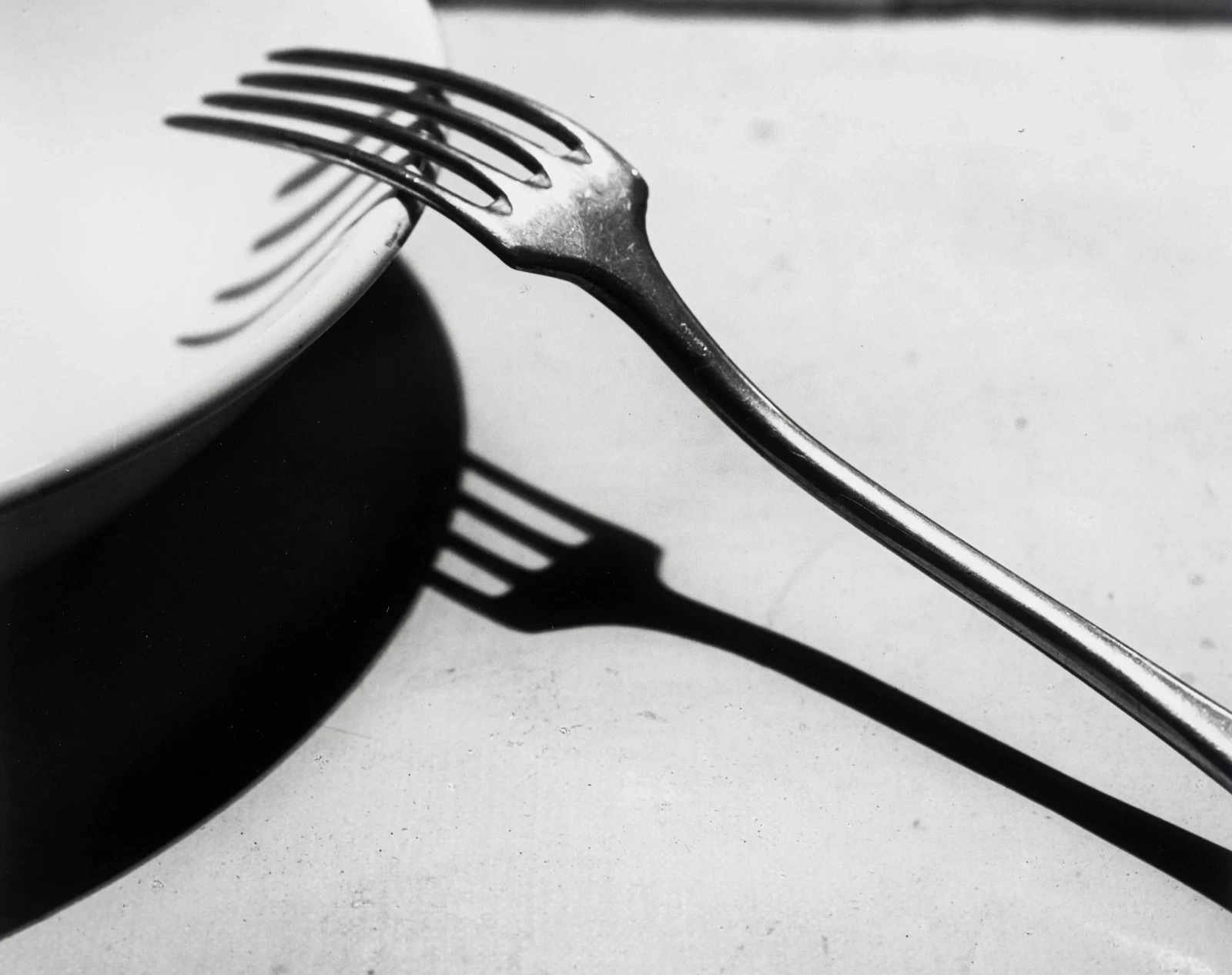
A fork rests against a plate, and its shadow turns an ordinary pause between meals into something worth looking at. André Kertész’s Fork has the economy of a good joke: almost nothing is needed, yet the result exceeds the sum of the objects. Its subsequent career adds a second joke. A photograph made as art would help advertise silverware, although the fork in the picture was not the German product the advertisement implied.[2]
That journey makes Fork an unusually compact way to think about photographic meaning. A picture can remain recognizable while the job it performs changes completely. On a gallery wall, it invites attention to an everyday object. On an advertising page, that same attention becomes useful to a seller. The transition need not require a new exposure, or even a new crop.
First, a fork stops being useful
The photograph reproduced here comes from LACMA, whose gelatin silver print is catalogued as Fork, 1928, Paris, made from the 1928 image and printed later.[1] Look first at the meeting between utensil and plate. The fork borrows support from the rim; the shadow gives that small arrangement a second, darker structure. Metal, ceramic, light, and tabletop each have a separate part to play.
Ordinarily, a fork directs attention toward food. Here it directs attention toward itself and then away again, toward the shape cast beside it. The eye moves between an object with thickness and a silhouette with none. Both belong to the same event, but they offer different pleasures: the fork has a surface; its shadow has an outline. The pale area around them makes that distinction easy to feel.
The tines cast fine lines across the plate, while the broader shadow falls onto the tabletop below. Light gives the utensil two different registers: delicate marks on the raised ceramic and a bolder silhouette beneath it.
The cropped plate adds another interruption of habit. We recognize what it is without receiving the complete circle. Part of an object is enough to establish the scene, leaving its sweeping edge free to act as a compositional line. There is no need to forget that these things belong on a table. Their familiarity makes the unexpected arrangement more satisfying.
The Met’s account locates the encounter at the end of a dinner in Fernand Léger’s Paris studio.[2] That is a museum’s historical account, not something the image can independently prove. Without it, the photograph supplies no host, guest list, or conversation. Its intimacy comes from the scale and nearness of the objects. The social occasion has fallen outside the frame.
Kertész had moved from Hungary to Paris in 1925. The Getty places his growing interest in still life within his engagement with the wider visual arts there, while also describing his continued habit of wandering the streets with a camera.[3] This tabletop belongs to that double attention: an appetite for the world as encountered, and an interest in what framing can make of it.
Then, looking becomes a sales pitch
Before its commercial use, Fork circulated as a modern photograph. MoMA’s research record lists its appearance in the 1928 Salon de l’Escalier in Paris and the 1929 Film und Foto exhibition in Stuttgart.[4] The Met associates it with New Vision photography’s renewed attention to ordinary things.[2] Seen in that setting, the utensil offered evidence of the photographer’s eye. The achievement lay in making something familiar newly visible.
An advertisement could put the same achievement to work. According to the Met, Kertész subsequently permitted the image to be used in a German silverware campaign. It appeared uncropped and with a credit, carrying its identity as an artwork into the commercial layout. Yet the photographed fork was a French department-store purchase.[2] MoMA supplies a precise publication anchor: an advertisement for Bruckmann-Bestecke in the November 1929 issue of Die Dame.[4]
The distinction matters because a photograph can be accurate about appearances while becoming misleading through its surroundings. Light really did encounter this particular fork. That does not establish who manufactured it. An advertiser’s name can encourage the viewer to make a connection the exposure itself cannot certify.
This is where the image’s spareness becomes commercially useful. Removed from the rest of the table, the fork can seem exemplary, almost an ideal of a fork. The shadow gives it visual distinction without requiring ornament on the handle. The qualities that reward looking—clarity, balance, an unexpected relation between simple forms—can also lend distinction to a product.
There is no need to decide that the advertisement spoiled the photograph. The more interesting consequence is that both readings remain available. We can admire the picture and still notice the extra claim its placement asks us to accept. The frame is unchanged; the implied sentence around it has changed.
The picture also becomes an object
A further shift occurs when the photograph enters a collection. Museums preserve individual prints, with dates and material histories that do not collapse into the date of the exposure. LACMA describes its example as printed later; MoMA dates the print it examined to 1928–30.[1][4] Both reproduce the familiar composition. They are separate physical objects.
MoMA’s technical record also identifies brush-applied retouching on its print.[4] That small fact complicates any temptation to equate the picture’s visual simplicity with an untouched passage from world to paper. A photograph has a made surface as well as a photographed subject. The evidence concerns that examined print; it should not automatically be transferred to every other version.
On a screen, those differences are easy to flatten. A single title and date can make a photograph seem like an image without a material life. The collection records restore some of that life: an exposure in Paris, prints made at different times, a surface worked by hand, an image circulated in exhibitions and print media.
Return to the fork after following those changes. It still rests on the plate; its shadow still holds the eye. What has multiplied is the number of purposes that this modest arrangement can serve. Kertész gives us an object worth noticing. The photograph’s travels give us another task: to notice who is asking us to look, and what they want that looking to establish.
Sources
- Los Angeles County Museum of Art, “Fork, 1928, Paris” — reproduction, gelatin silver medium, later print date, credit, and accession AC1998.182.17.
- The Metropolitan Museum of Art, “Fork,” André Kertész, 1928 — the Léger studio account, New Vision context, exhibition-to-advertising sequence, and the fork’s French origin.
- J. Paul Getty Museum, “André Kertész: Seven Decades,” 2007–08 exhibition — the move to Paris, street photography, and development of still-life work.
- Museum of Modern Art, Object:Photo, “Fork” — print dated 1928–30, conservation findings, historical exhibitions, and the November 1929 Bruckmann-Bestecke advertisement.