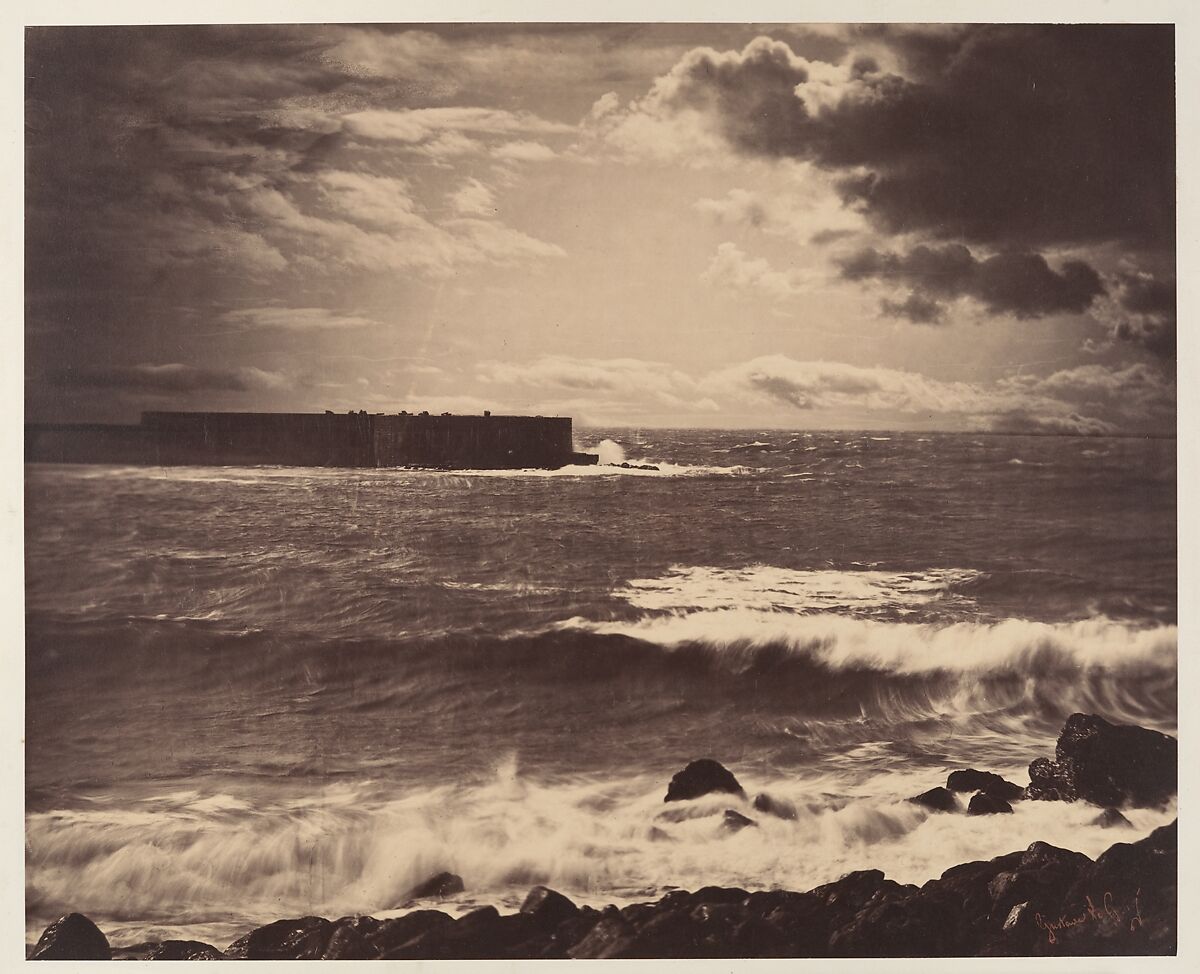
The foam seems to arrive before the title does. A pale surge spreads across dark water; rocks interrupt its ragged edge. Farther out, a breakwater draws a firm line into the sea. Above it, clouds occupy an almost equally weighty world. In Gustave Le Gray’s The Great Wave, Sète, the eye moves between a wave that is breaking and a sky that appears to have all the time it needs.
The photograph reproduced here is the Metropolitan Museum of Art’s albumen silver print, dated 1857. Its image measures 33.7 by 41.4 centimeters: a modest sheet carrying a spacious encounter with the Mediterranean.[1] What makes that encounter remarkable is the relation between its parts. Sea and sky feel continuous, although Le Gray constructed that continuity from separate negatives.[2]
A straight line inside the turbulence
Start below the horizon. The foreground is crowded with competing edges. Dark rocks have weight and definite contours; the surrounding foam frays into bright, uneven patches. The water offers no single outline to follow for long. Looking becomes a small exercise in losing and recovering one’s place.
The breakwater steadies this activity. Entering from the left, it stretches toward open water, giving the eye a direction that the surf repeatedly disrupts. Its distance matters. It is too far away to provide the viewer with shelter, yet clear enough to establish a human measure against the unsettled surface. One can imagine standing on it while remaining visually stranded among the nearer rocks.
This is how I read the composition’s tension: the wave supplies change, while the masonry supplies something against which change can register. The picture needs both. Remove the built edge and the sea would lose one of its strongest measures of force. Attend only to that edge and the water’s shifting textures become scenery around a structure.
Now look upward. The cloud forms are broader and less sharply divided than the rocks. Their pale and dark passages answer the variations below, but at a different scale. The horizon lets the eye compare these two fields without allowing either to swallow the other.
Where the exposures meet
That apparently simple boundary also belongs to the photograph’s manufacture. Nineteenth-century photographic emulsions responded unevenly to different colors of light, making satisfactory detail in both landscape and sky difficult to obtain in a single exposure.[2] Le Gray printed a negative exposed for the water and another exposed for the sky onto the same sheet.[4]
The solution gave the upper part of the picture an active role. A blank sky would have left the wave performing against an empty backdrop. Here, clouds have enough substance to answer the water. The print makes two areas, each with its own exposure requirements, legible together.
The Met’s 2008 Courbet exhibition described another print of this image, belonging to the Musée d’Orsay, as an albumen print from two glass-plate collodion negatives. Its commentary emphasizes the subsequent work in the studio: the seascape was composed through printing.[4] That account changes where we look for the artist’s decisions. The camera position matters, and so does the meeting of the two negatives on paper.
There is a limit to what this tells us. The Met notes that Le Gray sometimes combined negatives made on different occasions or in different places. That general description does not establish a particular date or location for the sky used here.[1] Separate exposures are the supported claim; a story about a specific borrowed storm would go beyond the evidence.
The feeling of an instant
LACMA curator Britt Salvesen identifies a revealing response to The Great Wave: critics who did not know the combination-printing method admired its impression of instantaneity.[2] The picture’s making and its reception pull in different directions. A print assembled through successive operations could feel like a single encounter caught as it happened.
That effect survives knowledge of the method. The foam still appears unstable. Its uneven brightness invites the viewer to anticipate the next movement, even though no next movement will arrive. Learning about the second negative adds another kind of time to the photograph: the duration of selecting, aligning, and printing that made this suspended scene possible.
The horizon becomes especially interesting once we know this. As a feature of the view, it locates the farthest visible water. As a compositional boundary, it holds unlike textures together. In this reading, its calmness is an achievement: the place where a divided procedure becomes a coherent experience.
An artist’s work continues after the camera
Le Gray had studied painting with Paul Delaroche before taking up photography. In his 1852 treatise, he argued for photography’s place among the arts; he also taught the medium and printed other photographers’ negatives. Malcolm Daniel’s account places the celebrated seascapes within his work of 1856–58.[3] These were pictures made by someone for whom technical instruction and artistic ambition were closely connected.
The Courbet exhibition makes a useful comparison with painting, while leaving an uncertainty intact: Courbet may have encountered Le Gray in Sète, but a meeting is not established.[4] The stronger point requires no meeting. Photographic composition could continue after exposure, just as the finished picture could organize experience beyond the circumstances of a single view.
Return to the foam, then let the eye climb toward the clouds. Knowing how they were brought together does not drain the sea of its presence. It makes the apparent ease of their relationship more demanding. The wave keeps breaking beneath a sky that the print has taught us to accept as its own.
Sources
- The Metropolitan Museum of Art, “The Great Wave, Sète,” accession 1976.646 — the reproduced print’s date, medium, dimensions, image, and curatorial account of separate sea and sky negatives.
- Britt Salvesen, “The Great Wave, Sète,” LACMA Collections, 2024 — combination printing, photographic sensitivity, and contemporary responses to the impression of instantaneity.
- Malcolm Daniel, “Gustave Le Gray (1820–1884),” The Metropolitan Museum of Art, October 2004 — training, the 1852 treatise, teaching, printing practice, and the seascapes’ chronology.
- The Metropolitan Museum of Art, “Gustave Courbet,” 2008 exhibition photo gallery, entry “The Great Wave, Sète” — the Musée d’Orsay print, two collodion negatives, studio composition, and the qualified connection with Courbet.