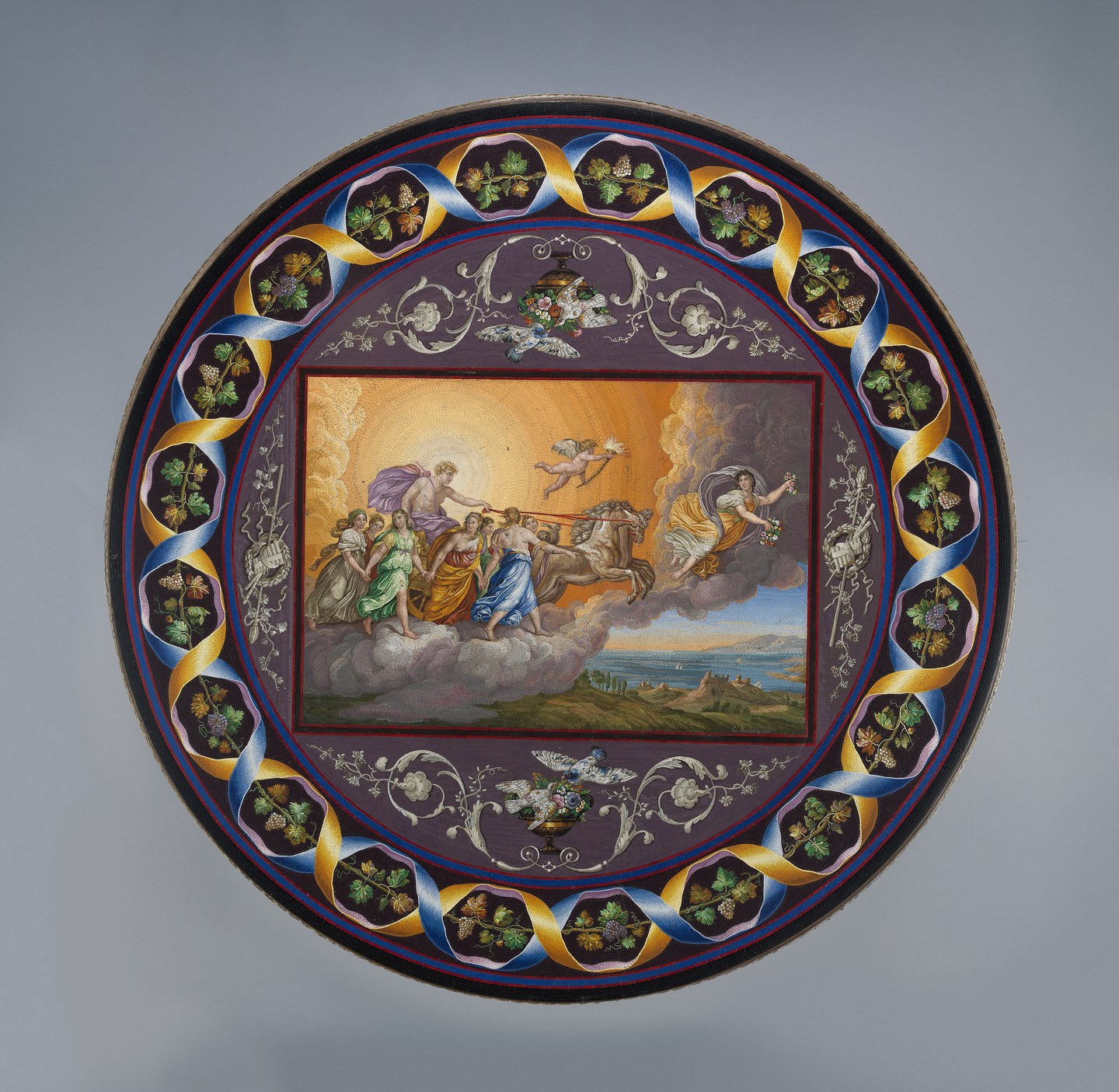
A ceiling painting has come down to the height of a table. In Gioacchino Barberi's Table top depicting Aurora and the Chariot of Apollo, made in Rome in 1822, a composition by Guido Reni occupies the center of a circular field of ornament. The Met identifies birds, flower-filled vessels, and acanthus scrolls around the scene.[1] The effect is lavish, but the most absorbing thing about it is quieter: all that apparent pictorial ease has been assembled piece by piece.
The tabletop is a micromosaic. Its small units of colored glass, called tesserae, can merge so convincingly that the viewer initially reads a picture rather than a construction. LACMA describes this recurring surprise in its own collection: objects that look painted or enameled resolve, on closer inspection, into thousands of separate pieces.[2] The pleasure lies in moving between those two ways of seeing. First comes the image; then comes the astonishing difficulty of making it.
“Micro” describes the work of the pieces, not necessarily the size of the object. Barberi's top measures 94 centimeters across.[1] That is enough room for the eye to travel from the central scene into the ornament and back again. The picture asks for a broad glance, while its method rewards a much closer one.
The crucial preparation happens before any tessera reaches the picture. Glass must become thin enough to offer the maker a fine vocabulary of marks. LACMA calls these slender strips or threads smalti filati: they are cut into the little elements from which an image is assembled.[2] Color arrives at the surface as a physical object with an edge. A change of tone therefore requires a decision about what to place next to what.
Conservator Elizabeth La Duc describes the process more closely. Colored glass is softened with a flame, drawn out, shaped while hot, and cut into small pieces. These are set into a bedding compound on a support such as stone, copper, or glass. Once the bed has hardened, the surface is abraded; colored wax fills the gaps, followed by a final polish.[3] The smooth finish is an achievement of the whole assembly.
Think of the consequences for a painted-looking fold. A brush can carry a changing load of pigment through one gesture. Here, a comparable passage has to be distributed across separate pieces. The maker must anticipate how their boundaries will behave when the eye stops inspecting each one. Softness is built through a sequence of hard decisions.
LACMA's account of Clemente Ciuli's micromosaic head of Bacchus offers a telling example. Ciuli used darker tesserae to establish contours and graduated tones to suggest shadows and highlights, producing the appearance of marble sculpture.[2] Glass can impersonate stone while remaining unmistakably glass under sufficient scrutiny. The craft's fascination extends beyond smallness to the translation of one material's visual character into another.
That ambition had a larger architectural history. At St. Peter's in Rome, painted altarpieces were being reproduced in mosaic by the end of the seventeenth century because humidity was damaging the paintings. The basilica's institutional account connects this work with sustained experimentation in colored enamels. It places the renewed development of minute mosaics around 1775, associated with Giacomo Raffaelli and Cesare Aguatti, and describes their spread onto boxes and jewelry bought by travelers.[4]
The shift in scale changed the encounter. A picture belonging to a vast church demanded a different kind of attention from one that could be held in a hand. The technique could carry an association with monumental permanence into an intimate possession. For a traveler, the work of looking could continue long after leaving Rome.
Barberi's tabletop gives that portability a grander domestic form. Its central subject derives from Reni's ceiling fresco in Rome's Pallavicini-Rospigliosi Palace; the Met places the object within a revival supported by affluent tourists.[1] A celebrated interior becomes something another interior can contain. In this reading, the tabletop offers both a remembered image and a conspicuous demonstration of the labor required to translate it.
Yet a finished micromosaic depends on materials that a casual glance cannot separate. La Duc's study of a different, later tabletop in Historic New England's collection found that wax between the glass pieces had been lost in places. Ultraviolet examination helped reveal the surviving fill. Her analysis also left the precise identity of the organic binder beneath its micromosaics unresolved.[3] A traditional recipe is useful context; examination still has to establish what survives in a particular object.
This matters to looking as well as to conservation. The spaces between pieces participate in the image. A continuous sky depends on how those intervals read, just as a contour depends on the glass beside it. The apparently effortless surface has a material life beneath its pictorial one.
Return to Barberi's tabletop with that in mind. Let the scene come together, then allow the ornament to pull your attention outward. Imagine the difference between recognizing a figure and choosing the tiny element that makes its outline turn. The craft becomes most vivid at that threshold, where a collection of solid pieces begins to feel like something as fleeting as a gesture.
Sources
- The Metropolitan Museum of Art, “Table top depicting Aurora and the Chariot of Apollo,” Gioacchino Barberi, 1822, accession 2016.709 — object record, composition, dimensions, patronage context, and photograph.
- Los Angeles County Museum of Art, “The Gilbert Collection: Mosaics and Micromosaics” — glass threads, tesserae, and Clemente Ciuli's tonal modeling of Bacchus.
- Elizabeth La Duc, “When in Rome, Do as the Romans Do? The Conservation of an Italian Marble and Micromosaic Tabletop,” Objects Specialty Group Postprints 23 (2016), pp. 179–198, published 2018 — especially sections 3.2 and 4 on manufacture, wax, and material analysis.
- Paolo di Buono, “The Mosaic Studio,” Fabric of Saint Peter — the reproduction of altarpieces, experimentation in enamel colors, and the development of minute mosaics for portable objects.